 NexCheck-筛号平台
The Two Problems to Solve After Receiving a List
When you have a list of customer or prospect numbers, you usually need to answer two questions: Can this number be used now? Does this number have an account on the platform I want to reach?
The first question belongs to the telecom network level—whether the number is in service, whether it is a mobile or landline number, and whether it is suspended or has become invalid. The second question belongs to the application level—even if the number is valid, the user may not be registered on WhatsApp or Telegram, or the account may have been banned. The tiered design of a number detection platform is meant to solve these two types of problems separately.
Only after clarifying what you need to detect can you choose the right tools and process.
Two Types of Detection Solve Problems at Different Levels
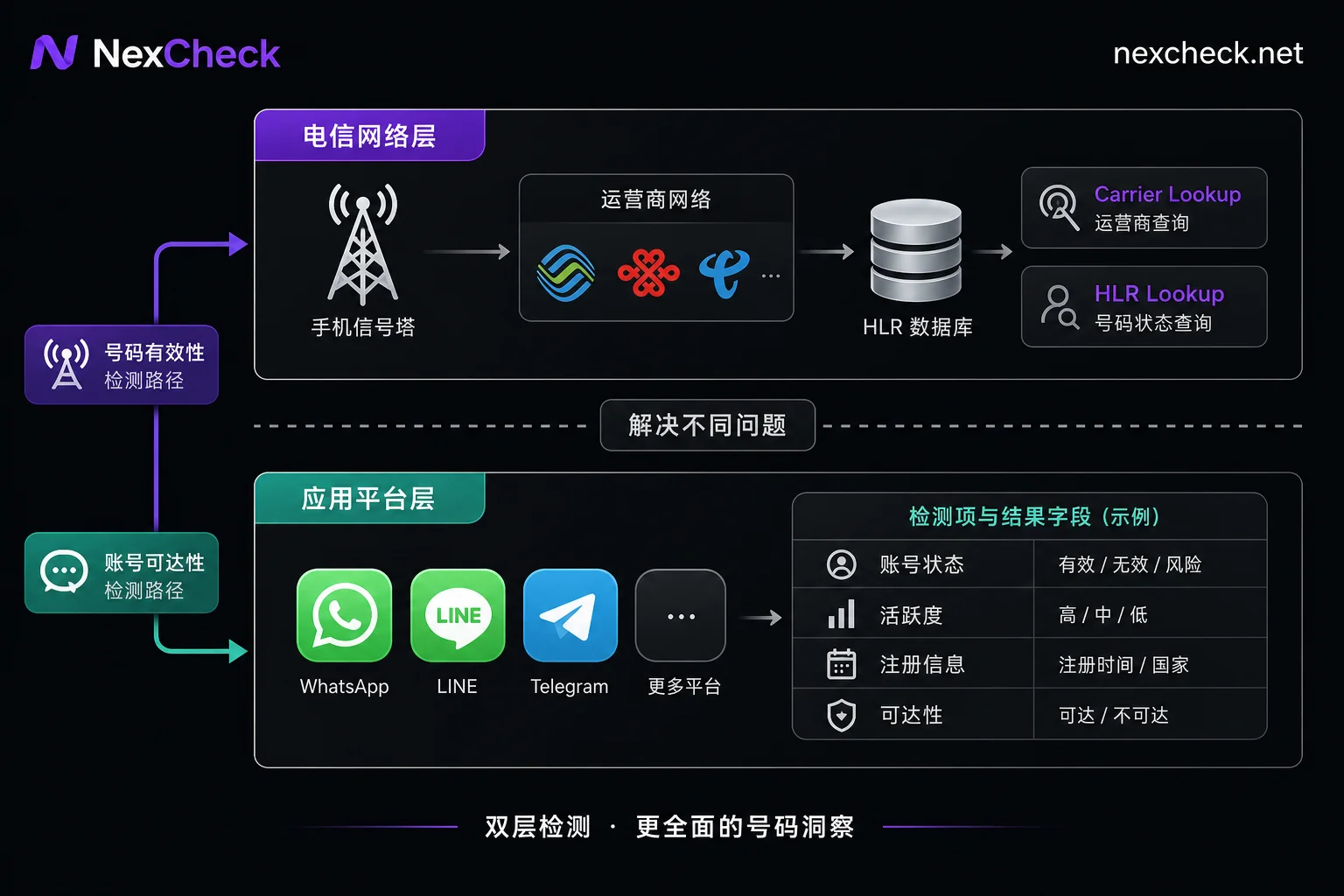
Basic Detection: Determining Whether a Number Is Valid at the Telecom Network Level
Basic number detection works at the carrier network level and includes two methods:
Carrier Lookup relies on number range databases and mobile number portability records, returning the number's carrier, country, and line type—Mobile, Landline, or VoIP. This type of query is low-cost, but it can only determine the static attributes of the number and cannot confirm whether the number is actually in service at the current moment.
HLR Lookup sends real-time signaling to the mobile cellular network to query the number's status in the carrier's HLR: Active, Absent (powered off or out of network), or Inactive/Disconnected (suspended invalid number or unassigned). HLR Lookup can confirm whether the number is currently reachable, but its per-query cost is higher than Carrier Lookup, and it only applies to mobile numbers.
When to use basic detection: When you need to remove unreachable numbers such as landlines, high-risk VoIP number ranges, invalid or suspended numbers, or when you need a preliminary assessment of the proportion of valid mobile numbers in the list.
Platform Detection: Confirming Account Status on a Specific Application
Application-layer detection targets specific product ecosystems (such as WhatsApp, LINE, Telegram, etc.). A number being valid at the telecom level does not mean the user has registered an account on a social or instant messaging platform. Platform detection can usually return:
- Whether the account is activated (registered / not registered)
- Recent activity or online status
- Registration time
- Ban status (normal / abnormal / banned)
- Public profile information (gender, estimated age, avatar, etc., depending on the user's privacy settings and platform visibility)
The detection items supported by each platform differ. For example, WhatsApp can check whether an account is activated and the last online time, while Telegram is more affected by user privacy settings, and some account information may be invisible. Detection results need to be returned grouped as valid (activated and normal) and invalid (unregistered or abnormal) to facilitate subsequent segmentation.
When to use platform detection: When you clearly need to reach users on a specific platform, such as sending marketing messages or customer service notifications via WhatsApp, you must first confirm whether the target number has a usable account on that platform.
The Correct Process Has Six Steps
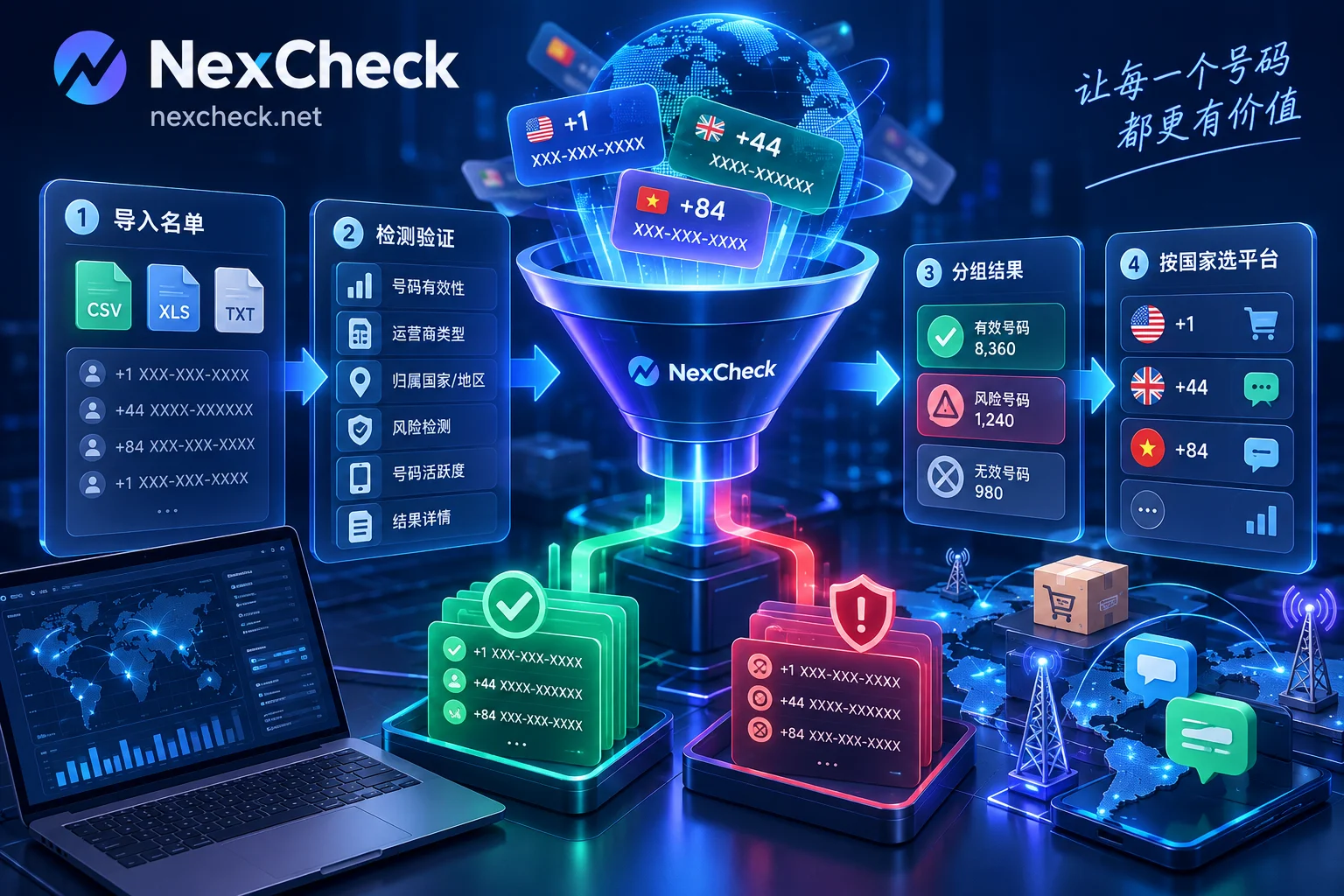
When facing a mixed list of numbers from multiple countries, processing in the following order can reduce invalid queries and rework:
1. Local Normalization and Deduplication
Before numbers enter the detection platform, they must first be formatted according to the International Telecommunication Union ITU-T E.164 standard. The standard format is + plus no more than 15 digits, consisting of the country code, area code or target network code, and subscriber number. It does not contain spaces, parentheses, hyphens, or domestic long-distance leading zeros (such as the 0 at the beginning of numbers in some countries).
Non-compliant formats or missing country codes will prevent the platform from identifying routing. For example, (86) 138-0013-8000 and 086 13800138000 do not conform to the standard and should be uniformly rewritten as +8613800138000. At the same time, deduplicate locally to avoid wasting quota on duplicate queries.
For specific cleaning rules, refer to How to Do E.164 Normalization Before Overseas Number Screening? 4 Types of Dirty Number Rewriting Rules.
2. Group by Country Code
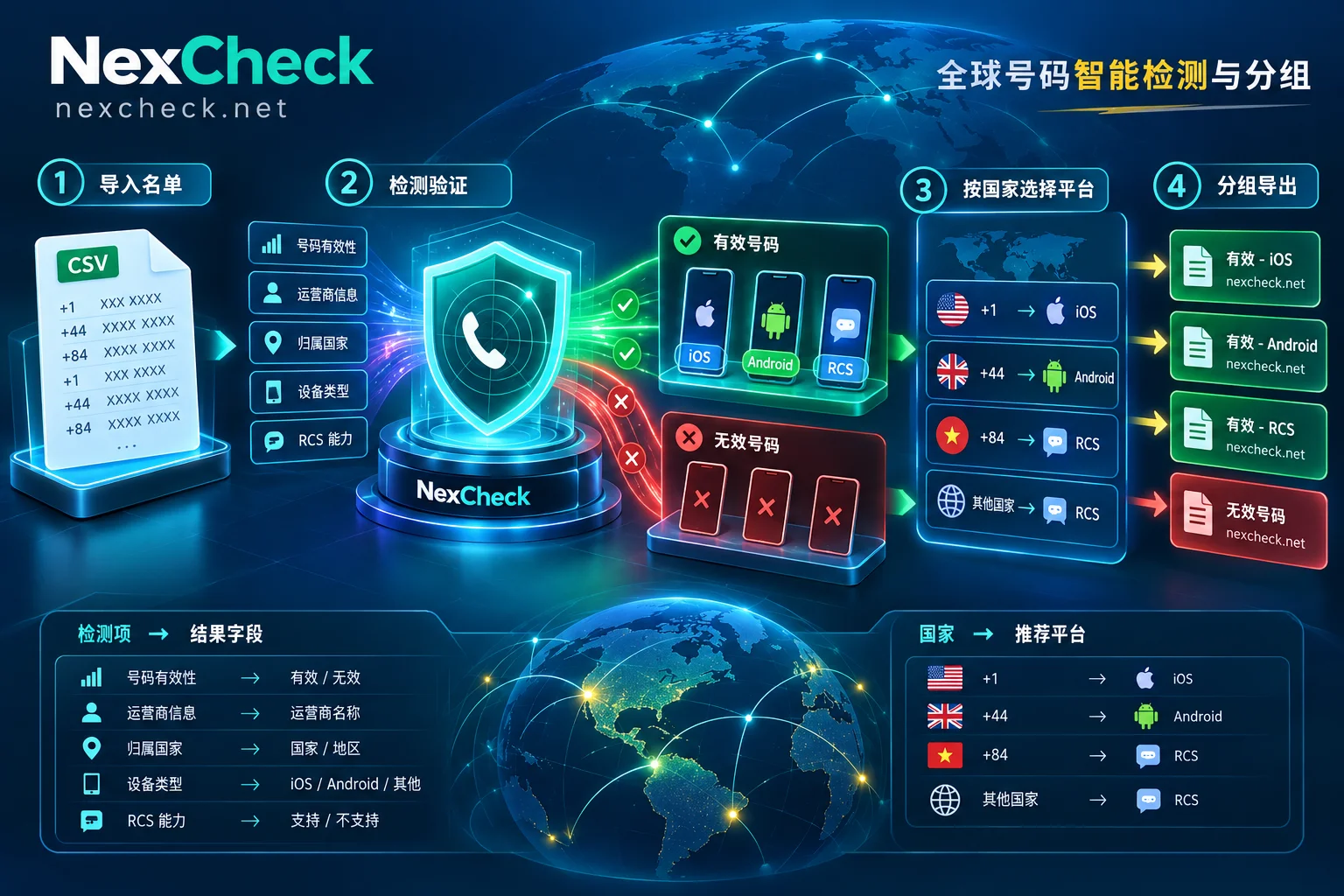
Different countries differ significantly in number range rules, carrier coverage, and platform penetration. Splitting the list by country code such as +1 (United States/Canada), +44 (United Kingdom), +86 (China), etc. can:
- Allow you to choose appropriate detection strategies for different countries (some countries have fast HLR data updates, while others have high WhatsApp penetration)
- Avoid mixed queries across countries that could lower results or cause misjudgments
- Make it convenient to assign tasks or calculate conversion rates by region later
3. Basic Line Filtering
Use Carrier Lookup for an initial screening to remove line types that are clearly not needed:
- Landline: If the target is a mobile application platform, landline numbers can be removed directly
- VoIP numbers: Accounts registered with virtual numbers are usually lower quality and are more likely to be flagged or banned by platforms
- Invalid country codes: Numbers that still cannot be matched to any country after formatting
This step is low-cost and can quickly reduce the number of invalid queries for subsequent HLR or platform detection.
4. Invalid Number and In-Service Status Detection (Optional)
If the list source is old or its quality is unclear, HLR Lookup can be used to further confirm whether the number is currently in service. Remove numbers with Inactive or Disconnected status and keep only Active or Absent (powered off but not deregistered) numbers for the next step.
This step is suitable for scenarios with sufficient budget and high requirements for list quality. If the list source is reliable and updated in a timely manner, you can skip this step and go directly to platform detection.
5. Target Platform Account Status Detection
According to your business goals, choose the corresponding platform for batch detection. Taking WhatsApp as an example, detection can return fields such as whether the account is activated and the last online time. After detection is completed, the platform will group the results into valid and invalid. Valid numbers can be used directly for subsequent outreach, while invalid numbers enter a pending activation or removal list.
The detection items and return fields supported by each platform differ and need to be confirmed in advance. You can visit the NexCheck platform capabilities page to see the detection items and pricing for specific platforms. For numbers in a specific country, you can also refer to the regional solution page to learn about the coverage of major platforms in that country.
6. Group and Write Back to CRM
The detection results need to be written back to the CRM or marketing automation system, tagging each number accordingly:
- Platform status tags such as
whatsapp_active,telegram_registered,line_verified - Network-layer tags such as
mobile_active,hlr_absent,voip_risk - Detection timestamp, used to judge data timeliness
In this way, operations or marketing teams can directly filter target audiences by tags, and development teams can also perform automated segmentation by field.
Console Upload or API Integration?
Uploading txt or csv directly through the console is suitable for one-time or low-frequency list cleaning tasks. After uploading the file, the platform processes it asynchronously and provides a download link when complete, or notifies you by email. This method requires no development and is suitable for operations staff to use directly.
Submitting via REST API is suitable for scenarios that need integration with existing systems. Through the API, you can:
- Automatically pull lists from CRM or data warehouses and submit detection tasks
- Receive detection results via Webhook pushback and automatically update database fields
- Set up scheduled tasks to periodically re-detect existing lists and keep data fresh
Single-batch submission has no limit and is priced per item. For specific integration steps, refer to How to Integrate a Batch Number Detection API? 6-Step Integration Method.
Three Criteria for Choosing a Detection Platform
1. Clear Business Goals Determine the Detection Tier
If you are only cleaning the list and removing invalid numbers and landlines, basic detection (Carrier + HLR) is sufficient. If you need to reach users on a specific platform, you must add platform detection. Do not use the results of basic detection as a substitute for platform detection—a number being in service does not mean it is registered on WhatsApp.
2. Match Detection Strategy by Country and Platform
The mainstream communication platforms differ by country. In Southeast Asia, LINE and WhatsApp coexist; in the Middle East, WhatsApp penetration is extremely high; in Russian-speaking regions, Telegram dominates. When choosing a detection platform, match the user habits of the target market to avoid wasting quota on platforms with low penetration.
3. Balance Budget and Timeliness
Basic detection is low-cost but provides limited information, while platform detection is higher-cost but more accurate. If the list is large and the budget is limited, you can first use Carrier Lookup to filter out obviously invalid numbers, then perform platform detection on the remaining numbers. If timeliness requirements are high, use a combination of HLR + platform detection directly to reduce intermediate steps.
Detection Results Are Not Once and for All
Number status changes: users may deregister accounts, change numbers, or be banned by platforms. The validity period of detection results depends on the business scenario:
- High-frequency outreach scenarios (such as daily customer service): It is recommended to re-detect active lists every 1-2 weeks
- Marketing campaigns: Re-detect within 3 days before the campaign to ensure the target list is up to date
- Existing customer maintenance: Clean the full list once a quarter or every six months
Regularly rerunning detection can promptly identify invalid numbers and avoid declines in reach rate or platform throttling.
The core value of a number detection platform lies in handling different problems in tiers: basic detection ensures that numbers are reachable at the telecom network level, while platform detection confirms that users can be reached on the target application. Understanding the boundary between the two and processing lists according to the correct process is the only way to use limited quota on truly valid numbers.


Comments(0)