 NexCheck-筛号平台
Every year in late October, cross-border e-commerce, independent stores, and overseas finance, gaming, and app teams preparing for Black Friday and Cyber Monday see their largest customer outreach peak of the year. Yet the overseas communications environment has changed profoundly in recent years: on one hand, Apple introduced a stricter SMS Screening Filter for unknown senders in iOS 26, while cross-platform RCS (Rich Communication Services) adoption has surged on both iOS and Android; on the other hand, telecom carriers in many countries are enforcing increasingly strict channel reputation oversight for A2P (application-to-person) international SMS and outbound calls.
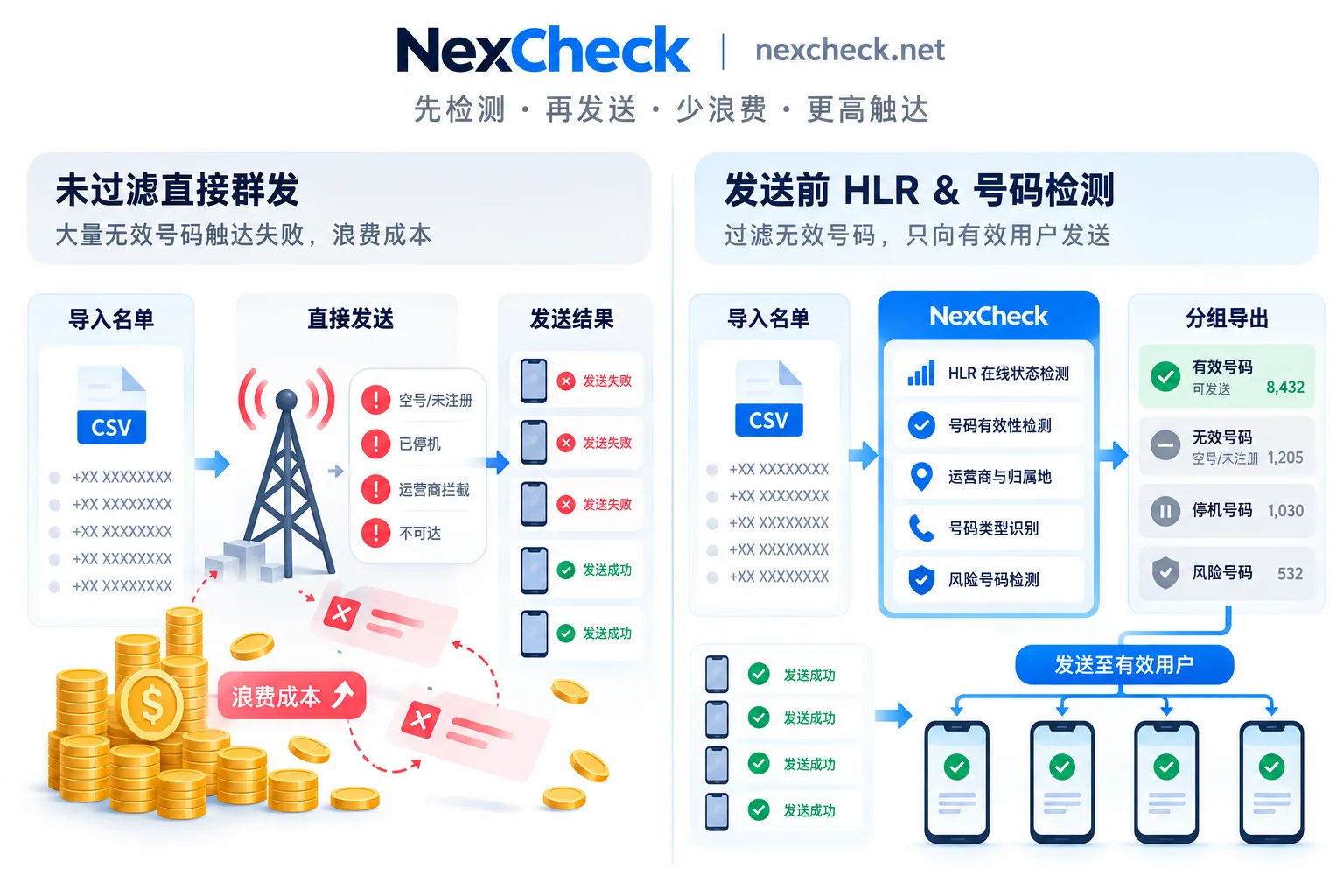
Against this backdrop, many teams have found that the old "blind send test" approach—stuffing hundreds of thousands of overseas mobile numbers accumulated over months directly into an international SMS gateway or outbound system and inferring validity from delivery receipts—not only burns through expensive cross-border channel budgets but also triggers carrier rate limiting and blocking due to high hard bounce rates and invalid-number ratios, leaving even legitimate order notifications and OTP verification codes stuck in the queue.
True overseas invalid number detection is no longer simply about judging whether "this number exists." It must solve four core problems before any outreach action: network status confirmation, carrier compliance risk avoidance, end-device ecosystem segmentation (iOS/Android/RCS), and cross-platform application onboarding. This article, based on the NexCheck detection matrix, lays out an overseas invalid number detection and segmentation solution that operations, marketing, and engineering teams can put into practice.
1. Why Overseas Lists Can't Be "Send First, Check Later": Three Hidden Costs
Unlike the highly unified interface environment of China's three major carriers, the overseas telecom market is highly fragmented. If a historical list covering users in the US, UK, Vietnam, Indonesia, or Latin America is put into outreach without upfront invalid number detection, it typically incurs three types of losses:
- Prepaid card recycling and silent attrition: In emerging markets such as Southeast Asia, Latin America, and Africa, prepaid SIM cards account for a very high share. Many users abandon their cards after registering for a new-customer promotion, and carriers typically suspend, deactivate, or reissue these numbers within 30 to 180 days. For deactivated invalid numbers, most gateways still charge the channel fee on a "billed on submission" basis when international SMS is sent.
- Channel rate limiting and blocking during peak concurrency: During peak periods like Black Friday, European and US carriers (such as those monitoring US 10DLC and toll-free numbers) assess sender invalid-number ratios and complaint rates in real time. Pushing marketing content to large numbers of invalid or frequently complaining numbers quickly drags down sender reputation scores, causing an entire marketing channel to be throttled or shut down.
- Plummeting open rates from terminal protocol mismatch: Today, overseas users' native inboxes have diverged into the Apple iMessage ecosystem, the RCS ecosystem supporting rich media interaction, and traditional plain-text SMS. Without distinguishing terminal system type and protocol support, a one-size-fits-all plain SMS with a short link easily falls into the "unknown sender/spam" folder on Apple devices, missing the attention of high-intent buyers.
2. What Does Overseas Invalid Number Detection Actually Check? Two Core Dimensions
Many teams new to cross-border data cleaning confuse "carrier-level invalid numbers" with "not registered on social media apps" (for the conceptual differences between the two, see our article "What's the Difference Between WhatsApp Screening and Number Verification? Detection Levels, Processing Order, and Result Merging Methods"). In the NexCheck number basic detection matrix, underlying status screening for overseas numbers is divided into two progressive dimensions:
1. Carrier-level status and network attributes
This is the foundation of overseas invalid number detection, directly answering the number's physical state in the telecom network:
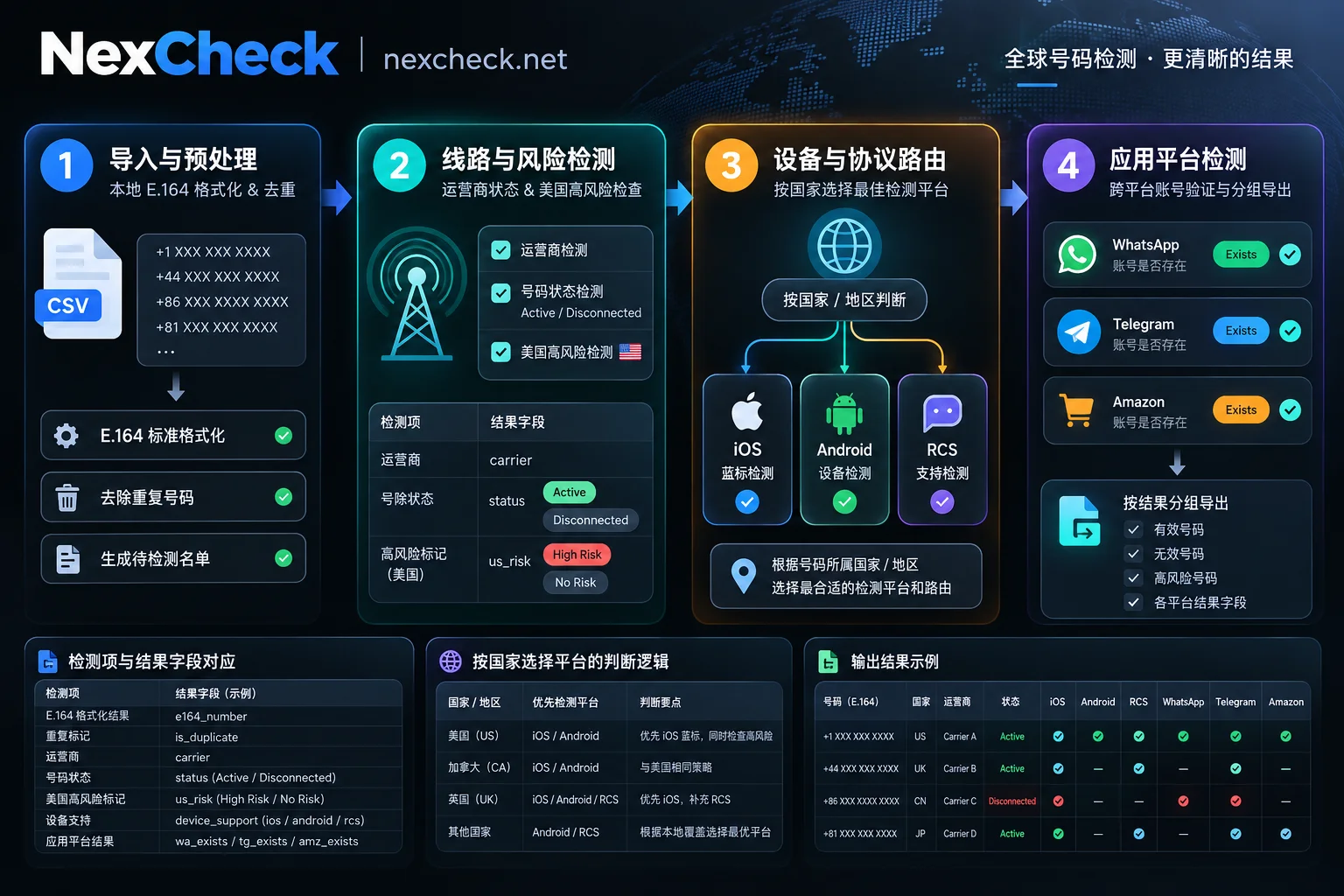
- Invalid numbers and on/off status: Identify whether a number is genuinely allocated and active on the local carrier network, distinguishing normally powered-on and available, temporarily powered off/out of service area, and fully unassigned or deactivated invalid numbers.
- Number type and carrier identification: Identify whether a number belongs to a mobile cellular network (Mobile), landline (Landline), or virtual carrier number range, and output the specific carrier attribution, carrier format, and T-card format. For platforms that only have a batch of number sources with no dedicated app detection item on the market (such as user leads for Cash App, OKX, Coinbase, or Discord), solid basic detection at this layer is the only lever for ensuring SMS and voice deliverability. (For deeper investigation of virtual number receiving and North American complaint risk control, see "How to Do Overseas Mobile Number Validity Detection? From Short-Lived Virtual Numbers and US Complaint Risk Control to a Two-Layer Verification Solution for E-Commerce and Social Media".)
- US carriers and high-risk complaint numbers: For the North American market, US carrier identification and US high-risk and complaint number screening are provided separately, helping teams strip out high-risk numbers prone to compliance lawsuits and channel blocking before sending.
2. End-device and native communication protocol segmentation (iOS / Android / RCS)
Once a number is confirmed as an "active real number," the next step is to see what device it is in, to determine the optimal outreach channel:
- Apple/Android devices and device models: Through Apple/Android segmentation and device model detection, identify the terminal camp the target number is currently bound to.
- iOS blue badge detection: Through dedicated iOS blue badge screening, determine whether the number is already activated on the Apple side (note: the iOS blue badge only answers whether it is on the Apple side; it does not include specific model, system version, or Apple account information).
- RCS activation and system type: As RCS becomes the rich media standard spanning Android and Apple, RCS number screening can detect a number's RCS activation status, RCS system type, and Android screening. Routing active RCS-capable numbers separately and pushing rich media messages with brand verification badges, high-definition carousels, and interactive buttons yields click-through rates far higher than plain-text SMS and effectively avoids plain-text link blocking.
3. Four-Step Implementation: A Low-Cost, High-Conversion Standard Operating Procedure (SOP) for Overseas Number Screening
Because NexCheck uses prepaid per-item billing and the console batch tasks do not automatically deduplicate repeated numbers in uploaded files (duplicates are still billed), the most budget-efficient approach is to follow the four-step order: free local cleaning first, then underlying invalid number checks, and finally business-based segmentation:
Step 1: Free local browser formatting and deduplication (zero cost)
Overseas leads come from all kinds of sources and often mix parentheses, dashes, spaces, or missing country codes; there are also special historical issues like Vietnam's 2018 change from 11-digit to 10-digit numbers (submitting the old 11-digit numbers directly will return no results).
Before creating a paid task, first open the number cleaning tool. This tool runs directly in your local browser and does not create a paid detection task:
- Select the correct "default country" according to the true origin of your number sources (be sure to note: if the default country is wrong, you will get correctly formatted numbers with incorrect attribution);
- The tool automatically recognizes various separators, completes country codes based on the default country, uniformly converts to the international standard E.164 format, and performs precise deduplication;
- Before exporting valid results, it is recommended to cross-check against the regional solutions (such as single-country pages for Vietnam, the US, Japan, etc.) for local number length, major carriers, and local realities. (For detailed format specifications, see "How to Do Number Cleaning? A Complete Workflow from Local E.164 Formatting and Deduplication and Basic Invalid Number Risk Control to Cross-Platform Batch Number Screening".)
Step 2: Run basic number detection to remove invalid and deactivated numbers
Upload the cleaned and deduplicated CSV, TXT, or XLSX file (one target value per line in the first column, ensuring file size and row count fall within the minimum and maximum quantity limits of the selected project) to the console; see the quick start documentation for detailed operations.
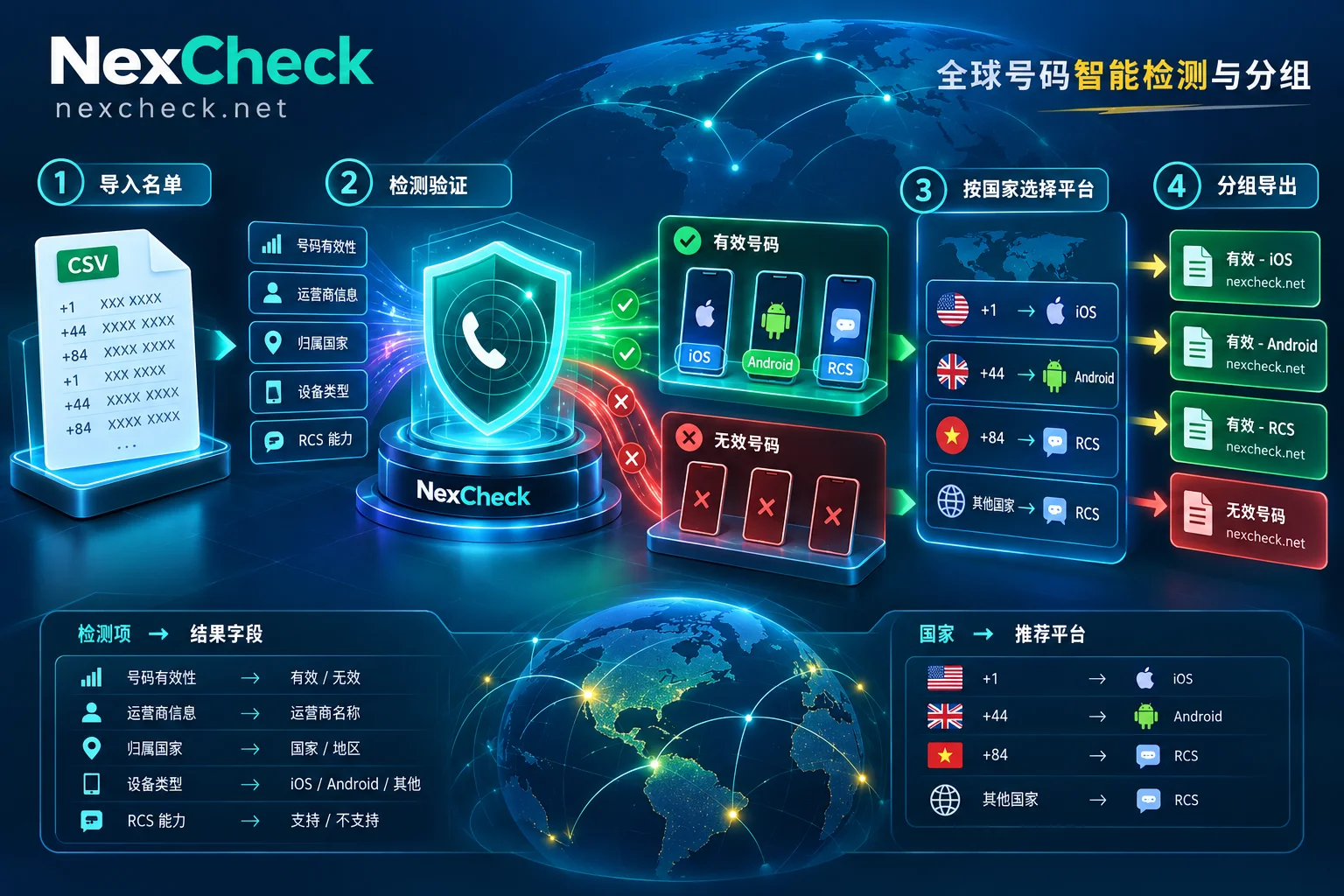
In the first round, select the invalid number and on/off status item in basic number detection (for North American lists, it is strongly recommended to add US high-risk and complaint number detection). After detection, the platform returns results grouped as "valid" and "invalid." Directly remove the invalid group (invalid numbers, deactivated numbers) and long-term powered-off numbers; this step alone typically cuts 15%–30% of ineffective cross-border communication budget for enterprises.
Step 3: Use "Continue Detection" for RCS and Apple/Android terminal segmentation
Once you have the package of active, valid real numbers, there is no need to download and manually re-upload. On the task results page in the console, click the "Continue Detection" button to feed the valid results that passed the previous round directly as input for the next project (a new task will be created and billed separately):
- If you plan rich media marketing: route to RCS detection or iOS blue badge detection to split the list into an "RCS reachable group," an "Apple blue badge group," and a "traditional SMS fallback group";
- If a batch of number sources proves too costly for SMS channels: route to mainstream instant messaging or e-commerce platforms for cross-channel onboarding.
Step 4: Cross-platform application activation and active engagement
For active real numbers, many go-global teams prefer to import them into social apps with lower private-domain costs and higher interaction rates, or verify their e-commerce attributes. In the supported platforms overview, you can connect them as needed:
- Instant messaging private-domain onboarding: such as WhatsApp number screening (supports activation detection, four-dimensional ecosystem activity and per-channel activity, banned account and zombie/ad account identification), Telegram number screening (supports number activation and 3/7/15-day activity tiers), LINE number screening (registration screening by region for Taiwan, Japan, Thailand, South Korea, Hong Kong, and the US; check activation first, then activity), or Viber number screening (supports activation, activity intervals, and "account age" detection to remove newly registered small accounts). (For fine-grained cross-platform activity tiers, see "How to Do Number Activity Detection? A Screening Solution from New Delivery Threshold Rules to Cross-Platform Activity Tiering".)
- Social media, e-commerce, and financial audience profiling: Verify whether a number is registered on Amazon, Temu, Shopee, TikTok, Facebook, or Binance (Binance detection does not log in to Binance or send verification codes to the number, making it safe and non-intrusive), helping marketing teams identify high-net-worth online shoppers and crypto finance audiences.
4. R&D Automation Integration and Data Security Compliance Boundaries
In actual business implementation, beyond marketing teams manually uploading spreadsheets in the web console, more and more enterprises choose to build overseas invalid number detection into registration forms, CRM ingestion, or marketing automation workflows:
- RESTful API real-time and batch integration: NexCheck provides a standard RESTful API supporting batch submission, real-time queries, and Webhook asynchronous result pushback. Because the public user manual does not show specific endpoint addresses, parameters, authentication, or callback formats, developers can complete free registration and then directly contact the official Telegram support (@nextipkf) for technical integration support.
- Objectively understand the timeliness and boundaries of detection results: Overseas invalid number detection results reflect only the telecom network or platform status at the moment of query. It can help you filter physical dead numbers, but it cannot determine the true identity, purchase intent, or commercial value of the number holder, nor does it guarantee that any single result is absolutely correct. In addition, the task center does not promise a result retention period and cannot be used as a long-term archive; it is recommended to export results promptly after detection and write them back to your own CRM.
- Privacy protection and data sovereignty: Facing strict overseas data regulations such as GDPR and CCPA, enterprises worry most that uploading customer lists will lead to data leakage. According to the NexCheck Privacy Policy, the customer is the data controller (and must ensure the source and purpose of the numbers are lawful); submitted lists are entirely the customer's own assets. The platform processes them only within the scope of executing detection tasks, never sells them, and never uses them to build a number database for external sale; customers can view, export, and completely delete records in the console at any time.
Conclusion
With overseas customer acquisition and communication costs rising, every blind full-list blast overdrafts both your marketing budget and your sender reputation. Before launching your next overseas promotion or routine outbound campaign, consider using the local number cleaning tool for free format standardization, then use the NexCheck console to complete underlying invalid number filtering and RCS/terminal device segmentation—so every dollar of cross-border outreach budget lands precisely on the phones of real users who are powered on and online.



Comments(0)