 NexCheck-筛号平台
In cross-border e-commerce fulfillment, overseas financial account opening, foreign trade B2B outbound calls, and international SMS/social media outreach, international mobile number validity detection is no longer an optional way to save on channel costs—it is a core defense line that directly determines advertising ROI, logistics delivery rates, and legal safety.
Entering 2026, the overseas number environment facing go-global teams is undergoing dramatic changes: on one hand, short-lived verification numbers and cheap prepaid cards driven by black and gray industries are flooding registration and coupon campaigns; on the other hand, overseas communication regulations, led by the United States, remain stringent, and the cost of mistakenly contacting high-risk complaint numbers or long-abandoned numbers has multiplied.
If a team's understanding of a "valid number" still stops at "the digits match and the country code can be added," they will often suffer severe hidden losses in actual operations. This article combines the latest pain points in the overseas number ecosystem to break down an implementation plan for international mobile number validity detection that balances underlying communication status and upper-layer business profiles.
Three New Pain Points in the 2026 Overseas Number Environment: Why "Correct Format" Does Not Equal "Truly Valid"?
In the past, many go-global teams were used to validating number length with regular expressions or simply throwing lists into bulk messaging tools for "blind testing." But in the current global communications and risk control environment, this rough approach hits three walls:
1. "Short-lived verification numbers" and recycled prepaid numbers are rampant, causing static lists to rot quickly
According to the "2026 Overseas Black Card Industry Research Report" released by the security firm Threat Hunter, in a tracking of nearly 50,000 overseas verification numbers, more than half of the verification numbers appeared only once or had an active period of no more than 30 days, while about 32.7% of numbers would be re-released to the market for recycling after 90 days of inactivity.
In addition, users in emerging markets such as Southeast Asia, Latin America, and Africa commonly use prepaid SIM cards. Once they stop topping up, carriers will suspend the number and reallocate it within 30 to 180 days. This means that a large portion of the leads you collected three months ago may today have become inactive, powered-off numbers, or have long since changed owners.
2. High compliance pressure on North American outbound calls and SMS makes blind dialing prone to "complaint landmines"
Marketing and outbound call teams targeting the North American market still face severe compliance tests in 2026. According to the latest enforcement standards of the U.S. Federal Trade Commission (FTC) and the Telephone Consumer Protection Act (TCPA), the maximum federal penalty for illegal outbound calls has climbed to over $50,000 per violation, private litigation compensation is between $500 and $1,500 per call, and 2026 imposes extremely high automated audit requirements on cross-channel unsubscribe response times (within 10 business days) and regular list cleaning. If the list contains professional complainant numbers or high-risk numbers, a single blind outreach could lead to high claims.
3. "Empty orders" losses in cross-border e-commerce fulfillment and cash on delivery (COD)
In independent site promotions, off-platform traffic diversion, or Southeast Asia/Middle East COD (cash on delivery) scenarios, buyers filling in fake numbers, powered-off numbers, or one-time verification numbers can prevent logistics couriers from contacting recipients, directly increasing package rejection rates and return logistics costs. Simply checking whether a number is "real" is not enough. If a number has neither registered on local mainstream e-commerce platforms nor activated any commonly used instant messaging apps, the authenticity of fulfillment behind it is often greatly reduced.
Redefining "Validity": A Three-Tier Detection Architecture for International Mobile Numbers
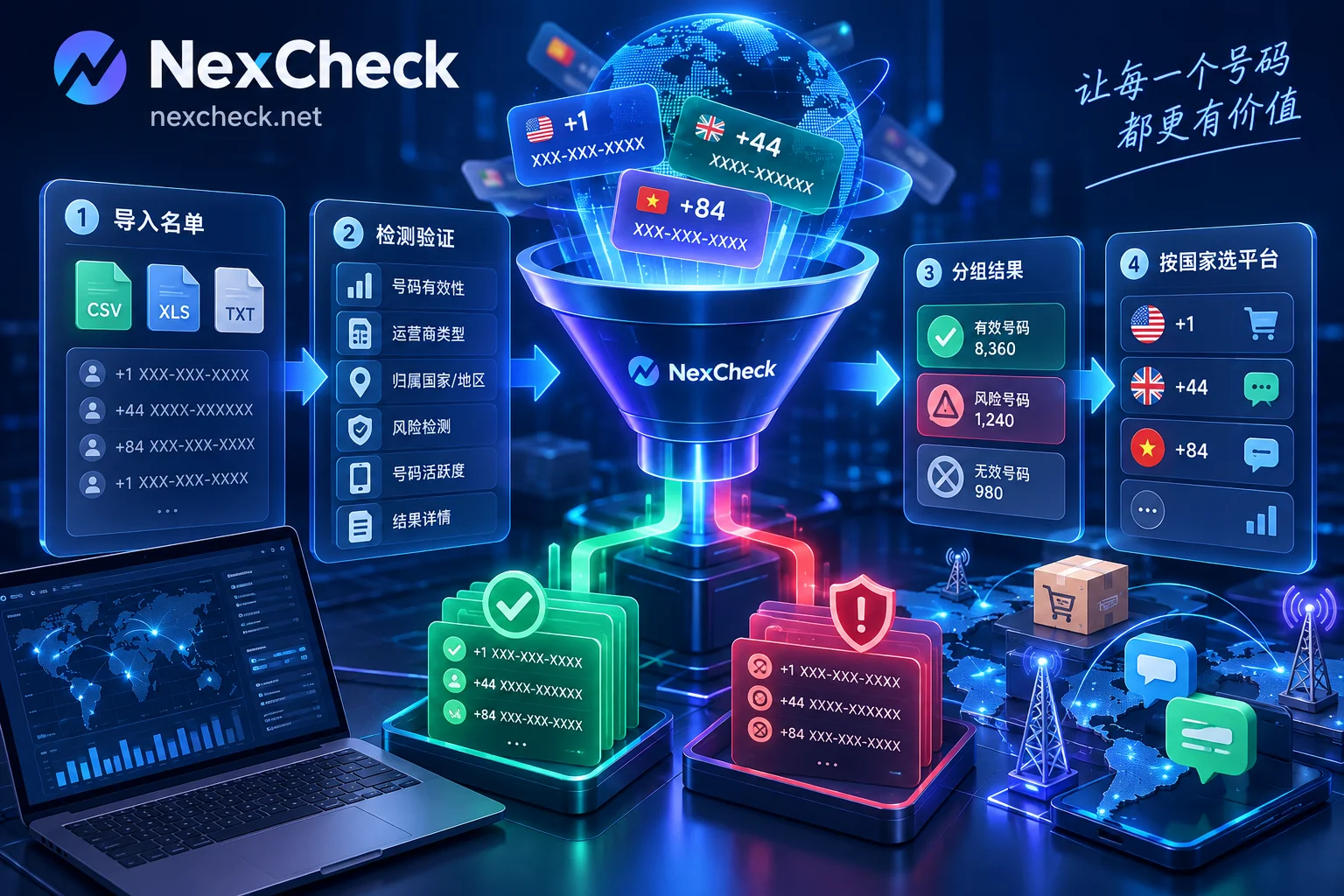
To thoroughly solve the above pain points, go-global data and operations teams need to break down international mobile number validity detection into three progressive tiers and apply the right remedy to each business scenario:
Tier 1: Syntax and Format Validity (Zero-cost pre-filtering)
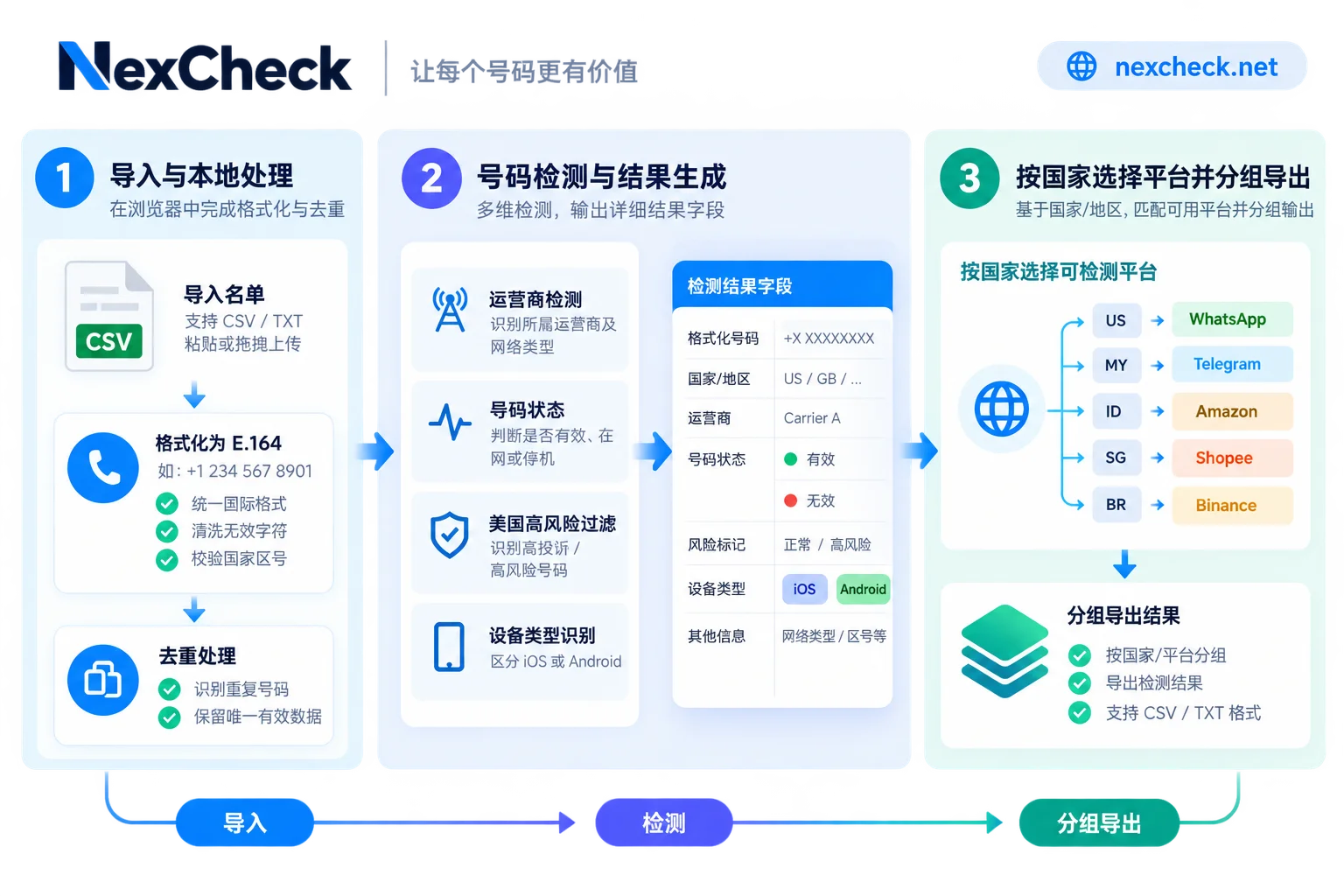
Number lengths and local leading-zero rules vary greatly across countries (for example, Vietnam fully converted 11-digit mobile numbers to a 10-digit format in 2018, and old 11-digit numbers can no longer be looked up). Before any paid detection, messy spreadsheets must be converted to E.164 standard format with country codes and duplicate rows removed.
Practical advice: Since platforms do not automatically deduplicate after tasks are uploaded (duplicates are still billed), it is recommended to first use a free browser-based number cleaning tool. It processes data locally without creating paid tasks, and can automatically identify separators, fill in country codes based on the selected default country, convert to E.164 format, and deduplicate. For details on formatting and deduplication, refer to our previous article "How to Clean Numbers? A Complete Process from Local E.164 Formatting and Deduplication, Basic Inactive Number Risk Control to Cross-platform Batch Screening."
Tier 2: Communication and Risk Control Validity (Blocking inactive, suspended, and high-risk numbers)
Once the number format is standardized, the second step is to confirm its physical status in the telecom carrier network. Through the NexCheck basic number detection matrix, teams can complete the following underlying verifications without disturbing users:
- Inactive and on/off detection: Directly identify unassigned inactive numbers, deregistered suspended numbers, and currently powered-off numbers, keeping basic communication dead numbers out.
- Number type and carrier identification: Identify the specific carrier and format of the number (supporting carrier identification, carrier format, and T-card format screening), and determine whether it matches the legitimate number segment characteristics of the target market.
- US-specific risk control (US carrier, US high-risk and complaint numbers): For the North American market, specifically screen US local carrier attribution and directly flag US high-risk and complaint numbers, helping outbound call and SMS teams eliminate dangerous elements prone to legal disputes before dialing.
- Device and system environment segmentation: Support detection of device model, Apple/Android device segmentation, iOS blue label detection (determining whether it is an Apple device), and RCS activation and system type. This is particularly useful for teams distributing app download links by device type or choosing iMessage/RCS outreach channels.
Note: For some business scenarios where only number sources are available and no platform-specific interface exists (for example, lists from Cash App, OKX, Coinbase, or Discord), this basic detection layer is currently the main way to verify the communication validity of numbers.
Tier 3: Business and Application Ecosystem Validity (Cross-platform cross-verification)
A number being in an "active real number" state does not mean it is a real active consumer—it could very well be a "black card" inserted in a SIM bank device waiting to receive verification codes. The most reliable way to determine whether there is a real person behind a number is to see whether it has integrated into the local digital life ecosystem.
In the NexCheck supported platforms overview, detection capabilities cover five major groups: instant messaging, social media, crypto and finance, e-commerce and logistics, and office and local life. You can choose the corresponding applications for cross-verification based on your business attributes:
- Cross-border e-commerce and logistics fulfillment verification:
Before shipping review or high-value old customer reactivation, you can batch detect whether numbers have activated accounts on leading e-commerce and logistics platforms in the target market, including Amazon, Temu, Shopee, Coupang (South Korea), Flipkart (India), Bukalapak (Indonesia), Noon (Middle East), and international logistics DHL. A mobile number that has already registered an account on Shopee or Noon has far higher credibility as a real online shopper than a blank number. Instant messaging and social media outreach verification:
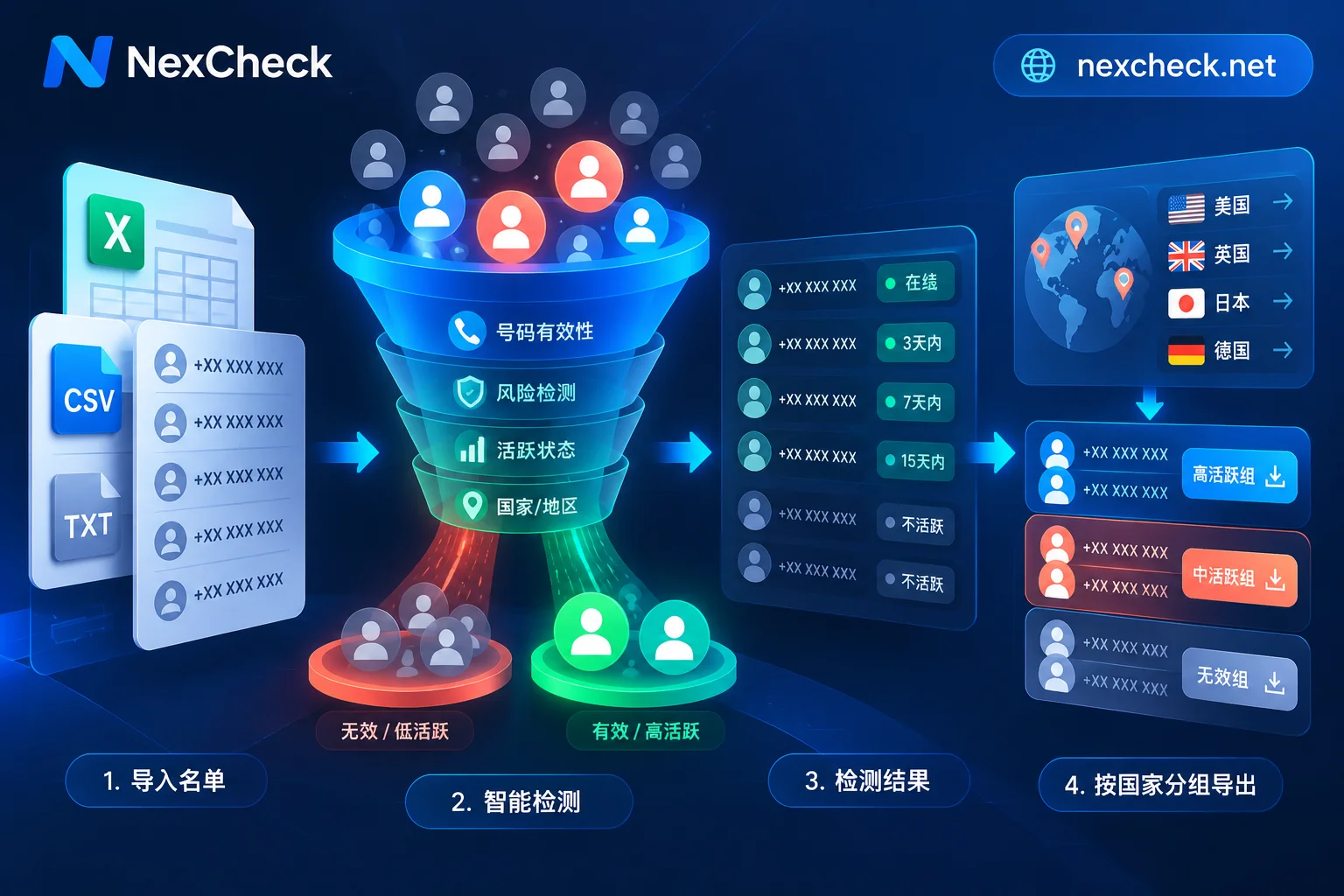
- Mainstream IM screening: Covers WhatsApp number screening (supporting activation, registration time, four-dimensional ecosystem activity, real-time online, zombie and advertising accounts, banned accounts, etc.), Telegram number screening (supporting number activation and 3/7/15-day activity tiers, as well as @username detection), LINE number screening (screening registration and activity by region: Taiwan, Japan, Thailand, South Korea, Hong Kong, and the US), Zalo number screening, and Viber number screening (including "account age" detection used to eliminate newly registered small accounts). If you have in-depth needs for activity tiering, you can read further "How to Detect Number Activity? A Screening Solution from New Delivery Threshold Rules to Cross-platform Activity Tiering."
- Social media screening: Supports Facebook (number/email activation, UID, and public gender/avatar), Instagram, TikTok, Twitter/X, Snapchat, Moj, and LinkedIn activation screening supporting US and Indian numbers.
- Web3, crypto, and high-net-worth financial verification:
For fintech and crypto industries, activation screening is supported for Binance (including registration screening, email detection, and Binance Pay transfer recipient channel, without logging into Binance or sending verification codes to target numbers), KuCoin, CoinW, HTX, MEXC, Vantage, Paytm, and MoniePoint (in addition, Robinhood and Nasdaq support email-based detection). - Office and vertical local life verification:
For B2B or specific regional businesses, you can also cross-confirm list quality through activation status on Microsoft, Microsoft Teams, Airbnb, Indian real estate and finance platforms (Magicbricks, The Economic Times), and Russian-speaking real estate and recruitment platforms (Cian, HeadHunter).
How to Combine the Most Efficient Screening Order for Different Go-Global Regions and Scenarios?
Facing dozens of detection capabilities, testing all items is neither economical nor necessary. In practice, it is recommended to combine NexCheck regional solutions (including local number formats, major carriers, and recommended screening order for each country) and use the console's "Continue Detection" feature for funnel-style screening:
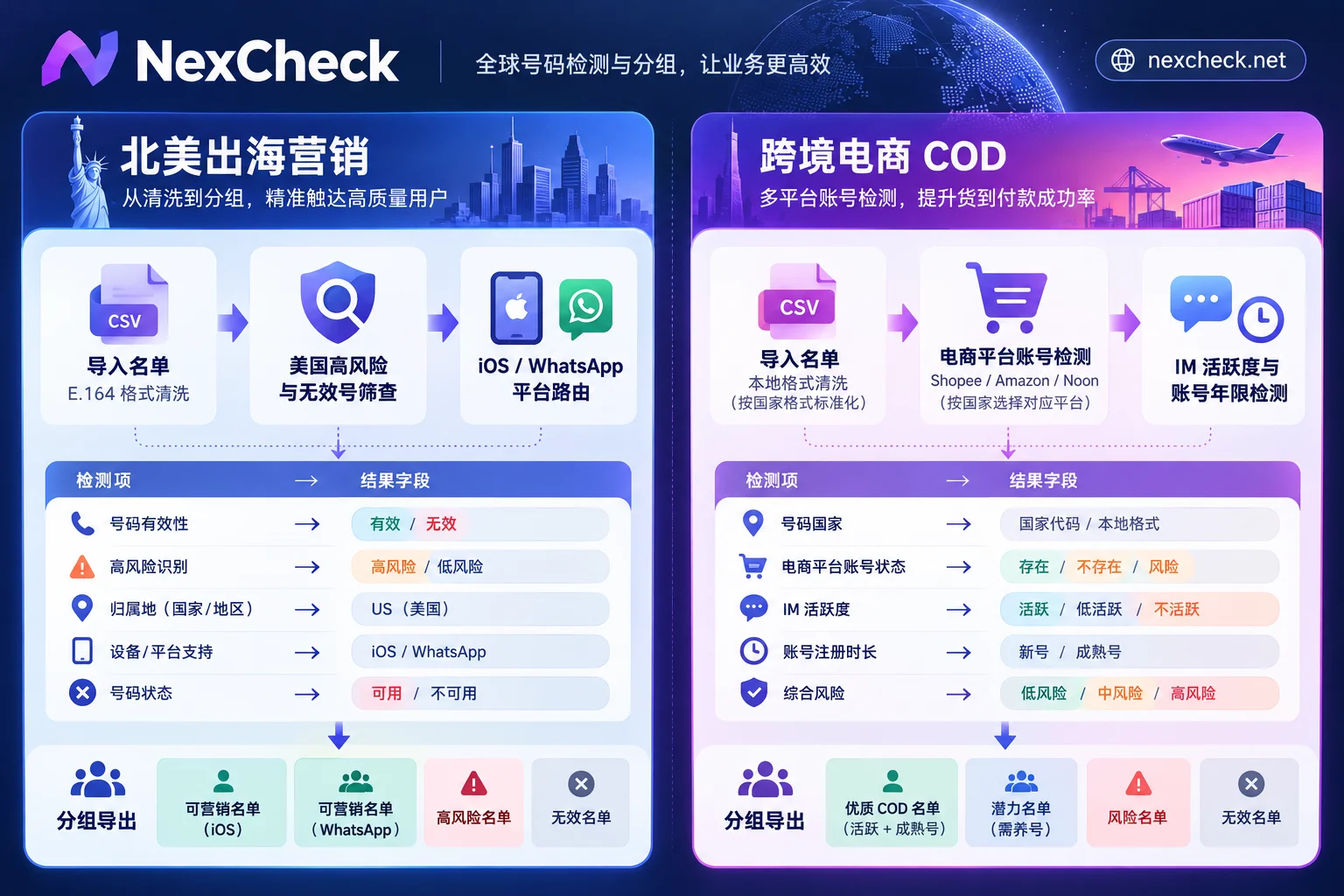
Scenario 1: US/North America Telemarketing and SMS Marketing Teams
- Core needs: Protect outbound call lines, avoid TCPA/DNC huge fines, and improve connection rates.
Recommended funnel order:
- Browser-based local cleaning (select US
+1, unify E.164 format, and deduplicate). - Submit US high-risk and complaint number detection + inactive and on/off detection to immediately remove complaint blacklists and dead numbers.
- On the results page, click "Continue Detection" to transfer the valid real numbers that pass screening directly to iOS blue label / RCS activation or WhatsApp / LinkedIn (US-India) activation detection, and distribute precisely according to channel preference.
- Browser-based local cleaning (select US
Scenario 2: Southeast Asia/Middle East/Latin America Cross-border E-commerce (Independent Sites and COD Logistics Verification)
- Core needs: Identify short-lived verification numbers from malicious orders, reduce logistics delivery failure rates, and build private domain repurchase pools.
Recommended funnel order:
- Complete local format cleaning according to target country rules (e.g., the 10-digit number specification required by the Vietnam regional solution).
- First run activation screening on e-commerce/logistics platforms for the corresponding region (e.g., Shopee for Southeast Asia, Noon for the Middle East, Amazon / Temu / DHL globally), or directly run activation detection on local national-level IMs (e.g., WhatsApp for the Middle East and Europe/US, Zalo for Vietnam, LINE for Japan, South Korea, Taiwan, and Thailand).
- For activated numbers, use "Continue Detection" to overlay activity/registration time/account age screening, eliminating high-risk orders that were registered just a few days ago and are highly likely black industry verification small accounts.
Practical Points for Implementing Batch Detection and API Automation on NexCheck
Whether you are a marketing operator with hundreds of thousands of historical leads or a developer responsible for building a CRM risk control platform, paying attention to the following four practical details when performing international mobile number validity detection on the NexCheck platform will maximize efficiency:
- Standardize file format and quantity ranges:
When submitting tasks in batches through the web console (see Quick Start Guide), CSV, TXT, or XLSX files are supported. Ensure each line contains one target value and is placed in the first column. Different detection items have their own minimum/maximum row requirements per upload; you can check the corresponding channel instructions in the console before submitting. - Make good use of multi-channel strategies and "Continue Detection":
Many popular platforms offer multiple channels for the same detection item (e.g., WhatsApp's fast channel and SVIP channel, Zalo's speed and stable channels). Each channel differs in speed, coverage regions, and returned field specifications, and unit prices are subject to the real-time price list in the console. The platform uses a prepaid pay-per-item model, and failed tasks are automatically fully refunded; using "Continue Detection" to directly use the previous round's "valid" group as input for the next round saves the tedious steps of repeatedly exporting and re-uploading (new tasks are billed separately). - Integrate with business systems via RESTful API:
If you need to automatically block invalid numbers at the moment of user registration, checkout, or lead entry, developers can integrate NexCheck's RESTful API into their own CRM or ERP systems, supporting batch submission, real-time queries, and Webhook result pushbacks. Since the public user manual does not directly display interface parameters and authentication details, technical teams can contact official Telegram customer service (@nextipkf) for integration support after registering an account for free. Clarify data timeliness, privacy boundaries, and compliance responsibilities:
- Timeliness: Detection results reflect the objective status of the target platform at the moment of query (and are limited by user privacy settings; avatar, signature, or gender fields set to private cannot be read). It is not recommended to use the console task center as a long-term archive database; after detection is complete, please export and write back to your own CRM in a timely manner.
- Data security: According to the NexCheck Privacy Policy, customer-uploaded lists are entirely the customer's own assets. The platform processes them only within the scope of executing detection tasks and never sells them or uses them to build number databases for external sale. Customers can view, export, and completely delete data in the console at any time. At the same time, as data controllers, enterprises themselves must ensure that the source of submitted numbers and subsequent outreach purposes comply with local laws and regulations.
Conclusion
In 2026, with high customer acquisition costs, frequent black industry verification numbers, and increasingly stringent overseas regulations, international mobile number validity detection is no longer a single "inactive number check" but a combination punch that integrates local format standardization, carrier underlying status identification, high-risk complaint interception, and cross-platform ecosystem verification. Visit the NexCheck official website now to see the supported platforms and channels for your target market, or directly register a NexCheck account to drive your global business growth with clean, real, and highly active number assets.


Comments(0)