 NexCheck-筛号平台
Every mid-November is a critical window for overseas e-commerce, fintech, and B2B marketing teams to sprint for year-end performance. But before maxing out bulk messaging budgets, several industry regulatory and platform rule changes in the second half of 2026 are sounding alarms for teams that blindly upload lists.
If you have accumulated a batch of historical customer lists, exhibition leads, or cross-channel data, directly throwing them into an outbound call system or messaging backend may no longer be just a small issue of "wasting a few cents on channel fees," but an underlying crisis related to legal litigation risks and the entire enterprise business asset pool limits.
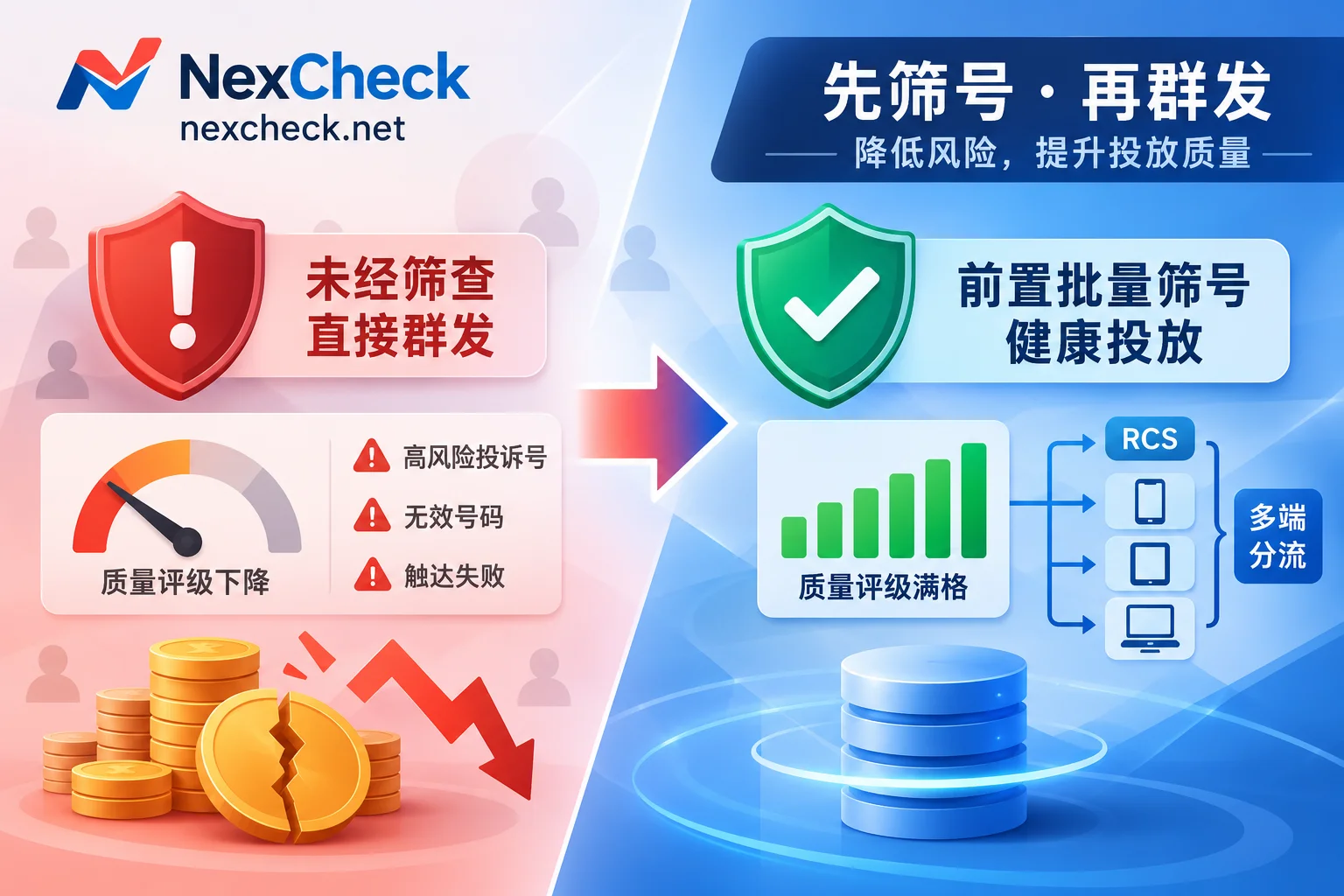
Why must current batch number screening upgrade from "single-point availability check" to "multi-dimensional pre-filtering"? Based on recent industry developments, we break down a practical batch screening solution that balances risk control security and conversion efficiency.
I. Three Latest Pain Points for Overseas Outreach in Late 2026: Why Can't You Just Bulk Send?
1. US FCC TCPA Opt-Out Rules Take Effect Soon, Reassigned and Complaint Numbers Are Costly
According to the latest directive from the US Federal Communications Commission (FCC 26-67), revised rules for commercial calls and SMS opt-out take effect on November 25, 2026. Meanwhile, class actions in US judicial practice against "reassigned numbers" and DNC (Do Not Call) lists remain highly active—in the second half of 2026 alone, a well-known flower e-commerce company faced a TCPA settlement of up to $6 million for sending promotional SMS to reassigned numbers.
A fatal misconception among many teams is that "a number with correct format that a customer opted in years ago" equals safety. In reality, once a number is suspended for non-payment and reassigned by the carrier, the original marketing authorization becomes void; if you accidentally hit professional litigants or high-frequency complaint numbers, statutory damages per violation can reach $500 to $1,500.
2. WhatsApp Portfolio-Level Limits: One Bad List Drags Down Everything
If you rely on WhatsApp to reach overseas customers, you must have felt the impact of Meta's tightened rules. Since Meta adjusted sending limits to be shared across the entire Business Portfolio, and calculates quality rating (Green/Yellow/Red) on a rolling basis based on user blocks, report reasons (such as "no subscription," "no longer needed," "spam") and read rates over the past 7 days, the fault tolerance for template messages has been greatly compressed.
Once you suddenly increase sending volume before a big promotion, and the list is mixed with many zombie accounts, ad accounts, banned accounts, or long-inactive dormant users, extremely low read rates combined with even a small percentage of "no subscription" reports will quickly push templates to Paused, or even block the entire business portfolio's limit increase path.
3. RCS Cross-Platform Breakthrough and Global Multi-Ecosystem Divergence: Single-Channel Push Is Extremely Costly
With Apple's full support for RCS (Rich Communication Services) on iOS and the maturity of infrastructure among mainstream European and American carriers, global RCS business messaging truly entered the mainstream in 2026. However, in actual deployment, fragmentation across countries and devices still exists: which numbers support RCS rich media cards? Which belong to Apple blue-badge devices? Are Southeast Asian customers using Zalo, LINE, or Viber? Without pre-diversion, blindly sending all numbers through high-cost international SMS or a single instant messaging channel will inevitably see ROI eaten up by high bounce and silent rates.
II. Four-Step Efficient Batch Screening: From Free Local Preprocessing to Multi-Platform Layering
To wash out the highest-value usable list at the lowest detection cost, never throw the raw spreadsheet directly into high-priced deep detection channels. Leveraging NexCheck's toolchain and console batch task mechanism, a standardized four-step funnel can help teams save a lot of unnecessary costs.
Step 1: Local Browser Cleaning, Zero-Cost Removal of Format Invalid and Duplicate Numbers
Many marketing teams receive multi-channel summary tables filled with parentheses, hyphens, spaces, missing country codes, and even duplicate entries.
In the billing rules that require special attention, console batch tasks do not automatically deduplicate after upload; duplicate values are still billed. Therefore, before formally creating a paid task, be sure to open the number cleaning tool.
- Purely local processing: This tool runs directly in the browser and does not create paid detection tasks.
- Standardization and deduplication: Automatically recognizes separators, fills in country codes according to the selected default country, uniformly converts to standard
E.164format and performs deduplication, while intuitively reporting valid, invalid, and duplicate counts. - Pitfall reminder: When operating, be sure to confirm the "default country" is selected correctly; otherwise, you will get numbers that appear format-compliant but have completely wrong country attribution. For more details on the cleaning process, refer to the previous article "How to Clean Numbers? Complete Process from Local E.164 Formatting Deduplication, Basic Invalid Number Risk Control to Cross-Platform Batch Screening".
Step 2: Basic Number Detection as Foundation, Block Invalid and US High-Risk Numbers
A clean-format list next needs to pass a physical communication-level "security gate." Through the basic number detection matrix, we can first perform underlying filtering:
- Invalid numbers and on/off status: Remove deactivated, unassigned dead numbers, and confirm the number is currently in normal network status.
- US market exclusive risk control: For North American outbound call and SMS marketing teams, be sure to check US carrier identification and US high-risk and complaint number screening. Stripping out high-risk numbers prone to TCPA complaints and channel bans in advance is far more cost-effective than dealing with opt-outs and lawyer letters afterward (further reading: "How to Detect Overseas Mobile Number Validity? From Short-Lived Verification Numbers, US Complaint Risk Control to Dual-Layer Verification for E-commerce and Social Media").
- Device and native message diversion: If your business involves native message outreach, you can perform RCS number screening (supports availability detection, system type and Android filtering), Apple/Android diversion, or iOS blue badge detection at this step (note: iOS blue badge only answers whether it is on the Apple side, not specific model, system version, or Apple account information). In addition, for business scenarios like Cash App, OKX, Coinbase, Discord that only have number sources and no platform-specific detection items, the initial list screening is also done through this basic number detection layer.
Step 3: Deep Screening of Core Instant Messaging Ecosystems, Use "Continue Detection" to Chain the Funnel
After underlying valid numbers are filtered out, there is no need to manually download and re-upload adjusted tables. In the NexCheck console, directly click the "Continue Detection" function to use the valid results filtered from the previous step as input for the next platform project (the system will create a new task and bill separately for the new project), achieving a smooth funnel-style deep processing.
For mainstream overseas private domain ecosystems, it is recommended to combine the following dimensions:
- WhatsApp screening: In addition to basic availability detection (offering fast channel and SVIP channel), before scaling up for big promotions, it is strongly recommended to add ecosystem four-dimension activity and channel-specific activity, zombie and ad account, banned account, and registration time detection. Remove banned accounts and non-interactive zombie accounts first, then combine gender and age (SVIP, channel 1, channel 2) for copy layering to maintain the quality green badge of the business account. (Note: Avatar, signature, and last seen time are limited by user privacy settings; fields set to private cannot be read.)
- Telegram screening: Not only supports availability check by phone number and 3/7/15-day activity tiers, gender, but also supports direct upload of
@用户名for username detection and username gender/age detection (since the profile page itself has no gender/age fields, the usability of such results depends on the user's public name and avatar). Major platforms in Asia-Pacific region:
- For Japan, Taiwan, Thailand, South Korea, Hong Kong, and the US markets, use LINE screening to screen registration status by region, which can return UID, nickname, avatar, and comprehensive age/gender (note: LINE activity detection must first screen availability).
- For the Vietnamese market, use Zalo screening to verify account availability, activity range, and gender/age (divided into fast and stable channels; stable channel includes nickname; please ensure Vietnamese numbers are in the 10-digit format after the 2018 reform; old 11-digit numbers cannot be detected).
- For Eastern Europe, Middle East, and specific Southeast Asian markets, you can call Viber screening (including availability, activity range, and account age—here account age refers to how long the account has been registered, specifically used to remove newly registered verification numbers, not the user's personal age), Botim screening (availability, gender/age), KakaoTalk, Band, and Signal. If unsure about the best combination for the target country, you can first consult the regional solution guide.
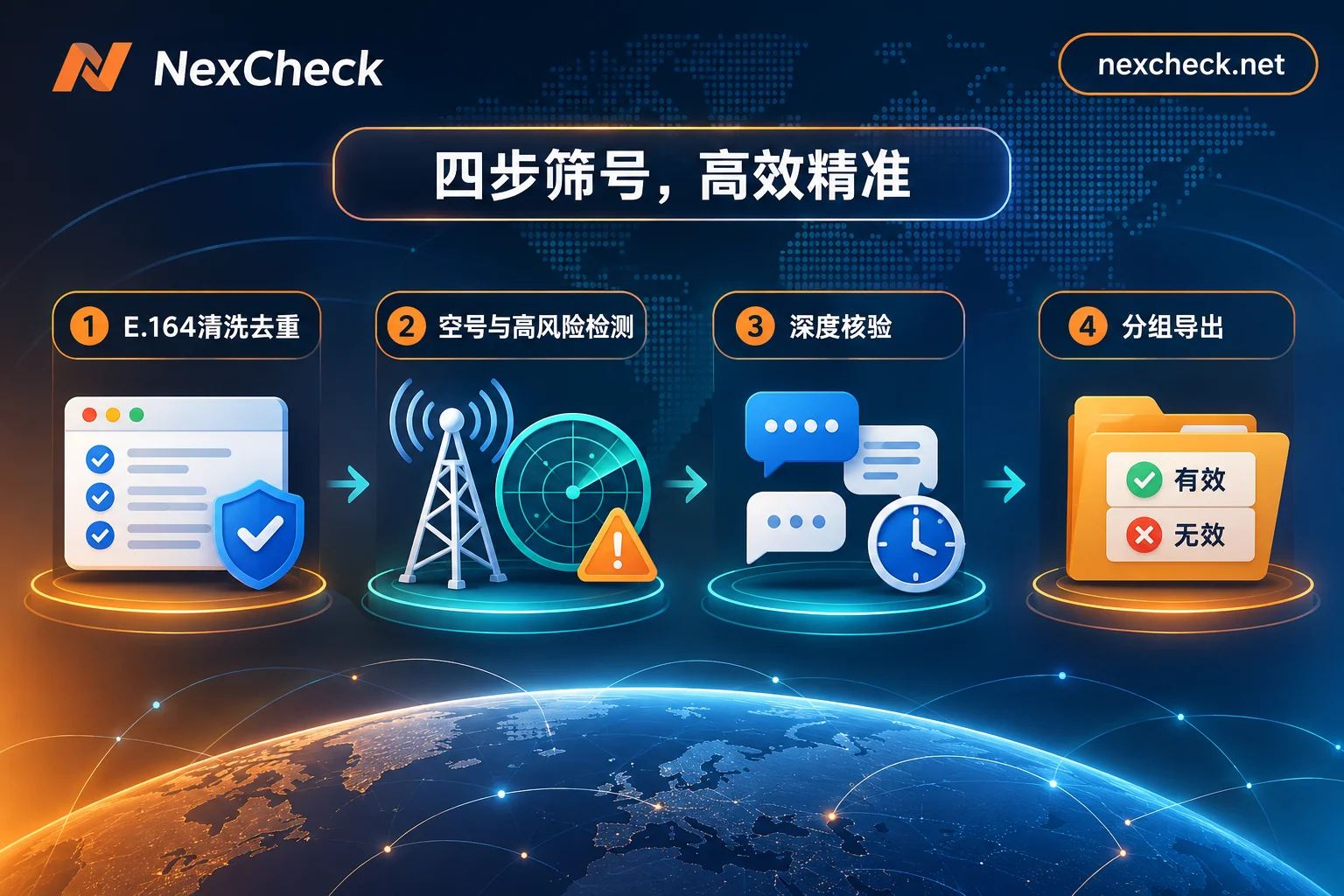
Step 4: Social Media, Crypto Finance, and Vertical E-commerce Availability Verification, Lock in High-Intent Customers
Besides instant messaging, many teams need to verify the coverage of the list on specific vertical platforms for ad Custom Audiences upload or vertical business conversion (see "Beyond 'Availability': How to Build a Precise Cross-Platform Multi-Dimensional Number Insight System?"):
- Social media matrix: Facebook screening supports number availability, email availability, UID, and UID profile gender/avatar (read-only public fields); Instagram, TikTok, Twitter/X, Snapchat, Moj provide number availability screening; for B2B prospecting, use LinkedIn screening (currently availability screening supports US and India numbers).
- Crypto and financial platforms: For Web3 and fintech teams, Binance, KuCoin, CoinW, HTX, MEXC, Vantage, Paytm, MoniePoint all support registration availability screening; among them, Binance, KuCoin, CoinW, HTX also have email detection, while Robinhood and Nasdaq specifically provide email detection. Notably, Binance also supports transfer channel detection (determined by whether the number can find a recipient in Binance Pay), and it never logs into Binance or sends any verification code to the target number, making it silent and safe.
- E-commerce, logistics, and office/life: Supports account availability screening for Amazon, Temu, Shopee, Coupang, Flipkart, Bukalapak, Noon, DHL, Microsoft, Microsoft Teams, Airbnb, Magicbricks, The Economic Times, Cian, HeadHunter. Complete detection items and channel differences can be checked anytime in the supported platforms overview.
III. Practical Pitfall Guide for Operations and Technical Teams
To ensure a smooth batch screening process and compliance with enterprise data security standards, when actually operating the console or integrating systems, several key details need to be aligned in advance by the team:
- File specifications and task creation: The console supports uploading
CSV,TXT, orXLSXfiles. Please place the target value (number, email, or@用户名) in the first column, one per line. Note that each detection item has its own minimum and maximum row limits per submission, and there are upper limits on file size, total rows, and columns (refer to the console page prompts for details). - Objectively understand the timeliness and boundaries of detection results: Screening results only reflect the platform status at the moment of query, returned grouped by valid and invalid. It can help you objectively remove dead numbers and unregistered numbers, but cannot determine the true identity, purchase intent, or commercial value of the number holder. In addition, the task center cannot be used as a long-term archive cloud drive; the platform does not promise result retention days. After task completion, please preview and download to local storage promptly.
- Fee mechanism and data privacy protection: NexCheck adopts a prepaid model, recharge first then deduct per item (specific unit price subject to console price list), charge upon task creation, and if a task fails, a full refund is automatically issued. In terms of data security, the list submitted by customers is their own asset; the platform processes it only within the scope of executing detection tasks, never sells it, and will not use it to build a number database for external sales; customers can view, export, and delete data in the console at any time (see Privacy Policy for details). At the same time, as data controllers, customers must also ensure the source and purpose of numbers are legal and compliant.
- CRM and business flow API automation integration: If you are a development team hoping to achieve millisecond-level automatic interception before form lead storage or outbound dialing, NexCheck provides a standard RESTful API, supporting batch submission, real-time queries, and Webhook asynchronous callbacks (refer to "How to Integrate Number Screening API? From CRM Real-Time Storage Interception, Asynchronous Webhook Write-Back to Cross-Platform Automated Cleaning Solution"). Since the public user manual does not include specific API endpoint addresses, parameters, and authentication documents, teams with integration needs should, after registering an account, directly contact official customer service Telegram (@nextipkf) for technical support and interface documents.
Conclusion
With regulatory compliance red lines tightening and major platforms strictly enforcing sending quality, "casting a wide net" has long become synonymous with negative ROI. Make batch number screening a standard pre-process for all marketing actions—first clean formats and duplicates locally, then use basic detection to clear mines, and finally combine target platform availability and multi-dimensional activity status for precise diversion—so that every cent of promotion budget lands precisely on customers who are truly online and reachable.
Now go to NexCheck Console to Register and Experience, or check the Quick Start Guide, to build a solid data foundation for your year-end overseas growth.