 NexCheck-筛号平台
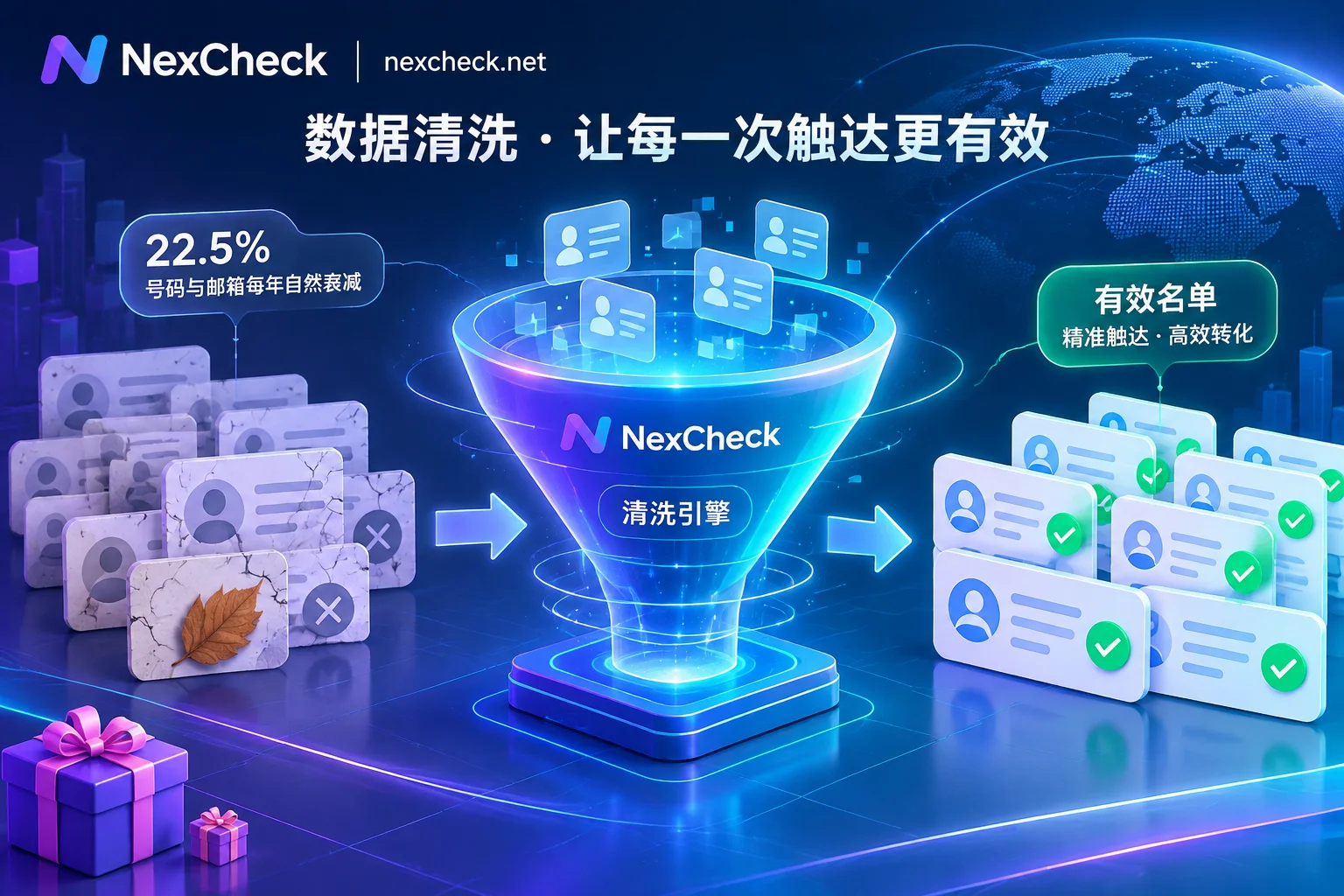
Every November, cross-border brands, e-commerce sellers, and B2B foreign trade teams face the traffic peak of Black Friday/Cyber Monday (BFCM) and year-end sprint. Many teams habitually export tens of thousands of historical contacts accumulated over the past year or two from CRM, independent site backends, or overseas exhibitions, and directly feed them into SMS channels, email sequences, or even this year's popular AI automated outbound calls and marketing agents for mass outreach.
But the results are often suffocating: budgets are spent, but what comes back is extremely high hard bounce rates, massive bills for failed sends, and even triggering risk control thresholds of channel providers and social media platforms.
The problem usually isn't the script or discount intensity, but that the underlying customer list has "rotted". Before launching any high-density year-end marketing actions, a thorough customer list cleaning is no longer a "nice-to-have" but a lifeline for protecting ROI and account security.
I. Why Your CRM List Is "Silently Failing" at 22.5% per Year
Many marketing and operations teams have a misunderstanding about "dirty data": as long as the customer provided a real number or email at the time of entry, that data is a permanent asset.
However, multiple authoritative CRM data health surveys in 2026 reveal a harsh reality:
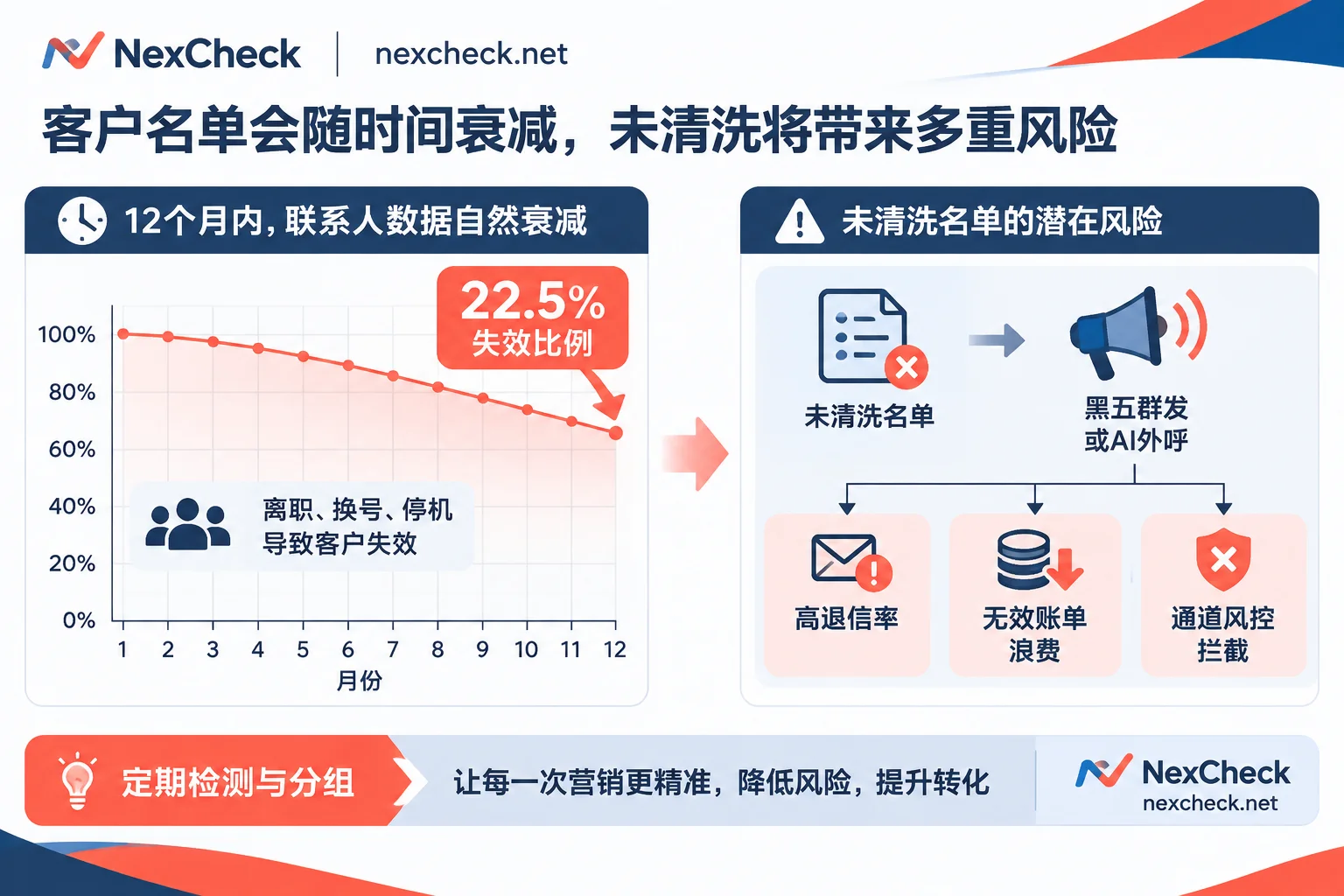
- Staggering Data Decay: Industry benchmarks show that B2B and cross-border customer contact data decays at an average of about 2.1% per month, with an annual natural decay rate of up to 22.5%; in the startup tech industry or high-turnover markets with frequent personnel changes, the annual decay rate even reaches 30% to 70%. Employees leaving or changing roles, phone numbers being suspended and recycled by carriers for reassignment, and temporary numbers being deactivated all turn originally real records into "dead numbers."
- Prolonged Year-End Campaigns Amplify Trial-and-Error Costs: In recent years, Black Friday/Cyber Monday is no longer a single-day explosion;预热 periods for major cross-border platforms and independent sites stretch from October all the way to early December, pushing up online advertising customer acquisition costs (CPC) across the board. As public domain traffic becomes more expensive, teams inevitably turn to private domain stock for repeat purchases; if they blindly send to a list where one-third is already invalid, they are voluntarily paying real money for invalid numbers.
- AI Marketing Tools Become "Amplifiers of Bad Data": According to Validity's "2026 State of CRM Data Management" survey, up to 92% of VP-level executives and 78% of C-suite management said they had made business actions based on AI-generated recommendations, only to later suspect those recommendations were built on outdated or incorrect underlying data. When your automated workflows run on uncleaned lists, AI will only harass invalid and complaining numbers at a faster rate, accelerating budget depletion and domain/account reputation damage.
If you have previously followed our layered revitalization plan for exhibition leads, CRM dormant customers, and advertising seed databases, you'll understand that stock lists from different sources have different revitalization logic; when facing "natural data decay caused by time," we need a standardized cleaning funnel that filters layer by layer according to the ecosystem.
II. The Four-Step Standard Funnel for Customer List Cleaning: From Format Standardization to Cross-Ecosystem Verification
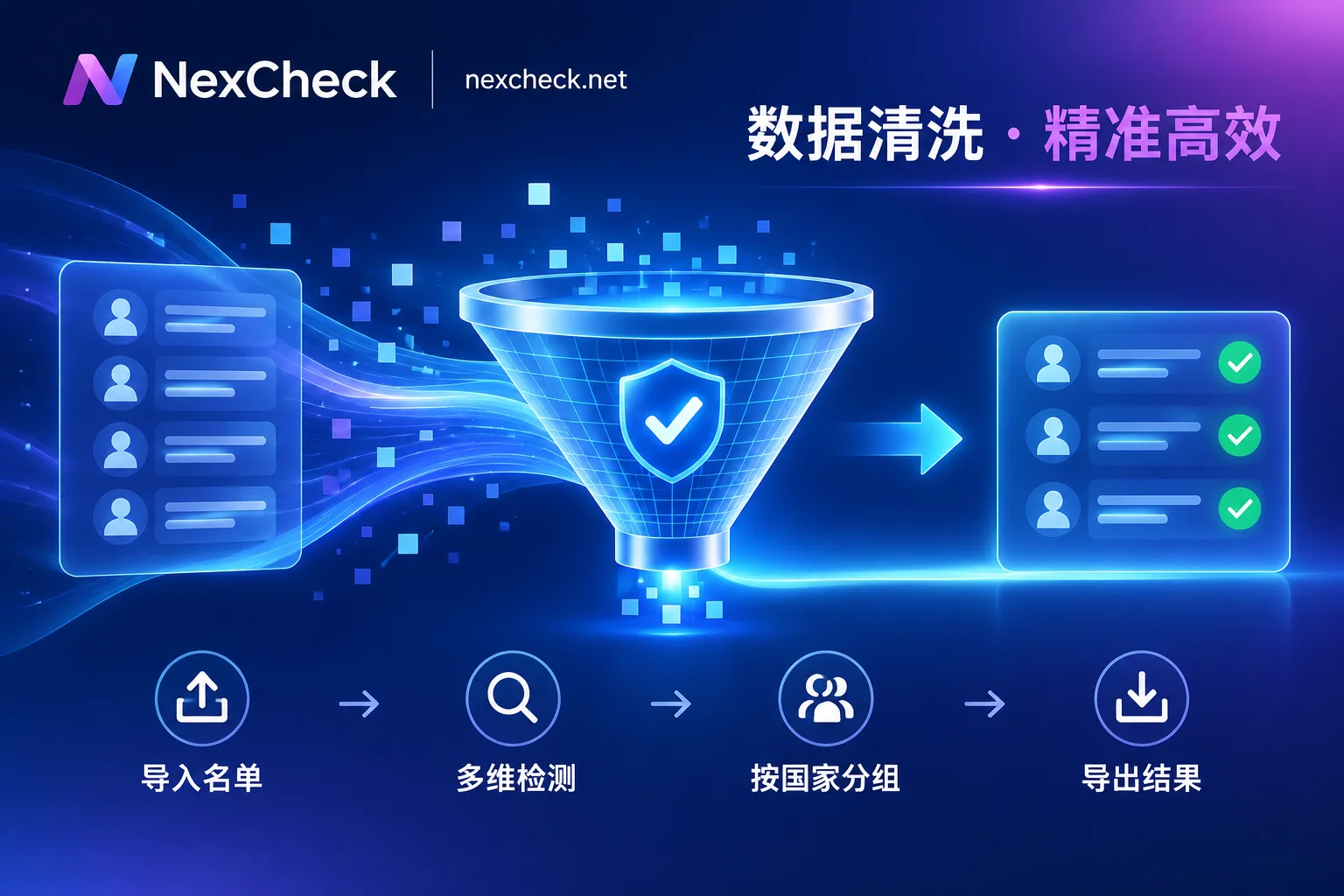
True customer list cleaning is by no means simply deleting a few wrong numbers with missing digits in Excel. With the toolchain and multi-platform detection matrix of NexCheck, operations and data teams can purify lists in four steps following the order of "cost from low to high, granularity from coarse to fine."
Step 1: Local Browser Deduplication and E.164 Format Standardization (Zero Detection Fee)
Before uploading the list to any paid channel, you must first solve the problems of format chaos and duplicate billing. Note that the NexCheck console does not automatically deduplicate after uploading a file; duplicate numbers will still be charged.
Therefore, the first step in cleaning is to open the free online number cleaning tool:
- Pure local processing: This tool runs directly in your browser and does not create paid detection tasks.
- Automatic standardization and deduplication: It can automatically recognize various separators, fill in country codes according to your default country, uniformly convert messy numbers into the standard international
E.164format, strip duplicates, and intuitively report the number of valid, invalid, and duplicate entries. - Pitfall reminder: Be sure to check whether the "default country" is selected correctly—if a UK list is mistakenly set to the US default country, you will get numbers that look correctly formatted but are completely wrong in attribution. Also, if cleaning a Vietnam market list, confirm that numbers are in the 10-digit format after the 2018 reform; old 11-digit Vietnamese numbers cannot be found in Zalo and other detections.
Step 2: Basic Number Detection to Remove Invalid, Powered-Off, and High-Risk Bombs
After the format is neat, don't rush to check specific social apps. If a number cannot even connect to the carrier network, all subsequent commercial outreach is empty talk.
Through the basic number detection matrix, you can first perform a communication-layer health check on the list (for more details, refer to the overseas invalid number detection and device triage guide):
- Invalid number and on/off status identification: Directly remove deactivated, unassigned invalid numbers, and long-term powered-off dead numbers.
- Carrier and number type identification: Verify number type, carrier identification, carrier format, T-card format, and determine number segment attribution.
- US market-specific risk control: For the US, the main battleground of Black Friday/Cyber Monday, it is strongly recommended to add US carrier identification and US high-risk and complaint number detection, to intercept complaint numbers that easily trigger compliance risks and channel bans before they enter the list.
- Terminal device triage: Supports detection of device model, Apple/Android device triage, iOS blue label, and RCS system type (Note: iOS blue label only answers whether it is on the Apple side, not specific model, system version, or Apple account information). In addition, for ecosystems that only have number sources but no platform-specific detection items (such as Cash App, OKX, Coinbase, Discord), this layer of basic detection is exactly what ensures number availability.
Step 3: Match Business Scenarios and Perform Cross-Platform Activation and Activity Deep Screening
A live mobile number is not necessarily active in the app you plan to reach. NexCheck divides supported platforms into five major groups (see Supported Platforms Overview); you can verify as needed based on the specific targets of year-end marketing:
Instant Messaging Private Domain Outreach (Focus on Activity and Anti-Ban)
- WhatsApp number screening: In addition to basic activation detection (fast channel, SVIP channel), it is strongly recommended to use ecosystem four-dimensional activity and channel-specific activity, real-time online detection when cleaning dormant lists, and specifically filter out zombie accounts and advertising accounts as well as banned accounts. For user segmentation, you can add registration time, gender/age (SVIP, Channel 1, Channel 2), and group link filtering (Note: avatar, signature, and last seen are limited by user privacy settings).
- Telegram number screening: Supports activation check by number, activation format, 3/7/15-day activity tiers, and gender; if you only have
@用户名left from social media, you can also directly upload for username detection and username gender/age detection (since the profile page itself has no gender/age field, the usability of results depends on the user's public name and avatar). - Regional mainstream IM: For markets like Japan, Taiwan, and Thailand, use LINE number screening (filter registrations by region: Taiwan, Japan, Thailand, South Korea, Hong Kong, US; can return UID, nickname, avatar; comprehensive items include age and gender; note that activity detection must first screen activation); for the Vietnam market, use Zalo number screening (check activation, activity range, gender/age, with fast and stable channels; stable channel includes nickname); for the Middle East and Eastern Europe, use Viber number screening (check activation, activity range, and account age—here account age refers to how long the account has been registered, specifically used to remove newly registered short-lived numbers, not the user's actual age) or Botim number screening, KakaoTalk, Band, Signal.
Social Media Advertising Seed Database and Lead Cleaning
- Facebook number screening: Supports dual-dimension detection of number activation and email activation, as well as UID, UID profile gender/avatar reading (only fields users set as public), very suitable for cleaning seed packages before running advertising custom audiences.
- Mainstream social media activation verification: Instagram, TikTok, Twitter/X, Snapchat, Moj all support number activation screening; teams doing B2B lead cleaning can use LinkedIn number screening (currently LinkedIn activation screening only supports US and India numbers).
E-commerce, Logistics, Office, and Local Life Verification
- For cross-border holiday crowds, you can directly verify whether a number is registered on Amazon, Temu, Shopee, Coupang, Flipkart, Bukalapak, Noon, or logistics platform DHL; for B2B and vertical industries, check Microsoft, Microsoft Teams, Airbnb, Magicbricks, The Economic Times, Cian, HeadHunter (all above platforms provide one account activation screening).
Crypto and Financial Platforms (Dual-Track Number + Email Cleaning)
- Web3 and fintech teams can perform activation (registration) screening on Binance, KuCoin, CoinW, HTX, MEXC, Vantage, Paytm, MoniePoint.
- Among them, Binance, KuCoin, CoinW, and HTX also have email detection, while Robinhood and Nasdaq only provide email detection. Notably, Binance also supports transfer channel detection (whether the recipient can be found in Binance Pay by number), and the query process does not log into Binance or send verification codes to the target number, completely silent and non-intrusive.
Not sure what order to combine for your target market? You can directly consult the regional solution guide (covering major overseas countries except mainland China, e.g., Vietnam number screening solution), which details local number formats, main carriers, and recommended screening order.
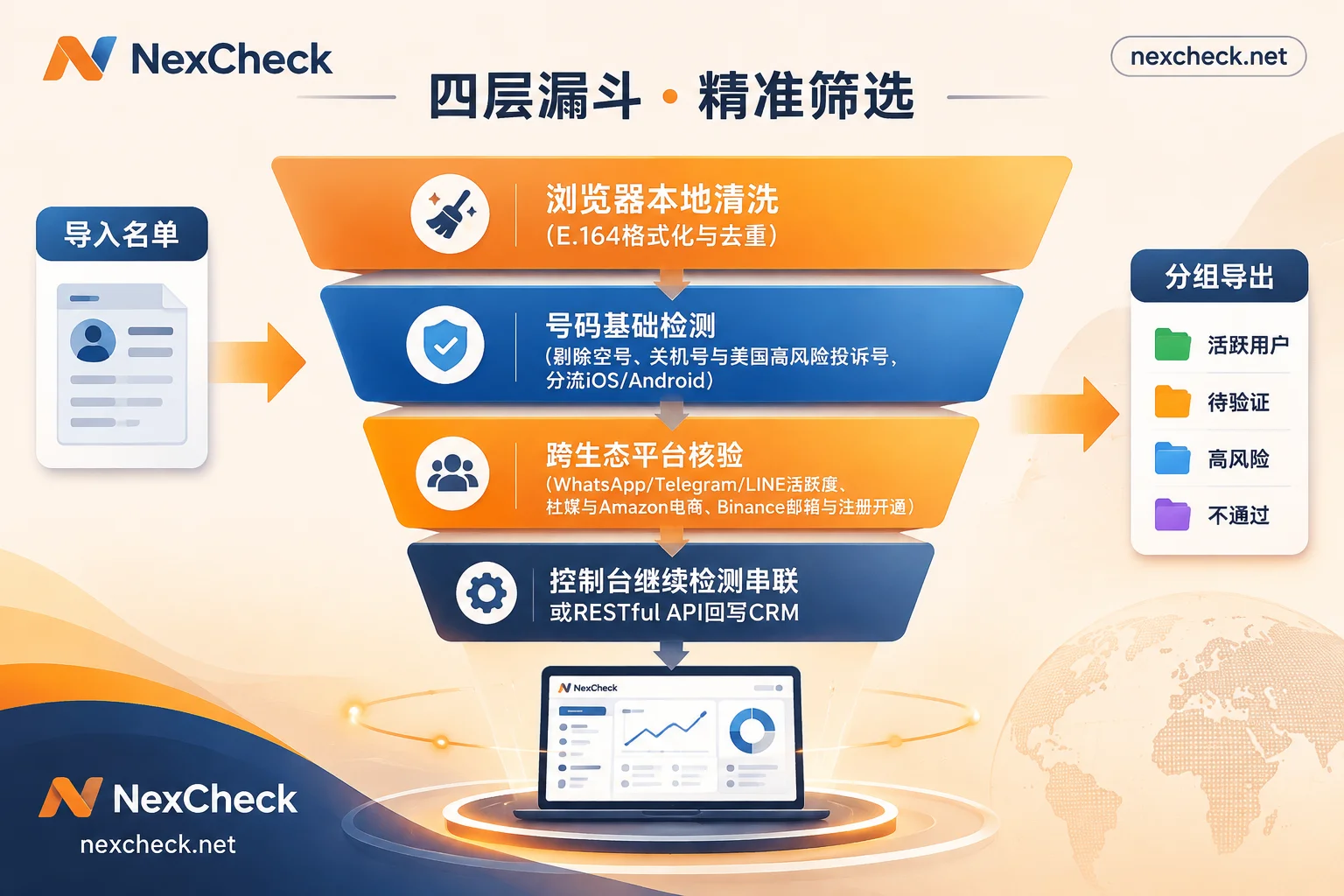
Step 4: Use the Console's "Continue Detection" to Chain Pipelines, or Integrate API for Real-Time Cleaning
In practice, you don't need to download the results of each screening and re-upload them. According to the console quick start guide:
- Chained screening: After uploading a CSV, TXT, or XLSX file (one target value per line in the first column, select the corresponding country or region and ensure the number of rows falls within the project's specified minimum and maximum) to complete the first round of activation detection, results are returned grouped by "valid" and "invalid". You can directly click "Continue Detection" to use the passed results as input for the next project (e.g., activity or gender/age detection) (a new task will be created and billed separately), achieving a smooth funnel-style filtering.
- API automated cleaning: If the R&D team wants to embed this cleaning mechanism directly into the CRM to prevent dirty data from entering the database, NexCheck provides a RESTful API supporting batch submission, real-time queries, and Webhook callbacks (for architecture ideas, refer to number screening API integration and CRM real-time interception solution). Since the public user manual does not display specific endpoint addresses, parameters, authentication, and callback format documentation, developers can register for a free account and then directly contact official customer service Telegram (@nextipkf) for technical integration support.
III. Setting Boundaries: Compliance and Expectation Management for Customer List Cleaning
To ensure long-term robust data governance, teams using NexCheck for list cleaning also need to clarify the following platform rules and data boundaries:
- Export and archive promptly; do not use the task center as cloud storage: NexCheck does not guarantee the retention period of detection results, and the console task center cannot be used as a long-term archive database. After a task is completed, promptly preview and download the result file in the console and sync it back to your own CRM.
- Objectively understand the timeliness of detection results: All screening results only reflect the platform status at the moment of query, do not determine the real identity, purchase intention, or commercial value of the number holder, and do not guarantee the absolute correctness of individual results; similarly, for profile fields that users have set as non-public (such as avatars and signatures under some privacy protections), the system cannot read them either.
- Strict data privacy and ownership isolation: On data security (this is also the bottom line we repeatedly emphasize in the screening platform selection and data leak prevention guide), customer-submitted lists are entirely the customer's own data. NexCheck processes them only within the scope of executing detection tasks, never sells them, and never uses them to build a number database for external sales; you can view, export, and delete them in the console at any time. Correspondingly, as the data controller, the customer must also ensure that the source and purpose of the submitted numbers and emails are legal (see Privacy Policy).
- Transparent billing with no tricks: The platform adopts a prepaid model, recharge first and then deduct per item (specific unit prices, channel coverage, and quantity ranges are subject to the console price list). Charges are deducted when creating a task, and if a task fails, a full refund is automatically issued.
Conclusion
A customer list is never real estate that "retains value forever once stored," but a current asset that depreciates every month. Whether you are preparing to launch cross-channel marketing during the upcoming Black Friday/Cyber Monday or plan to rebuild a clean underlying CRM database for the 2027 sales team and AI outbound system, now is the best time to start customer list cleaning.
Go to the NexCheck official website to register now, first use the free number cleaning tool to run local deduplication and formatting, then use multi-dimensional platform detection to spend every marketing dollar on customers who are truly alive and truly active. For large-scale cleaning or API integration needs, feel free to check the user manual for operational details or contact customer service Telegram @nextipkf.