 NexCheck-筛号平台
In overseas marketing, cross-border e-commerce repurchase, and Web3 community operations, many growth and data teams have fallen into the same trap: the customer list in hand has just undergone communication-level real-number screening, confirming that the numbers are not empty and are in normal active status, but once imported into the business system for targeted outreach, there are still large-scale "no such person" errors, high bounce rates, and even platform risk control triggers due to frequent messages to non-target users.
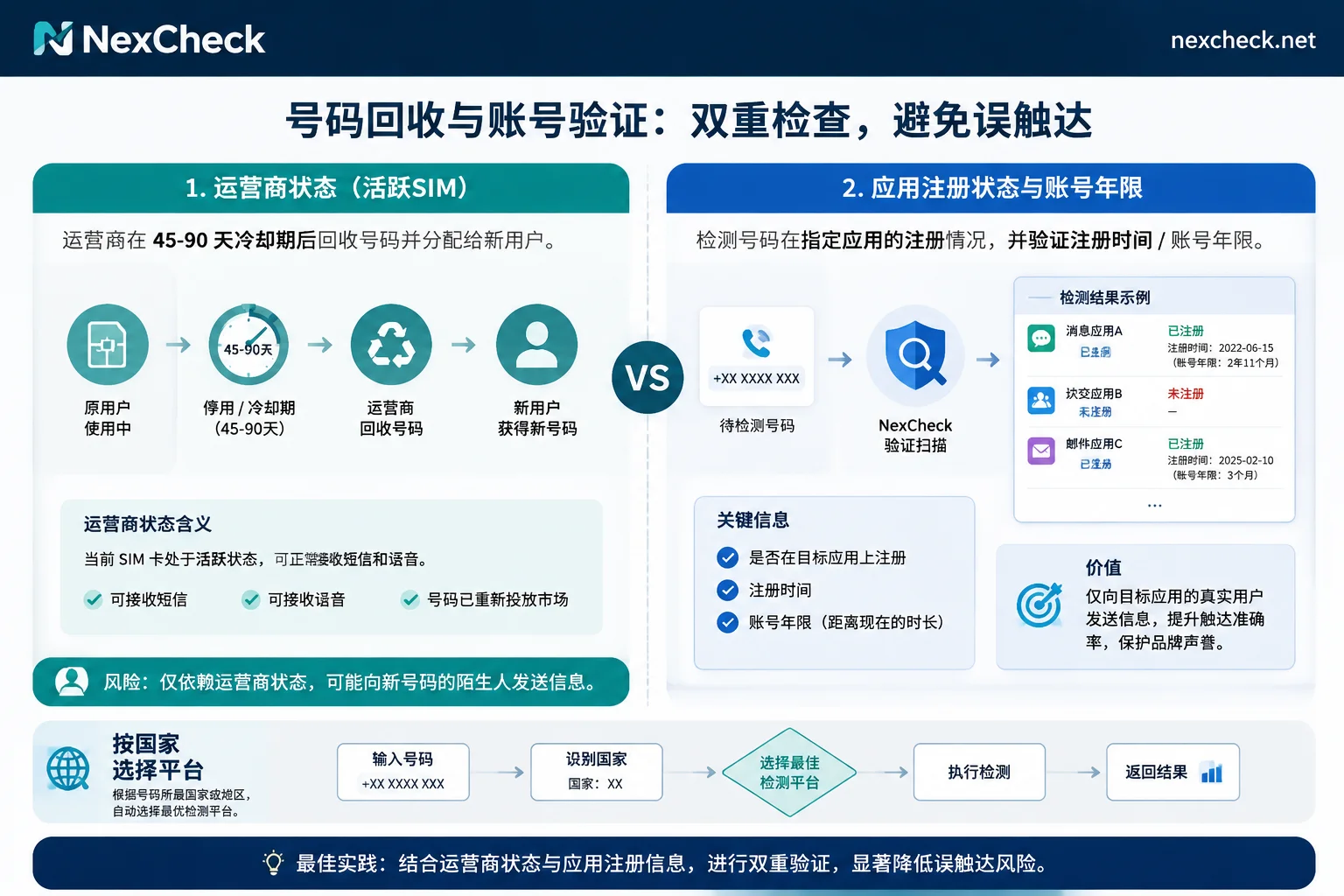
Why do numbers with "normal communication" become invalid leads on the business side? The core reason is that the team confused "carrier network status" with "application-layer phone number registration status check (account activation check)". Even more troublesome is that even if a number shows "registered" on a platform, due to the globally common carrier number recycling and reassignment (secondary number assignment) mechanism, the owner behind this account may have already changed.
Without registration status verification and account age screening for the target platform, marketing budgets will be largely consumed on "unregistered users" and "new owners who took over old numbers". This article starts from the trends of overseas carrier secondary number assignment and multi-platform differentiation, and breaks down a cross-platform phone number registration status check solution that balances cost and accuracy.
I. Why do "reachable real numbers" still fail in business outreach?
When an operations team receives a batch of exhibition leads, ad forms, or CRM dormant old customer lists, the numbers face two invisible thresholds in real business flows:
1. Carrier "secondary number assignment" and platform silent recycling mechanisms
Mobile phone numbers are not lifelong unique identifiers for users. Taking the North American market as an example, telecom carriers recycle and reassign about 35 million retired numbers (Recycled Phone Numbers) to new users each year, accounting for nearly 10% of all number resources, and some high-churn area codes even have an annual recycling rate of 20%. After the original owner cancels the number, it usually goes through a cooling-off period of 45 to 90 days before being re-listed for sale to new users.
At the application level, major platforms also have their own cleanup logic for recycled numbers. For example, the WhatsApp official help center clearly states: to avoid confusion caused by recycled numbers, the platform monitors account inactivity; when an account has not been used for 45 consecutive days and is then reactivated on a new mobile device, the system determines it as a recycled number and erases historical account data such as the old profile picture and status bound to that number.
This means that the "old customer numbers" accumulated in your CRM for more than half a year may not only be communication-active but also "activated" on social platforms today—but it is very likely a "newly registered account" just reactivated by a new owner. If you directly use the old customer's order information or reactivation scripts for outreach, it will at best cause customer confusion and complaints, and at worst trigger data compliance risks.
2. App registration is highly differentiated across regions and vertical tracks
There is no single "all-in-one national app" overseas. For a real and valid overseas mobile number, its application-layer registration status often shows strong regional and industry differentiation:
- Regional habit differences: Users in Southeast Asia and Latin America frequently use WhatsApp; users in Japan, Thailand, and Taiwan, China are highly dependent on LINE; the main local communication tool in Vietnam is Zalo; and in Eastern Europe and some Middle Eastern markets, the penetration of Viber and Botim cannot be ignored.
- Vertical business attributes: Teams running cross-border e-commerce independent sites are more concerned about whether the number has registered on Amazon, Temu, or Shopee; teams promoting finance and Web3 urgently need to know whether the target lead has activated trading platforms such as Binance or KuCoin, and such queries must be completed without disturbing users or triggering security alarms.
Therefore,单纯的海外空号检测或海外手机号有效性检测只能解决"whether the call can get through and whether the SMS can be received" at the communication layer; to truly determine the business direction of the lead, it is necessary to go deep into the specific application layer to perform phone number registration status checks.
II. Three Core Dimensions of Phone Number Registration Status Checks
In the NexCheck supported platforms overview, screening for numbers and emails is divided into five groups: instant messaging, social media, crypto and finance, e-commerce and logistics, and office/local life/device. Around the core requirement of "registration status", actual business needs to interpret it in three layers:
1. Basic activation status: Is the target platform registered at all?
This is the most direct "valid/invalid" triage. By checking whether the numbers in the list are activated on a platform-by-platform basis, the list is directly split into two:
- Instant messaging and social media: Screen whether the target number has activated WhatsApp, Telegram, LINE, Zalo, Viber, Botim, KakaoTalk, Band, Signal, as well as Facebook, Instagram, TikTok, Twitter/X, Snapchat, Moj or LinkedIn (LinkedIn activation screening currently only supports US and India numbers).
- E-commerce and local life: For cross-border sellers and B2B teams, support account activation screening on platforms such as Amazon, Temu, Shopee, Coupang, Flipkart, Bukalapak, Noon, DHL, Microsoft, Microsoft Teams, Airbnb, etc., to quickly determine whether the lead has high-frequency online shopping or business office attributes.
2. Registration time and account age: Is it an old account or a newly activated one?
To address the "carrier secondary number assignment" mentioned above and the "short-lived verification code accounts" batch-generated by grey industries, just looking at "whether activated" is not enough; you also need to see when it was registered:
- WhatsApp registration time check: In WhatsApp screening, in addition to activation checks split into fast channel and SVIP channel, it also supports querying the account's registration time and banned account status. If your CRM old customer record was entered two years ago, but the check finds that the WhatsApp registration time of this number is only in the last month or two, it means the number has most likely undergone carrier recycling and has been re-registered by a new owner, and should be immediately removed from the old customer reactivation queue.
- Viber account age check: In Viber screening, the platform specifically provides an account age check item. Note that "account age" here refers to how long the account has been registered (not the user's physical age), specifically to help operations teams identify and remove newly batch-registered accounts.
3. Silent non-intrusive verification and multi-dimensional identifiers (email / @username)
In crypto finance and some high-privacy social media scenarios, phone number registration status checks have two special requirements:
- Zero-disturbance silent checks: Many finance and Web3 teams worry that checking registration status will trigger the target platform to send SMS to users. Taking Binance screening as an example, NexCheck supports number activation (registration) screening, email checks, and transfer channel (whether the recipient can be found in Binance Pay by number), and explicitly adopts a silent verification mechanism—the query process does not log into the Binance account and never sends verification codes to the target number, avoiding alerting customers or causing security complaints. Similarly, KuCoin, CoinW, HTX, MEXC, Vantage, Paytm, MoniePoint also support activation screening.
- Email and username supplementary verification: When the lead database only has email or social media handles, email activation checks can be performed on Facebook, Binance, KuCoin, CoinW, HTX, Robinhood, Nasdaq; and in Telegram screening, in addition to checking activation and activation format by number, you can also directly upload
@用户名to perform username validity and username gender/age checks.
III. 4-Step Practical Process for Cross-Platform Phone Number Registration Status Checks
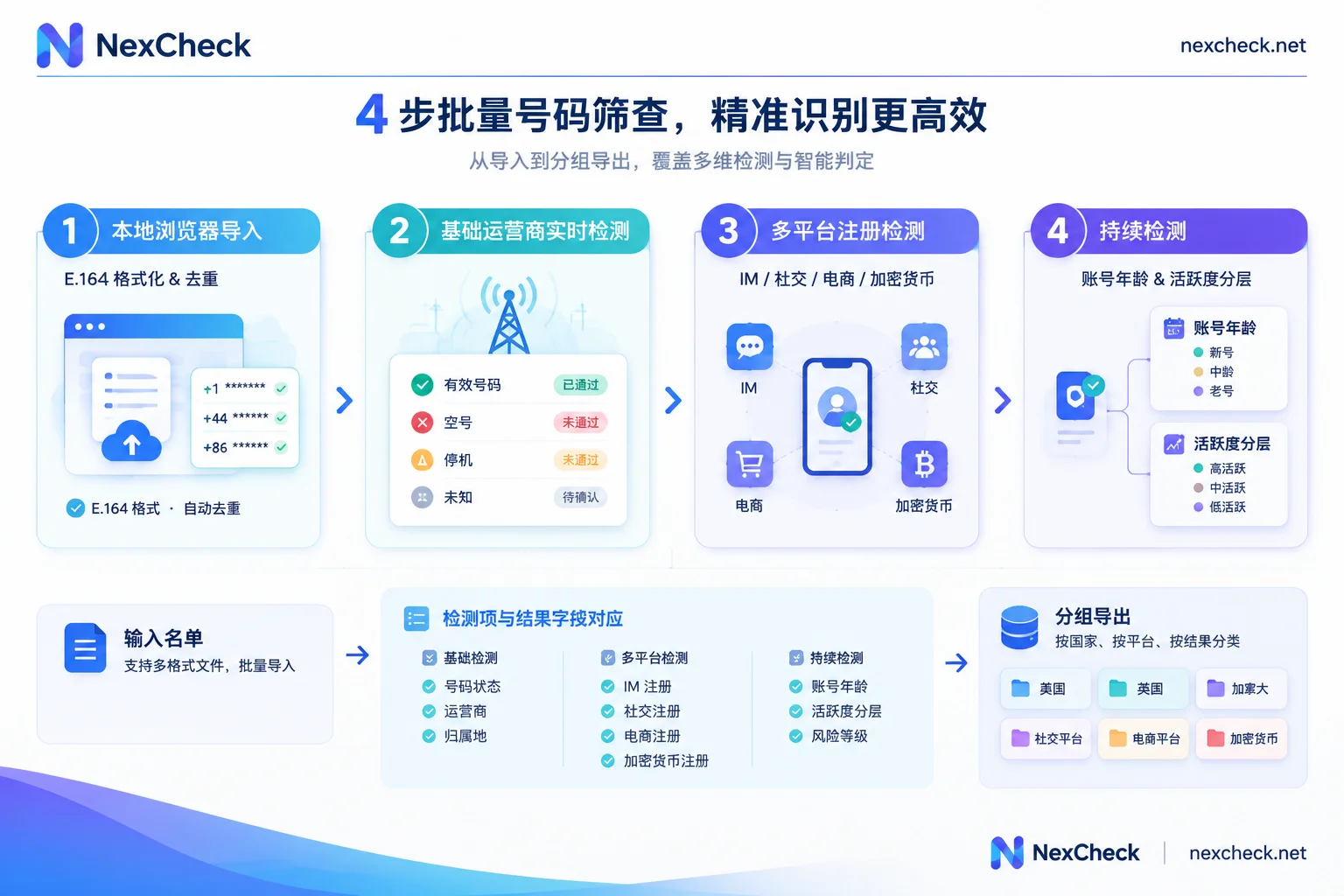
Faced with raw lists of tens of thousands or even hundreds of thousands of entries, running all platform check items without strategy will make data cleaning costs very high. Combined with the NexCheck toolchain, it is recommended to follow the order of "local free standardization first, then basic communication checks, and finally platform activation串联 by funnel":
Step 1: Free local browser cleaning of format and deduplication (avoid special number segment traps)
Since the NexCheck console does not automatically deduplicate after uploading a list, and duplicate values are still billed normally, before formally submitting a paid task, be sure to use the number cleaning tool for local preprocessing in the browser.
This tool is completely free, does not create paid detection tasks, can automatically identify separators, fill in country codes according to the selected default country, convert to standard E.164 format and complete deduplication, and report the number of valid, invalid, and duplicate entries.
- Practical pitfall avoidance: The default country must not be chosen incorrectly, otherwise you will get numbers that are "correctly formatted but have the wrong attribution". In addition, for specific countries, pay attention to local number restructuring rules—for example, when doing Zalo screening, Vietnamese mobile numbers must be in the 10-digit format after the 2018 restructuring; the old 11-digit numbers cannot be queried (for detailed rules, refer to our article "How to Do Zalo Screening: Vietnamese 10-Digit Number Cleaning, Dual-Channel Selection, and Layered Detection Order"). If you are not clear about the number segment characteristics of the target market, you can first check the NexCheck regional solutions to learn about local number formats, major carriers, and recommended screening order.
Step 2: Pre-basic communication layer checks (handle platforms without dedicated items and dead numbers)
After completing format unification and deduplication, if the list sources are mixed (such as historical repositories or third-party purchased leads), it is recommended to first run "empty number and on/off status" or "carrier identification" in the basic number detection matrix.
This step has two key effects:
- Directly remove communication dead numbers that have been cancelled or suspended due to arrears, saving subsequent higher unit-price multi-platform application detection fees.
- Carry the needs of platforms without dedicated detection items: For applications such as Cash App, OKX, Coinbase, Discord that currently only have number sources and no platform-specific activation detection items, the underlying reachability can only be ensured by performing basic number checks (such as empty number and on/off status, US high-risk and complaint numbers, iOS blue mark, Apple/Android device triage, RCS system type).
Step 3: Select corresponding platforms and channels for activation screening according to the business funnel
With confirmed active real numbers, go to the console to upload CSV, TXT, or XLSX files (each line contains one target value in the first column; for number items, select the corresponding country or region; the number of lines must fall within the minimum and maximum quantities specified for the selected item). When specifically selecting platform activation items, pay attention to platform rules and channel differences:
- Split detection by region: For example, LINE screening registration screening is submitted separately by region (Taiwan China, Japan, Thailand, South Korea, Hong Kong China, US); and if you want to check LINE activity, you must first screen activation (see "How to Do LINE Batch Screening").
- Choose channels by speed and field requirements: The same detection item is often divided into several different channels, with different speeds, coverage, and returned result formats. For example, WhatsApp activation detection is divided into fast channel and SVIP channel; Zalo activation and gender/age are also divided into speed channel and stable channel (the stable channel also returns user nicknames). Teams can flexibly check according to whether the current task pursues "speed of results" or "richer additional attributes".
Step 4: Use "Continue Detection" to seamlessly串联 registration time, activity, and profiling
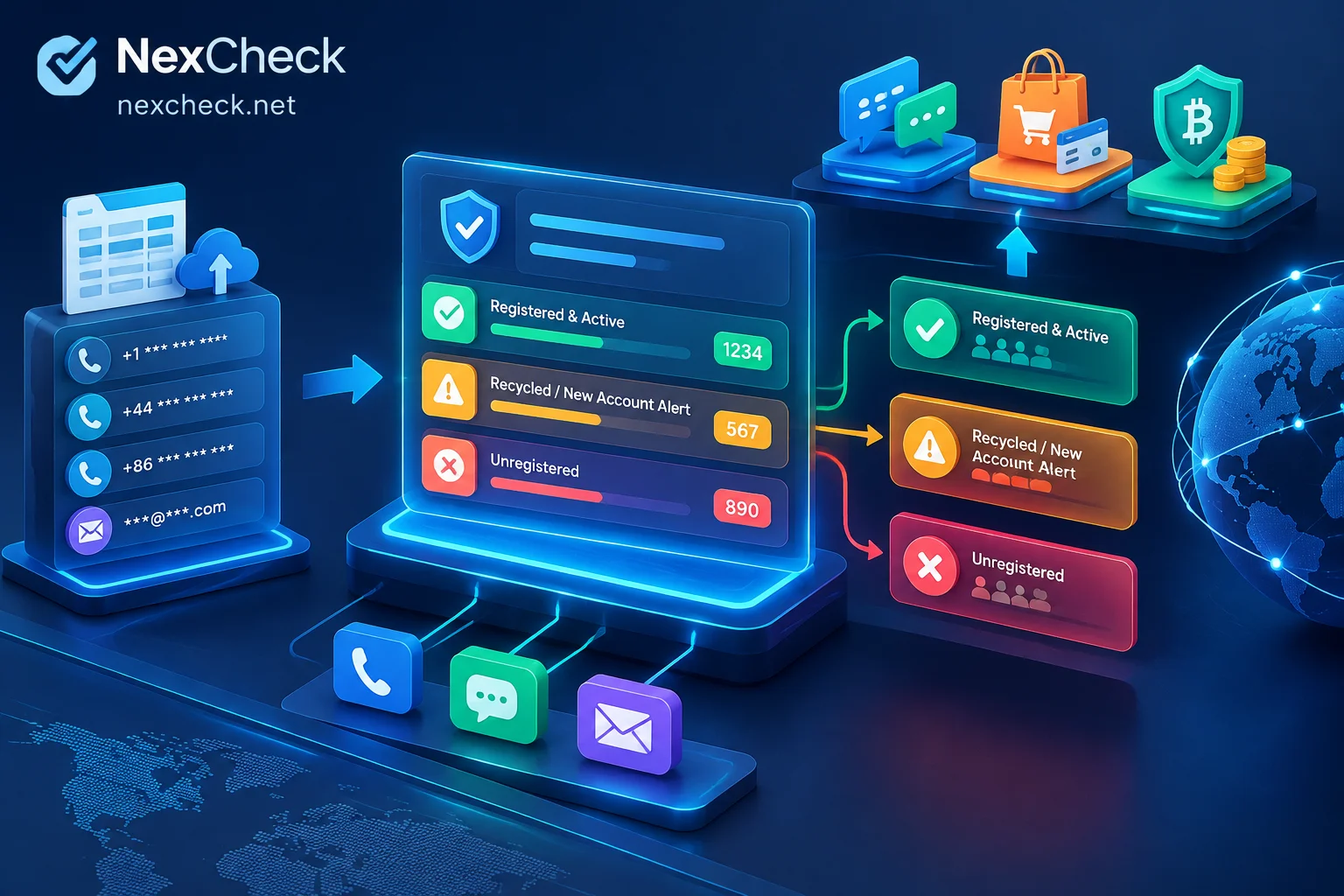
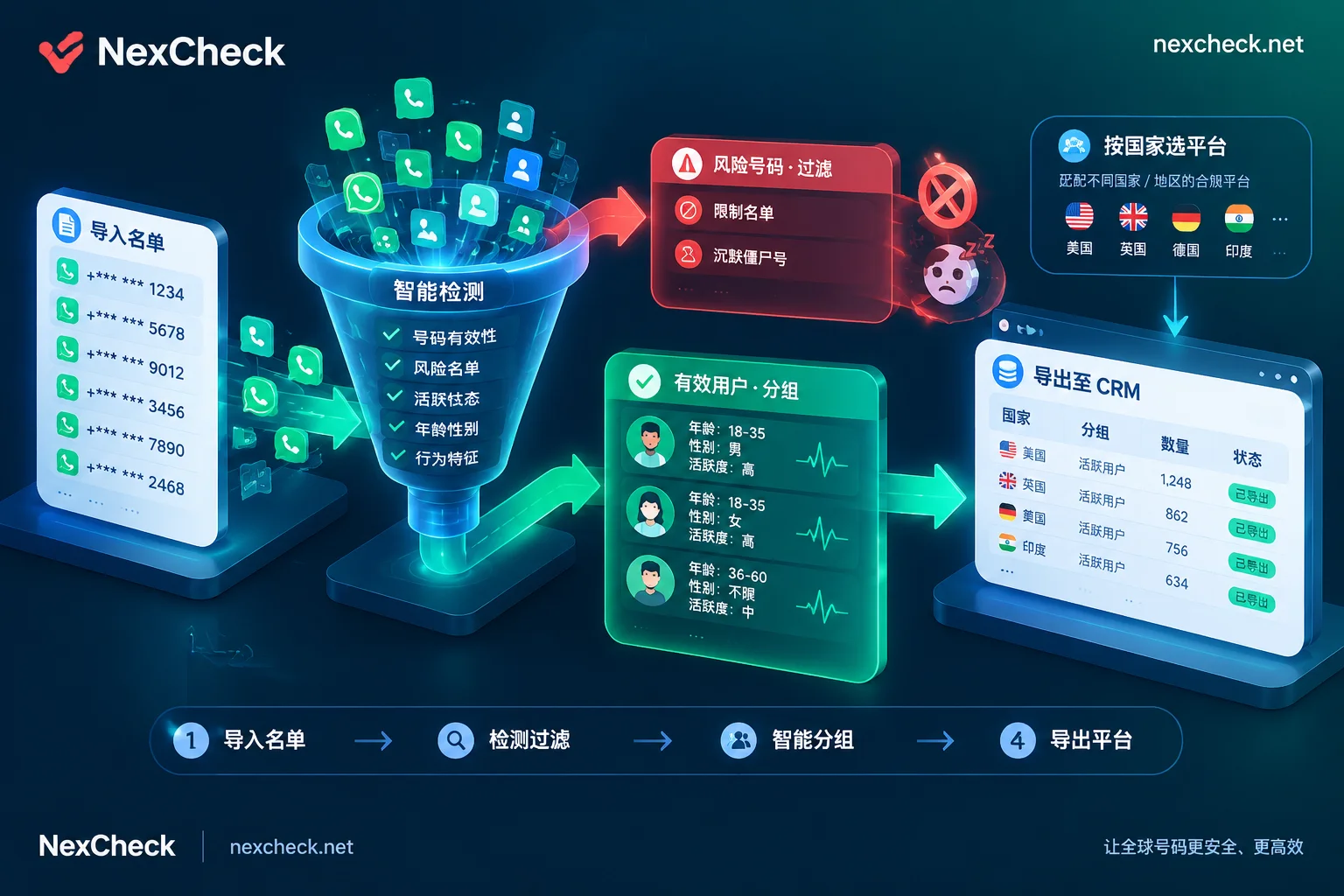
After the basic "phone number registration status check" is completed, the system will return results grouped by valid (activated) and invalid (not activated), supporting online preview and download.
At this point, there is no need to download the valid list locally and re-upload it—just click the "Continue Detection" function in the console to directly use the "activated numbers" (or all processed data) that passed the previous round as input for the next project (a new task will be created and billed separately):
- 串联 anti-recycling and risk control items: For numbers already activated on WhatsApp, click "Continue Detection" to add "registration time" and "banned account/zombie account" screening to identify new owners of secondary numbers and abnormal accounts (see "How to Do WhatsApp Screening").
- 串联 activity and profile attributes: For numbers confirmed activated and not newly recycled, continue to add activity screening (such as Telegram's 3/7/15-day activity tiers, WhatsApp ecosystem four-dimensional activity, refer to "How to Do Phone Number Activity Detection") or public profile reading (such as gender/age, Facebook UID homepage gender/avatar, etc.), to achieve refined segmentation from "registered" to "high-value active customers".
IV. Objectively Understand Boundaries: 4 Caveats for Using Phone Number Registration Status Checks
To ensure that screening results maximize value in CRM and marketing automation systems, technical and operations teams also need to clarify the following objective boundaries when implementing:
- Detection results only reflect the status at the time of query: Whether registration status, ban status, or activity range, the returned data only represents the platform snapshot at the moment the query is executed. It cannot determine the true identity, purchase intention, or commercial value of the number holder, and the platform does not guarantee the absolute correctness of individual results.
- Respect user privacy setting restrictions: In some detection items that return additional attributes (such as WhatsApp's avatar, status, last seen time, Facebook homepage gender/avatar, and Telegram's gender/age inferred from public name and avatar), the availability of results strictly depends on the target user's own privacy settings. Fields that users set as private cannot be read.
- Export results promptly and write back; do not treat the console as a long-term archive: NexCheck does not promise retention days for task results, and the task center cannot be used as a long-term data archive network drive for enterprises. After the task is completed, please download the results promptly and write them back to your own business system.
- Supports RESTful API automated access: If your enterprise needs to embed phone number registration status checks directly into registration forms, lead entry pipelines, or CRM systems, NexCheck provides a RESTful API that supports batch submission, real-time queries, and Webhook asynchronous pushback. Since the public user manual does not include interface addresses, parameters, and authentication documents, teams with development integration needs can contact official customer service directly after free registration for integration support.
Start Your Cross-Platform Phone Number Registration Status Check Now
Say goodbye to blind mass messaging and budget waste caused by recycled numbers. NexCheck adopts a flexible prepaid pay-per-item deduction model (deducted when the task is created, automatically fully refunded if the task fails). The list you submit is only processed within the scope of executing the detection task and will never be sold externally or used to build a public number database.
- Free format cleaning and deduplication: Open the NexCheck online number cleaning tool to quickly complete E.164 standardization locally in your browser.
- View all platform detection items and prices: Visit the supported platforms overview or read the quick start guide.
- Create batch tasks or apply for API: Go to the NexCheck console to register an account now. If you need API documentation or a customized number screening solution, feel free to contact Telegram official customer service @nextipkf.


Comments(0)