 NexCheck-筛号平台
In the customer acquisition and user growth funnel for global expansion, enterprises' SMS and outreach bills are facing dual pressure. On one hand, international A2P (Application-to-Person) SMS channel surcharges and compliance costs remain high; on the other hand, SMS fraud known as AIT (Artificially Inflated Traffic) is intensifying. Industry security reports indicate that in 2026, global losses due to SMS fraud are expected to approach $71 billion, with the fastest growth in AIT attacks that use automated scripts to maliciously trigger OTP verification codes and specifically consume high-cost international routes.
Many growth and risk control teams find when reviewing bills: delivery rates appear stable, but actual registration conversion rates or marketing response rates plummet. The reason is that large budgets are consumed on batch-generated virtual number ranges, carrier dead numbers, or "white numbers" with no real business footprint.
In our previous discussion on carrier recycled numbers and registration time verification, we analyzed the risks of mismatched second-hand numbers. This article will break down how to use systematic number registration status checks from the perspectives of pre-emptive risk control and cost control and vertical industry value tiering, to spend every outreach budget where it matters most.
Why "Send First, Check Receipts Later" Is Draining Customer Acquisition Budgets?
In the past, many teams habitually pushed form-collected or externally purchased mobile numbers directly into SMS gateways or outbound call systems, attempting to verify number validity through delivery receipts. In the 2026 communications environment, this rough approach has three obvious cost black holes:
- Multi-layer billing stacking per verification: Take North America or some emerging markets as examples. When an enterprise sends a verification or notification SMS, besides the basic channel fee, carrier fees and even failed status processing fees are often added. Once a dead number or rejection triggers automatic system resend, the cost per outreach multiplies.
- Proliferation of data center VoIP and SMS receiving numbers: Black and gray industry scripts heavily use cheap data center virtual numbers (VoIP) or one-time SMS receiving numbers to submit forms. Such numbers can normally receive SMS and generate bills on communication routes, but there is no real user behind them.
- "Reachable" does not equal "business value": A real active mobile number may belong to a high-net-worth crypto trader, a frequent online shopper, or a low-potential user who rarely uses smart apps. Without understanding the number's activation status on various vertical platforms, indiscriminate full-volume campaigns will inevitably lead to low ROI.
To plug these loopholes, the key is to front-load number registration status checks before message delivery and agent follow-up: first check authenticity at the communication layer, then check footprints in the application ecosystem.
First Line of Defense: Local Format Pre-cleaning and Communication Underlying Status Verification
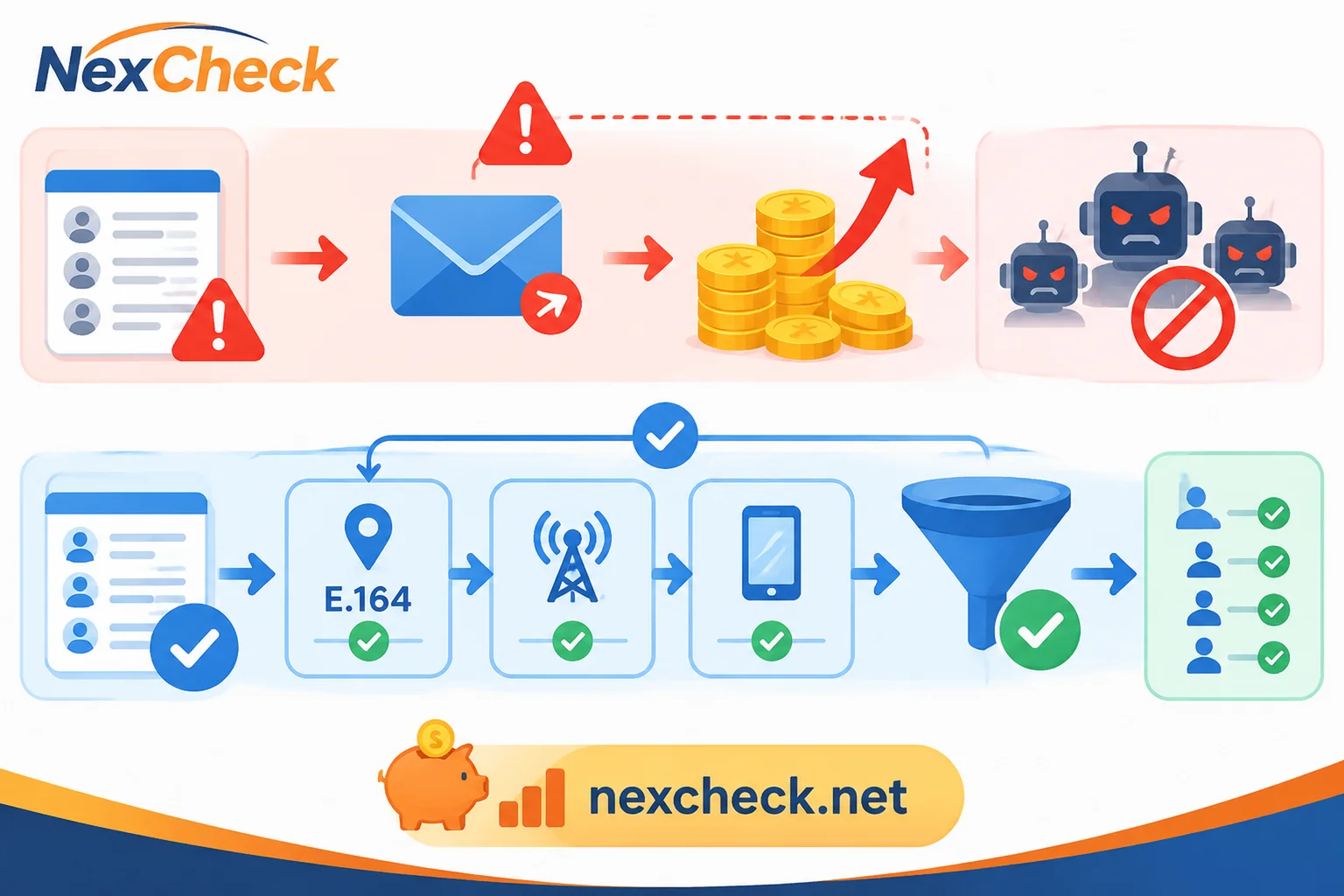
Before querying any specific application platform, you should first eliminate numbers with format errors, unroutable numbers, or high-risk numbers at the communication foundation.
1. Zero-cost Local Format Normalization and Deduplication
Externally imported lead lists often contain spaces, hyphens, parentheses, or missing country codes. Since batch detection tasks are billed by the actual number of uploaded rows and do not automatically merge duplicates, it is recommended to first use the browser-based free number cleaning tool before formally creating a task.
This tool runs entirely in the local browser, automatically strips special separators, fills in international area codes based on the selected default country, and uniformly converts to standard E.164 format. It also removes duplicate rows and generates valid/invalid statistics reports. Note: be sure the selected default country matches the actual origin of the numbers, otherwise you will produce invalid data with compliant format but mismatched country codes.
2. Basic Communication and High-risk Attribute Interception
After format normalization, you can quickly complete the underlying health check through the NexCheck Number Basic Detection Matrix (for a more complete understanding of overseas invalid number detection and device routing logic, refer to previous guides):
- Invalid number and power-on/off detection: Directly remove unallocated, deactivated, or long-term powered-off invalid numbers to avoid invalid routing charges.
- Number type and carrier identification: Distinguish real mobile network numbers (Mobile), landline and virtual network numbers (VoIP), identify T-card formats and specific carrier attribution, and intercept batch SMS receiving scripts at the source.
- North America-specific risk control: For the US market, you can specifically perform "US carrier" and "US high-risk and complaint number" screening to pre-filter complaint blacklists that easily trigger compliance fines.
- Terminal device routing: Through Apple/Android device identification, iOS blue label detection (determines whether it is an Apple-side supported status, excluding device model, system version, and Apple account information), and RCS system type detection, provide a basis for subsequently choosing low-cost native rich media channels or SMS channels.
In addition, for business scenarios such as Cash App, OKX, Coinbase, Discord, etc., which currently have no platform-specific activation detection items, this layer of basic detection can also ensure the communication availability of the number source.
Second Layer of Insight: Cross-Vertical Ecosystem Number Registration Status Checks
Once a number passes the communication underlying verification, the next step is to use cross-platform number registration status checks to determine whether the number is bound to a real active internet user, and to segment the audience based on their ecosystem. In the NexCheck Supported Platforms Overview, detection capabilities cover five core business quadrants:
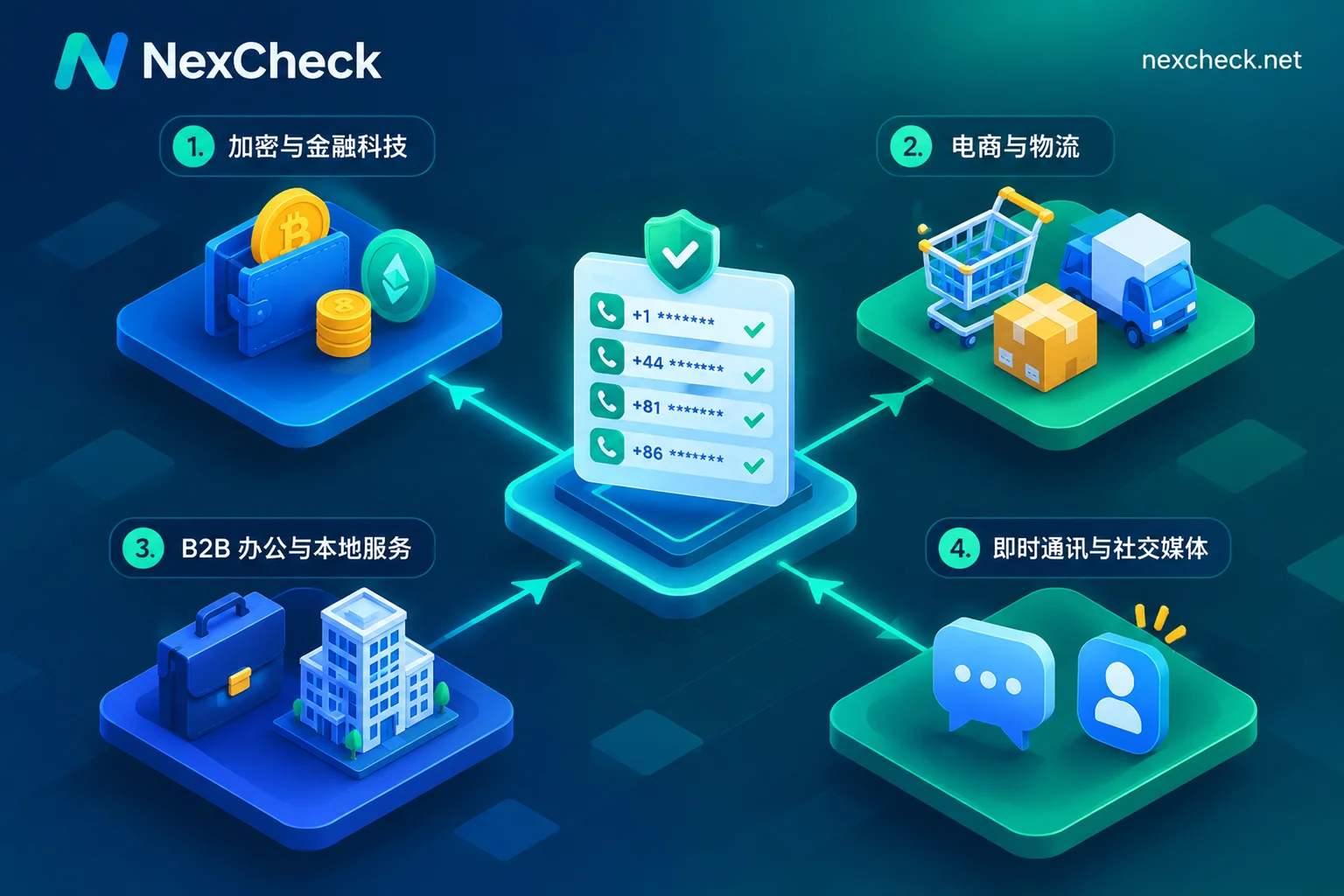
1. Crypto and Financial Platforms: Anchor High-Net-Worth Traders
Fintech, Web3, and cross-border payment teams have extremely high requirements for customer acquisition precision. Rather than searching in a broad traffic pool, it is better to directly verify the registration status of the target list on mainstream financial and trading platforms:
- Multi-platform activation verification: Supports account activation (registration) screening for Binance, KuCoin, CoinW, HTX, MEXC, Vantage, as well as local payment giants Paytm and MoniePoint.
- Dual-dimension and transfer channel verification: Among them, Binance, KuCoin, CoinW, and HTX also support email-dimension activation detection; Robinhood and Nasdaq provide exclusive email detection. For Binance, the platform also offers "transfer channel" detection (determined based on whether the number can match a recipient in Binance Pay).
- Non-intrusive compliance verification: Taking Binance detection as an example, the entire query process does not log into a Binance account, nor does it send any verification code SMS to the target mobile number, completing high-net-worth attribute confirmation without any disturbance to the customer.
2. Cross-border E-commerce and Logistics: Lock in Real Online Shoppers
Before launching major promotions or new product campaigns, independent site sellers and brand global expansion teams can use e-commerce platform activation status to verify the consumer quality of the list:
- Supports account activation screening for Amazon, Temu, Shopee, Coupang, Flipkart, Bukalapak, Noon, and international logistics platform DHL.
- If a number is shown as registered on local mainstream e-commerce platforms (such as Coupang in South Korea, Noon in the Middle East, Shopee in Southeast Asia), it indicates a real active online fulfillment number, which can greatly reduce marketing bounce rates and exclude blank new numbers used only for arbitrage.
3. B2B Office and Local Life: Verify Workplace and Business Leads
For B2B SaaS sales, overseas recruitment, or real estate vertical operations, the workplace authenticity of the list is crucial (for long-term maintenance of B2B leads, see Customer List Cleaning and Data Decay Response Guide):
- Office and workplace verification: Supports account activation screening for Microsoft and Microsoft Teams; LinkedIn activation screening specifically supports number verification for the two core markets of the US and India.
- Regional verticals and local life: Covers account activation detection for global homestay platform Airbnb, Indian real estate and financial platforms Magicbricks and The Economic Times, as well as Russian-speaking real estate and recruitment giants Cian and HeadHunter.
4. Instant Messaging and Social Media: Match the Best Outreach Channel
After determining the commercial value of the lead, the final step is to find the social or IM channel through which you can reach them:
- In-depth screening of major IM: Covers WhatsApp (provides fast/SVIP activation channels, registration time, gender and age, four-dimensional activity, banned number and zombie ad number identification), Telegram (supports activation detection by number or direct upload of
@用户名, 3/7/15-day activity tiers, and gender/age inferred from public name and avatar), LINE (screens registration by region: Taiwan, Japan, Thailand, South Korea, Hong Kong, US; returns UID, nickname, avatar; activity detection requires prior activation screening), and Zalo (requires 10-digit new format numbers after Vietnam's 2018 reform; distinguishes fast and stable channels). - Regional specialty IM: Supports Viber (includes activation, activity intervals, and "account age" detection to eliminate newly registered numbers), Botim commonly used in the Middle East, and activation screening for KakaoTalk, Band, and Signal.
- Mainstream social media matrix: Supports number activation detection for Facebook (number activation, email activation, UID, and public profile gender/avatar), Instagram, TikTok, Twitter/X, Snapchat, and Moj.
If you are unsure about the mainstream ecosystem and number rules of the target country, you can directly consult the NexCheck Regional Solutions Guide (for example, the Vietnam number screening solution for the Vietnamese market), and combine screening according to local carrier realities and the order of major platforms.
Practical Implementation: How to Efficiently Execute in Console and CRM?
To transform the above multi-dimensional number registration status checks into daily standard operating procedures, teams can choose manual batch chaining or API automation integration based on business scale.
1. Console Batch Upload and "Continue Detection" Funnel Chaining
For marketing and operations teams, refer to the Quick Start Guide to launch tasks within minutes:
- File preparation: Supports uploading CSV, TXT, or XLSX files. Place the numbers to be tested (E.164 format recommended) or emails/
@用户名in the first column, and select the corresponding country or region. Please note the file size, column count, and minimum/maximum row limits specified on the page for the project. - Seamless "Continue Detection" flow: After the first round of screening (e.g., "invalid number detection" or "Amazon activation detection") is completed, results are automatically returned grouped by valid and invalid. You do not need to manually export and re-upload; simply click the "Continue Detection" function in the console to directly use the valid results from the previous round as input and seamlessly launch the next detection (e.g., "WhatsApp activity detection", creating a separate task billed per item).
- Billing and data archiving reminders: The platform uses a prepaid mechanism. Fees are deducted per item when creating a task; if a task fails, the system automatically refunds in full. Since the platform does not guarantee long-term retention days for detection results, do not use the task center as a permanent archive. After task completion, please promptly preview and download results to local storage.
2. RESTful API Real-time Interception and Asynchronous Write-back
For development teams with in-house systems or those wishing to implement automated interception at registration forms or CRM entry points, NexCheck provides a RESTful API that supports real-time single queries, large batch submissions, and asynchronous Webhook result push-back (for detailed system integration ideas, refer to the Number Screening API Integration Guide).
Note that the public user manual does not include specific endpoint addresses, parameters, and authentication documentation. To obtain the complete API technical integration documentation, you can first register for a free NexCheck account, then directly contact official customer service Telegram (@nextipkf) for integration details.
3. Clarify Result Boundaries and Data Privacy Compliance
When using any number detection tool, it is equally important to maintain an objective understanding of data boundaries:
- Timeliness and objective limitations: Detection results only reflect the target platform's status at the moment of query; due to each platform's user privacy settings, avatars, signatures, or gender fields set as private cannot be read; results only answer account status and do not determine the number holder's real identity, purchase intention, or commercial value.
- Data ownership and security: Lists uploaded by customers belong entirely to the customers. According to the NexCheck Privacy Policy, the platform processes data only within the scope of executing detection tasks, never sells customer lists, and does not use customer data to build number databases for external sale. Customers, as data controllers, can independently view, export, and delete data in the console, and must also ensure that the source and purpose of submitted numbers are legal and compliant.
Conclusion
In 2026, with high customer acquisition costs and frequent traffic fraud, making number registration status checks a standard action before user onboarding and outbound outreach can not only help enterprises block unnecessary international SMS bill losses, but also, through cross-verification across finance, e-commerce, office, and social ecosystems, match every high-value lead to the most efficient conversion channel.
If you want to immediately optimize your customer list, welcome to register for the NexCheck console to view real-time price lists for each platform and create your first screening task, or refer to the NexCheck Official User Manual for more practical details.