 NexCheck-筛号平台
Many overseas operations and marketing teams have recently encountered a strange phenomenon when reviewing private domain and messaging reach data: their customer lists have been checked for 'account registration' and even had invalid numbers removed, yet when sending marketing notifications, the delivery rate plummets, the backend frequently reports errors, and engagement hits rock bottom.
Why can't messages be delivered to 'registered' numbers, or why do they go unanswered?
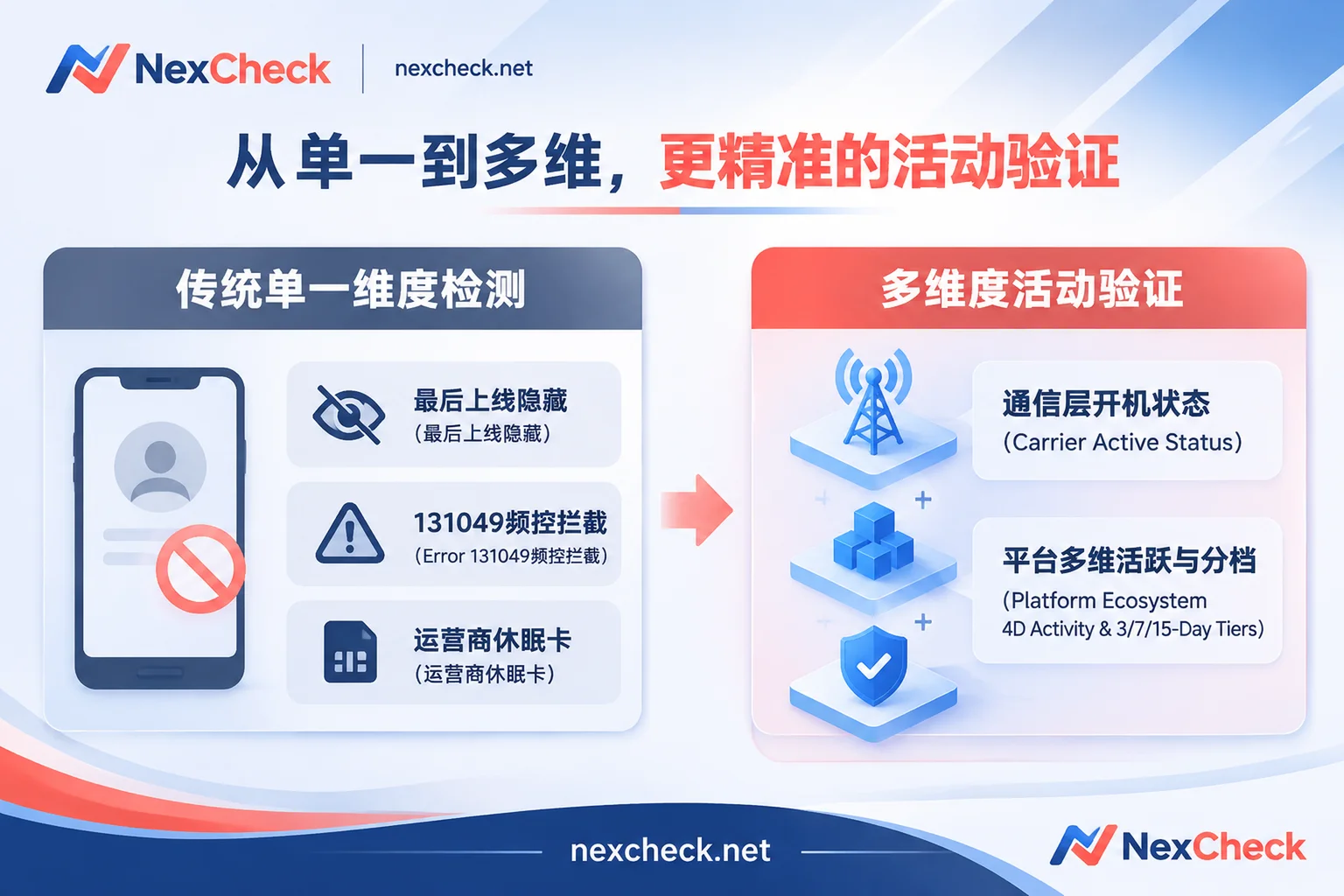
The reason is that two profound changes are occurring in the global instant messaging ecosystem and telecom regulations: platform-side per-user inbox protection mechanisms are tightening comprehensively, and user-side privacy hiding habits are becoming the norm. In this context, the traditional approach of 'only checking registration and last seen timestamp' has become ineffective. Number activity detection must upgrade from reading a single field to multi-dimensional ecosystem signal verification.
1. Why 'Registered' Does Not Equal 'Reachable': Three Latest Industry Pain Points
Before formulating a list cleaning strategy, we need to understand the three core issues causing reach failures:
1. Per-User Dynamic Frequency Capping and Shared Messaging Quotas (Error Code 131049)
According to Meta's official per-user marketing template message limits, the platform dynamically restricts the number of marketing messages a user can receive based on their recent marketing message read rate and inbox congestion. Industry monitoring data shows that when a user receives approximately 2 marketing messages from all brands within 24 hours without interacting, any subsequent marketing messages from any brand to that number will be directly blocked by the system, returning 131049 (inbox saturated) or indicating abnormal system activity.
More troublesome is that since WhatsApp introduced the Business Portfolio quota sharing mechanism, all numbers under the same business entity share a single maximum messaging quota pool, and the system dynamically evaluates account quality rating every 6 hours. If you waste your precious daily messaging quota on dormant or zombie accounts that never open the app or read messages, not only will you trigger numerous blocking errors, but you will also directly drag down the rating and expansion speed of the entire business number pool.
2. The Blind Spot in Evaluation Caused by the Wave of Hiding 'Last Seen'
In the past, many teams relied on scraping users' 'Last Seen' to judge number activity. But now, whether on WhatsApp or Telegram, users can set their last seen and online status to 'nobody' or 'only some contacts'.
Since fields that users set as private cannot be read in compliance checks, if relying solely on a single 'Last Seen' indicator, many high-value real active customers who have enabled privacy protection will be misjudged as 'no data/inactive' and wrongly discarded; conversely, some dead accounts that still have a fixed signature but have long been abandoned may sneak into the send queue.
3. Operator Dormancy and Account 'False Activity' Mismatch
The lifecycle of numbers at the communication layer is also shortening. For example, the Kenya Communications Authority (CA)'s 'Guidelines for the Suspension and Recovery of Dormant Telecommunications Number Resources (CA.G.520:2026)', effective September 2026, stipulates that numbers with no revenue-generating activities such as calls, SMS, data, or top-ups for 90 consecutive days enter a suspension notification period, and if not activated within 6 months, they will be forcibly unbound and recycled for reassignment; in markets like the UK and US, different operators have recycling periods ranging from days to months for low-use or deactivated numbers.
Often, a mobile number has been shut down or suspended due to unpaid bills at the operator level, but because it has not yet been rebound to a social account by a new owner, its historical registration status on some social platforms still exists. Such numbers—'dead at the communication layer, falsely alive at the application layer'—are invisible black holes that drag down reach ROI.
2. Breakthrough Approach: How to Bypass Privacy Blind Spots and Do True 'Number Activity Detection'?
Facing privacy shielding and frequency capping red lines, how can number activity detection avoid mistakenly harming quality customers? The core logic is to cross-verify 'communication foundation status' with 'platform-specific multi-dimensional activity signals'.
In the NexCheck supported platforms overview, the underlying mechanisms of different platforms determine completely different ways to interpret activity. Here are activity screening strategies for mainstream overseas channels:
1. Communication Foundation First: Remove Invalid and Dormant Numbers
Before proceeding to expensive deep platform profiling, it is advisable to first perform basic number detection.
By verifying invalid and on/off status, number type, and carrier identification, you can directly block invalid numbers that have been deregistered at the telecom network level and dormant cards that have been off for a long time. If your business involves the North American market, you can also simultaneously screen for US high-risk and complaint numbers to avoid triggering channel risk control and compliance fines from the source.
2. WhatsApp: Replace Single Last Seen with 'Four-Dimensional Ecosystem Activity'
Addressing the pain point that WhatsApp users widely hide last seen, profile photos, and signatures (these fields are restricted by user privacy settings), WhatsApp filtering provides a more comprehensive solution:
- Four-dimensional ecosystem activity and sub-channel activity: Not limited to a single public timestamp, but comprehensively evaluates the account's activity performance within the ecosystem from multiple dimensions.
- Real-time online: Captures numbers that are online at the moment of query, suitable for time-sensitive flash campaigns or call follow-ups.
- Negative screening (zombie accounts, advertising accounts, and banned accounts): While positively finding active users, reversely eliminate accounts banned by the platform, zombie accounts with no interaction value, and advertising accounts used by competitors. Combined with registration time detection (identifying abnormal short-lived accounts recently registered), it ensures that only real active personal terminals enter the send queue.
3. Telegram: 3/7/15-Day Activity Tiers and Dual-Track Verification via @username
Telegram users are more privacy-conscious, and many Web3, finance, and community leads are @用户名 rather than phone numbers. In Telegram filtering (see also Telegram dual-track verification solution):
- 3/7/15-day activity tiers: For phone number lists, clearly categorize activity within 3 days, 7 days, and 15 days, making it easy for operations teams to prioritize reaching highly active users within 3 days based on budget and frequency capping urgency.
- Direct @username detection: If no phone number is available, you can directly upload
@用户名for username detection and username gender/age detection (note: Telegram profile pages do not have gender or age fields; the usability of such results depends on the user's public name and profile photo).
4. LINE, Zalo, and Viber: Strictly Follow 'Registration First, Then Activity' and Local Special Rules
For key platforms in Asia-Pacific and Eastern Europe, activity screening must follow their respective platform prerequisites:
- LINE filtering: Registration screening is separated by region such as Taiwan, Japan, Thailand, South Korea, Hong Kong, and the US, and activity detection must first screen for registration. First confirm that the number is registered on LINE in the corresponding region, then screen for activity or extract UID, nickname, profile photo, and age/gender composite items, which can greatly save ineffective detection costs.
- Zalo filtering: Supports detection of account registration, activity intervals, and gender/age (available in fast and stable channels; the stable channel also includes nickname). Note that Vietnamese numbers must be in the 10-digit format after the 2018 reform; old 11-digit numbers will not yield results.
- Viber filtering: In addition to supporting registration and activity interval detection, it also provides account age detection. Here, 'account age' refers to how long the account has been registered, specifically used to eliminate newly batch-registered numbers and fraudulent accounts, not the user's biological age.
3. Practical Workflow: Four Steps to Complete Cost-Effective Activity Segmentation and Cleaning
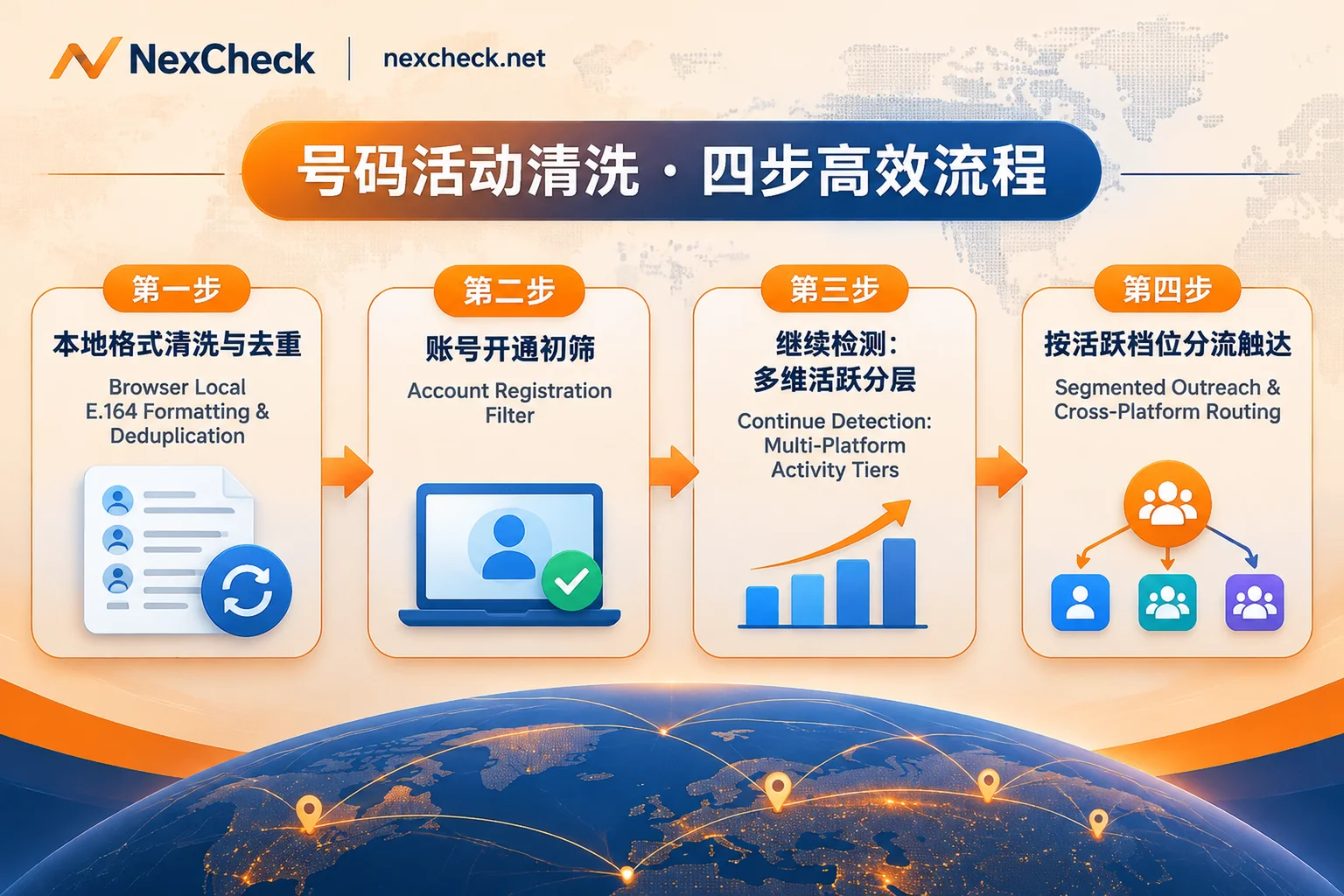
To spend every bit of filtering budget wisely, it is recommended that operations and data teams execute tasks on NexCheck using the following four-step funnel (for complete operation details, refer to the Quick Start Guide):
Step 1: Free Local Browser Formatting and Deduplication
Before uploading the list to the console to create a paid task, be sure to open the number cleaning tool.
This tool runs directly in your browser locally and does not create a paid detection task. It can automatically identify separators, complete country codes based on the selected default country, uniformly convert to standard E.164 format, and perform deduplication, while reporting the number of valid, invalid, and duplicate entries.
Pitfall Alert: Bulk tasks uploaded to the console are not automatically deduplicated; duplicate numbers will still be charged. Also, the default country in the cleaning tool must not be selected incorrectly, otherwise you will get numbers with correct format but wrong attribution. If you are unsure about the number segment characteristics of the target market, you can first consult the regional solutions.
Step 2: Upload File and Perform 'Registration Detection' Initial Screening
Go to the console and upload the organized CSV, TXT, or XLSX file (one target value per line in the first column; the number of lines must fall within the minimum and maximum specified for the selected project). First select the target platform's 'Registration Detection' (e.g., WhatsApp's fast channel or SVIP channel). The system uses a prepaid per-item deduction model; charges are deducted upon task creation, and if the task fails, a full refund is automatically issued.
Step 3: Use 'Continue Detection' to Seamlessly Connect Activity Screening
After initial screening, results are returned grouped by valid and invalid. At this point, there is no need to manually download and re-upload; simply click the 'Continue Detection' function in the console to use the 'registered' results from the previous step as input and create a new 'Four-dimensional Ecosystem Activity', '3/7/15-day Activity Tier', or 'Activity Interval' detection task (new tasks will be charged separately according to the selected project). This funnel-style chaining ensures you only pay for deep activity detection on numbers that are actually registered.
Step 4: Implement Cross-Channel Segmented Reach by Activity Tier
After obtaining the results, it is recommended to download and write them back to your business system immediately (note: the task center does not guarantee result retention days and cannot be used as long-term archiving):
- High activity and non-risk control numbers (e.g., active within 3 days / real-time online / four-dimensional high activity): As the core whitelist, prioritize allocation of daily WhatsApp marketing template quotas or manual high-priority follow-up to maximize avoidance of
131049frequency capping blocks. - Registered but recently low activity / privacy-restricted numbers: Extend the reach interval, or combine with Apple/Android device split, iOS blue label (to determine if on Apple side), RCS filtering, and registration status on social, finance, and e-commerce platforms such as Facebook, Instagram, Binance, Amazon, to shift the reach focus to backup channels that customers actually use.
If your team has new leads entering the CRM every day and wants to automatically complete the above verification at the moment of entry, NexCheck also provides a RESTful API that supports batch submission, real-time queries, and Webhook callbacks (for related architecture design, refer to the Number Filtering API Integration Guide; for specific API integration, contact Telegram customer service for support).
Conclusion and Compliance Statement
It should be noted that the results of any number activity detection only reflect the platform status at the moment of query and cannot determine the true identity, purchase intention, or commercial value of the number holder. The list submitted by the customer is entirely the customer's own data; NexCheck processes it only within the scope of executing the detection task and never sells or uses it to build a number database for external sales (see Privacy Policy).
In today's world of tightening platform frequency capping and rising user privacy, saying goodbye to blind mass messaging and reshaping list quality with multi-dimensional activity detection is the certain path to safeguarding channel security and marketing ROI. Immediately register a free NexCheck account or consult the official user manual to start your refined list cleaning workflow.