 NexCheck-筛号平台
In overseas business operations deeply rooted in Eastern Europe (Ukraine, Romania, Bulgaria, Serbia), CIS countries, and Southeast Asian markets like the Philippines and Vietnam, Rakuten Viber remains an irreplaceable primary communication infrastructure. Whether for cross-border e-commerce logistics notifications, abandoned cart recovery, or OTP verification code delivery and VIP customer follow-up by fintech and general entertainment platforms, Viber carries a high conversion weight.
However, entering the second half of 2026, many operations teams relying on Viber Business Messages and business accounts have found that the previous rough model of "obtaining a batch of phone numbers and directly importing them into CPaaS channels for mass sending" not only frequently triggers channel rate limiting but also causes monthly communication bills to skyrocket inexplicably.
If your team has previously understood the basic How to Screen Viber Numbers: Registration, Activity Intervals, and "Account Age" Detection List Cleaning Order, then in the face of the intensive policy adjustments in the 2026 Viber business ecosystem, we need to re-examine the core value of Viber number screening in the entire business chain from the perspectives of cost leakage prevention, compliance risk control, and cross-platform routing.
I. Three Major Changes in the 2026 Viber Business Ecosystem: Why Blind Sending Is Getting More Expensive
To understand why number screening must now be prioritized, we first need to clearly see the three key rule changes implemented by Rakuten Viber in 2026:
1. Mandatory Transactional Templates and Tightened Standalone Fair Usage Policy (FUP)
Starting from July 2026, Rakuten Viber officially mandates that all transactional and verification messages (including OTP verification codes, order confirmations, logistics updates, billing reminders, etc.) must use pre-approved Transactional Message Templates. At the same time, Viber introduced a stricter Standalone Fair Usage Policy and added special "Philippines Business Account Additional Terms" and compliance reviews for key markets like the Philippines; for Micro or Small Business accounts, the platform explicitly sets a monthly sending limit of 10,000 messages, and exceeding the limit or triggering spam complaints will directly result in feature restrictions or even account suspension.
In this highly regulated environment, if your sending list is mixed with a large number of dead numbers without Viber, dormant numbers that haven't logged in for a long time, resulting in an abnormally high undelivered rate or extremely low engagement rate, your business sender reputation and template health will rapidly deteriorate.
2. The First-Touch Game Under the "24-Hour Session Free" Bonus
In the second half of 2026, Viber gradually upgraded its rich media interaction capabilities (supporting 9:16 vertical images, GIF animations, and Quick Replies up to 1,000 characters) and officially announced in October: customer-initiated 24-hour business conversation sessions will be free of session fees globally (supporting up to 60 two-way interactive messages per session).
This means that as long as an enterprise can use one high-quality marketing or notification message to "knock on the door" of real active users and guide them to click a quick reply to start a 24-hour free conversation, the subsequent customer nurturing and order promotion costs are almost zero. But the premise is—the first promotional or notification message you pay to send must precisely land on a real human account that has actually been using Viber recently.
3. The Hidden Billing Black Hole of SMS Fallback and TTL Timeout
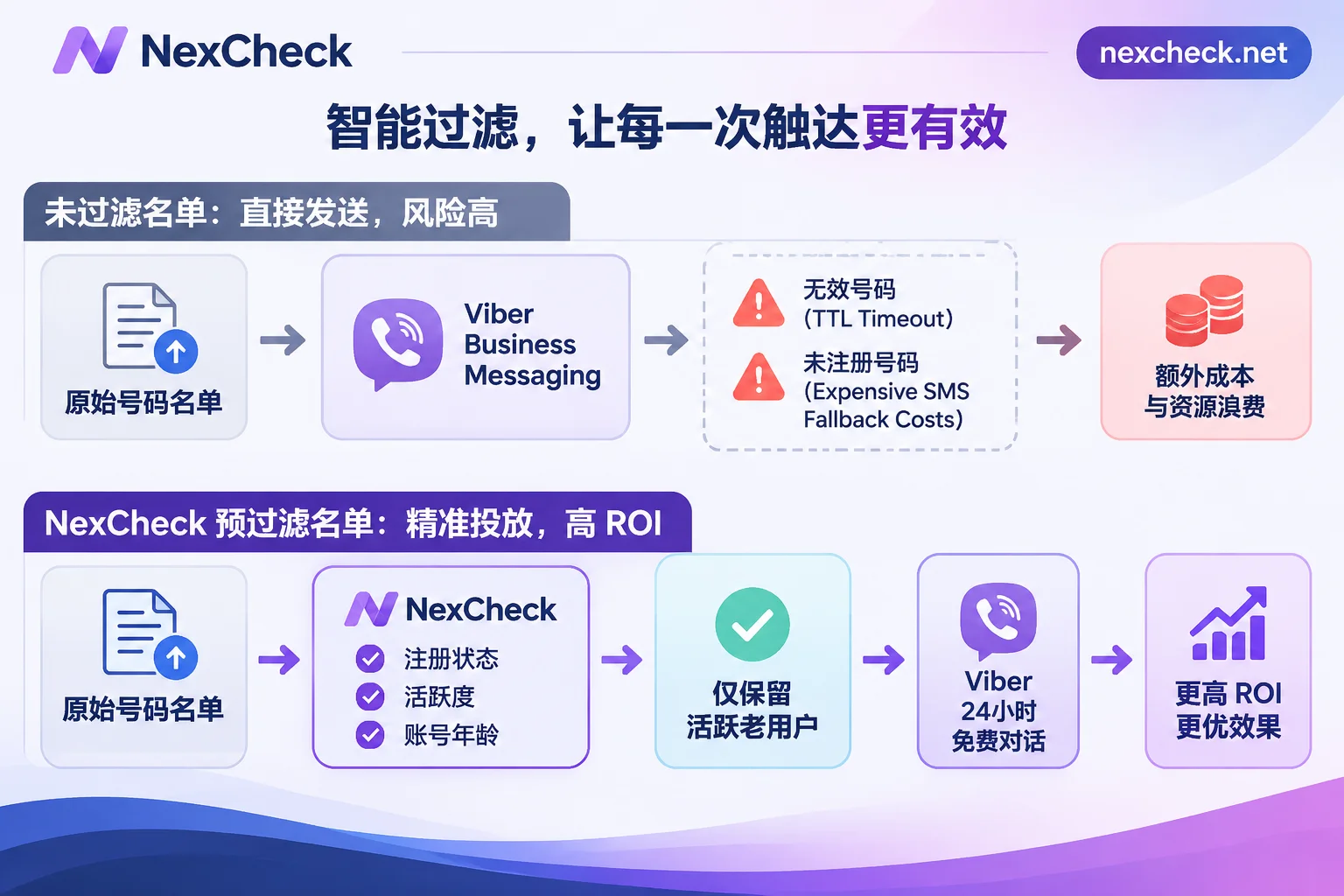
To ensure the reach rate of verification codes or marketing notifications, the vast majority of enterprises connected to Viber enable SMS Fallback in the service provider's backend: when a Viber message is sent, if it cannot be delivered within the set time-to-live (TTL) (for example, the recipient has not registered Viber at all, or has uninstalled the app and been offline for a long time), the system will automatically resend the message as a regular international SMS.
The problem lies exactly here: in many Eastern European and Southeast Asian countries, the cost of a single Viber business message is often 50% to 80% cheaper than an international SMS. If you do not perform Viber number screening on the list beforehand, 40% of unregistered and dormant offline numbers in the list will automatically trigger expensive international SMS channels after the TTL timeout. Worse still, a large portion of them are empty numbers that have already been canceled by the carrier—you not only fail to reach the customer but also pay expensive SMS fallback fees for these invalid numbers.
II. Core Solution: Three Key Dimensions of NexCheck Viber Screening
To plug the above cost and risk control loopholes, before importing numbers into marketing systems or triggering OTP routing, operations and data teams can use the NexCheck Viber screening channel to perform a pre-check on the list. NexCheck provides three core detection metrics for the Viber ecosystem, each addressing three types of business pain points:
1. Registration Check: Cut Off Invalid SMS Fallback Triggers
By batch-verifying whether the phone numbers in the list have registered and activated Viber, results are returned grouped as "valid (registered)" and "invalid (not registered)". For numbers without Viber, enterprises can directly exclude them from the sending strategy or route them from the start to low-cost local email/outbound channels, avoiding them entering the Viber queue and passively triggering expensive SMS Fallback due to delivery failure.
2. Activity Status Check: Lock in High-Potential Audiences Who Can Start "Free Sessions"
As mentioned earlier, "registered" does not mean "online". Many old numbers of users in Eastern Europe or the Philippines may have been bound to Viber but the user may have changed numbers or not opened the app for months. If paid promotional messages with GIFs or Quick Replies are sent to such dormant numbers, the messages will only fail after waiting for the TTL timeout.
Combined with the tiering logic in How to Do Number Activity Detection? From New Delivery Threshold Rules to Cross-Platform Activity Tiering Screening Solutions, using NexCheck's Viber activity interval detection, teams can prioritize budgets for recently highly active "golden lists", maximizing first-touch read rates and the awakening rate of 24-hour free sessions.
3. Account Age Check: Intercept Registration Abuse and SMS Verification Black Market Numbers
Among NexCheck's Viber detection items, "account age" is a very unique and high-value anti-fraud indicator. It is important to clarify: "account age" here refers to how long the Viber account has been registered, not the biological age of the number holder.
Why is this indicator particularly important in 2026?
- Marketing anti-brushing/anti-abuse: During Black Friday, Christmas promotions, or new platform user acquisition, many grey/black industry studios use SMS verification platforms to batch-register brand-new Viber accounts to claim new user coupons, trial funds, or participate in lotteries. If before distributing high-value benefits, you screen Viber account age via API or batch tasks and directly exclude "newly registered accounts", you can instantly filter out the vast majority of batch account farming scripts.
- Outbound calling and private domain follow-up anti-fraud: In recent years, Viber has significantly upgraded its Caller ID (caller identification and anti-harassment) and anti-fraud monitoring systems. For high-ticket industries (such as overseas real estate, financial services, B2B trade), sales teams can verify the other party's Viber account age before following up on leads—an old account registered and used for many years has far higher authenticity and business trust than a temporary account registered just a few days ago.
III. Practical Workflow: From Local Format Cleaning to Cross-Platform Precise Routing
In actual business, a standard Viber lead cleaning and routing solution is not complicated. Whether dealing with newly collected exhibition lists, ad forms, or revitalizing hundreds of thousands of historical customers in the CRM, you can implement it in NexCheck in the following four steps:
Step 1: Browser Local Formatting and Deduplication (Free Pre-processing)
Lists mixed with numbers from Eastern Europe, CIS, and Southeast Asia are most prone to issues like leading zeros not removed, missing country codes, spaces or hyphens, and duplicate entries.
Since the NexCheck console does not automatically deduplicate when creating a detection task, duplicate rows are still billed, it is strongly recommended to first open the free NexCheck Number Cleaning Tool before uploading. This tool runs locally in your browser and does not create paid tasks:
- Select the corresponding default country (Note: the default country must be selected correctly; otherwise, correctly formatted numbers with the wrong attribution will be generated. For specific country formats, refer to the Regional Solutions Overview).
- One-click remove separators, fill in country codes, convert to standard E.164 format, and remove duplicate numbers, then export the clean list.
Step 2: Basic Number Detection and Viber-Specific Screening Relay
After obtaining a clean E.164 format list (supporting CSV, TXT, or XLSX, with one number per line in the first column), log in to the console to create a batch task (for detailed operations, see the Quick Start Guide):
- For high-value/high-risk scenarios, check the basic layer first: If the list source is mixed, you can first use Basic Number Detection to screen for empty numbers and on/off status, stripping out completely canceled dead numbers.
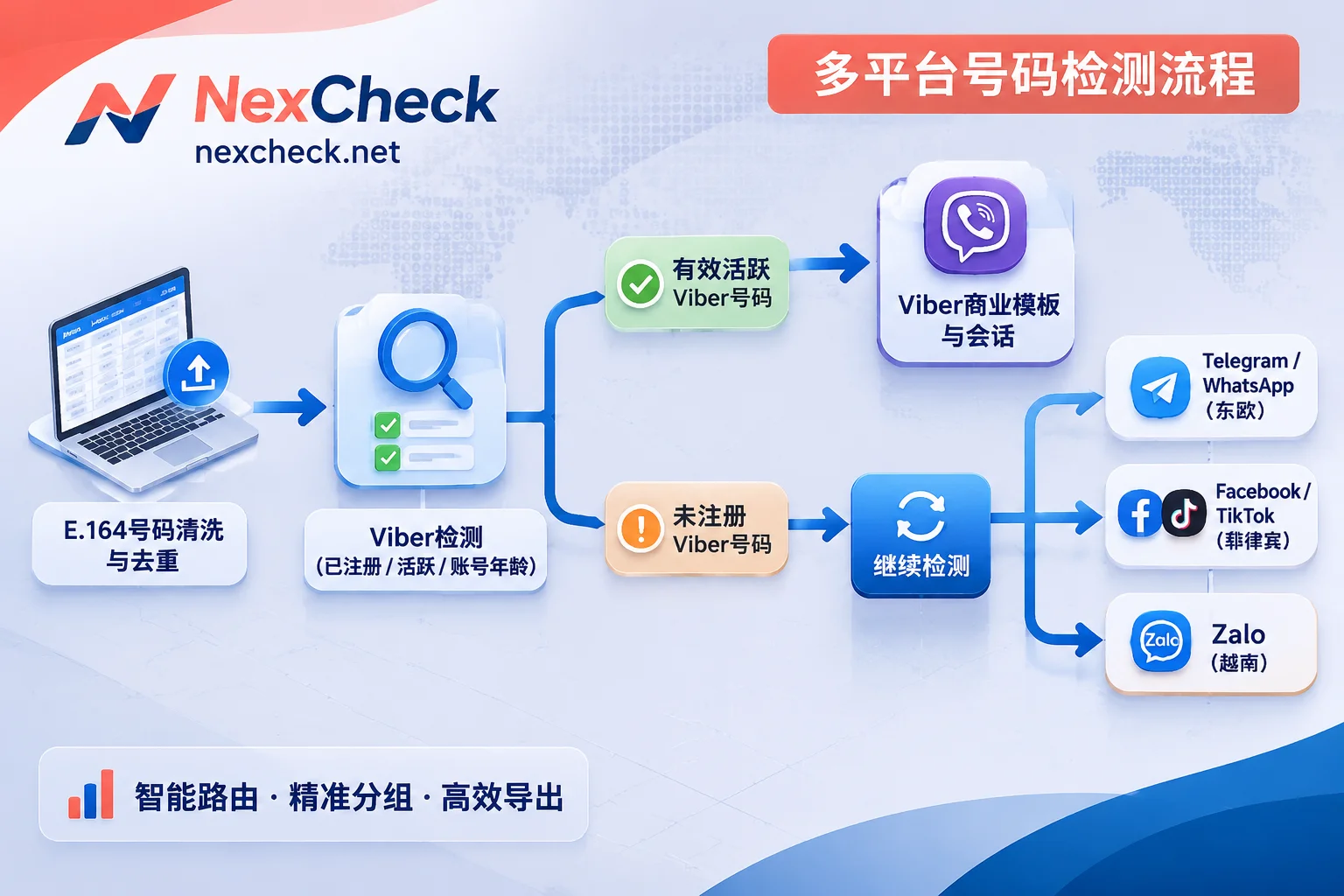
- Seamless "Continue Detection": After the first task is completed, there is no need to download and reorganize before uploading again. Directly use the console's "Continue Detection" feature to use the valid results that passed the filter as input for the next project (a new task will be created and billed separately), sequentially completing Viber registration, activity interval, and account age detection.
Step 3: Cross-Platform Secondary Revitalization for "Non-Viber" Numbers
Many marketing teams, after screening Viber, directly discard the batch of numbers showing "not registered on Viber" as invalid, which actually causes a huge waste of leads (see details in How to Clean Customer Lists: Tiered Revitalization Solutions for Exhibition Leads, Dormant CRM Customers, and Ad Seed Audiences).
In different regional markets, users' instant messaging habits often show dual-platform or even multi-platform coexistence. Using the console's "Continue Detection" feature, you can route the list of real numbers but not registered on Viber (or extremely dormant on Viber) to the second main platform in the local area for secondary screening (all supported platforms are visible in the Supported Platforms Overview):
- Eastern Europe and CIS markets (e.g., Ukraine, Kazakhstan): If the number is not registered on Viber, immediately switch to Telegram number screening to check registration status and 3/7/15-day activity tiers, or use WhatsApp number screening to find reach opportunities.
- Philippines market: In addition to heavy Viber usage, Philippine users are highly dependent on the Meta ecosystem and short video platforms for social and e-commerce. For Philippine numbers not registered on Viber, you can conveniently screen Facebook account registration, TikTok registration, or Shopee registration status to convert them into social media Custom Audiences seed packages or WhatsApp private domain leads.
- Vietnam market: Although Vietnam has a certain proportion of Viber business users, the national app is Zalo. If a Vietnamese 10-digit number is not registered on Viber, directly switch to Zalo number screening to verify registration and activity intervals for seamless fallback.
Step 4: API Automation Integration for Real-Time Interception at Registration and Sending Sources
For R&D teams that have new registration leads entering the database daily or need to automate OTP and transactional template triggers, manual export and upload is obviously not efficient enough. NexCheck provides a standard RESTful API supporting batch submission, real-time queries, and asynchronous Webhook result pushback (for related architecture design, refer to How to Integrate Number Screening API? From CRM Real-Time Ingestion Interception, Asynchronous Webhook Write-Back to Cross-Platform Automated Cleaning Solutions).
After embedding the detection API into the business middle platform, when a user submits a phone number on the frontend, the system can immediately determine whether the number is registered on Viber and whether the account age is too short:
- If registered and not a newly registered black market account, prioritize routing to the low-cost, high-interaction Viber transactional template channel;
- If not registered on Viber, directly route to regular SMS or backup social channels, completely bypassing invalid Viber attempts and timeout fallback delays.
(Note: The public user manual does not include specific API interface documentation. To obtain interface addresses, authentication parameters, and callback format descriptions, please first register a free NexCheck account and contact official customer service on Telegram @nextipkf for technical integration support.)
IV. Data Compliance and Usage Boundaries
When choosing a number screening tool, data security and billing transparency are the core considerations for enterprises:
- Strict data privacy boundaries: All lists submitted by customers to NexCheck are customer-owned data. The platform processes data only within the scope of executing detection tasks, never sells customer lists, and does not use customer data to build number databases for external sales. As the data controller, customers can view, export, and delete task data at any time in the console and must ensure that the source and purpose of the submitted numbers comply with local laws and regulations (see Privacy Policy for details).
- Transparent prepaid mechanism: The platform adopts a prepaid model where you recharge first and then pay per item. Fees are deducted when creating a task, and if a task fails, the system will automatically refund the full amount (specific channel unit prices and the range of items per task are subject to the console price list).
- Objectively understand detection results: Since the task center does not promise result retention days, it is recommended to export and archive results promptly after detection. Also note that any number detection result only reflects the platform's public status at the moment of query, used to assist in optimizing routing and cleaning dead numbers, and does not represent an absolute guarantee of the number holder's true identity, purchasing intention, or commercial value.
Conclusion
As Rakuten Viber enters an era of refined operations with "strict template review + strict anti-spam + free two-way sessions", simply competing on sending volume is no longer effective. Before every mass send or automated workflow trigger, using Viber number screening to clean out unregistered, dormant offline, and newly registered abuse accounts not only saves the team a large amount of unnecessary SMS fallback bills but is also a necessary step to protect enterprise sender reputation and leverage high-conversion private domain conversations.
Go now to the NexCheck official website to register an account, or check the official user manual to start your multi-platform precise number cleaning journey; for large batch detection or API integration needs, feel free to contact official customer service on Telegram @nextipkf at any time.