 NexCheck-筛号平台
Entering 2026, the growth logic of global enterprises is undergoing a profound restructuring. With the tightening of global privacy regulations and the invalidation of third-party cookies and rented audience signals, first-party data has become the last marketing moat for B2B and cross-border teams. However, industry surveys show that contact data in enterprise CRM databases naturally decays at a rate of about 30% per year—number changes, suspensions, platform bans, or abandonment quickly degrade originally high-value customer assets into "invalid liabilities."
To eliminate invalid leads and reduce the cost of outbound calls and message outreach, phone number screening platforms have become essential infrastructure for operations, marketing, and data teams. But opening a search page reveals a myriad of tools: some use local software to scan and poll, some claim "low-cost screening" but actually resell number sources, and others claim to be all-in-one but cannot even clarify basic channel specifications.
With platform risk controls and data compliance both tightening, choosing the wrong screening platform not only wastes budget but may directly lead to the total loss of business accounts or the leakage of core customer assets. This article will dissect the hardcore standards for evaluating professional screening platforms in 2026 from four dimensions: underlying mechanisms, data sovereignty, channel transparency, and cross-ecosystem collaboration.
Pain Point Review: Why Are Traditional "Screening Software" Dragging Down Global Teams?
After communicating with numerous cross-border e-commerce, Web3 operations, and overseas B2B teams, we found that when choosing screening tools, everyone is most likely to fall into the following three hidden pitfalls:
1. Chain Bans Caused by "Local Scanning/Using Secondary Accounts"
Early desktop screening software typically required users to run a client on their local computer, scan a QR code to log in to their idle social accounts (such as WhatsApp), or even plug in open-source automation scripts to batch request target number APIs. By 2026, major instant messaging and social media platforms have upgraded detection of companion devices, headless browsers, and high-frequency enumeration behaviors to millisecond-level. Using your own business or channel accounts to run batch screening often triggers platform restrictions or even permanent bans after screening just a few thousand entries. The hidden costs of buying secondary accounts and configuring environments far exceed the screening itself.
2. First-Party Core Lists Become Others' "Public Number Databases"
High-intent customer lists accumulated by teams through expensive exhibition sponsorships and ad clicks are the enterprise's most core digital assets. However, some platforms with ambiguous business models simultaneously operate "screening" and "selling numbers/generating number segments" businesses. When enterprises upload unmasked real customer lists to platforms lacking privacy boundaries, these high-net-worth numbers are highly susceptible to being intercepted, tagged in the backend, and resold as "industry-precise leads" to competitors.
3. Fragmented Single Tools, High Cross-Ecosystem Verification Costs
Today's overseas customer acquisition is no longer a single-channel battle. A Vietnamese customer may use both Zalo and Telegram, and a fintech user may use WhatsApp and also register on Binance. If every channel change requires finding a new tool and re-adapting contracts and table formats, the data team will spend a lot of time on cross-tool table export and field alignment.
Four Hard Criteria for Evaluating Professional Screening Platforms in 2026
To upgrade list cleaning from a "high-risk guerrilla war" to a "standardized data governance pipeline," enterprises should focus on the following four core indicators when selecting a screening platform:
Criterion 1: Non-Intrusive Cloud Detection Architecture (No Business Account Binding, No Customer Disturbance)
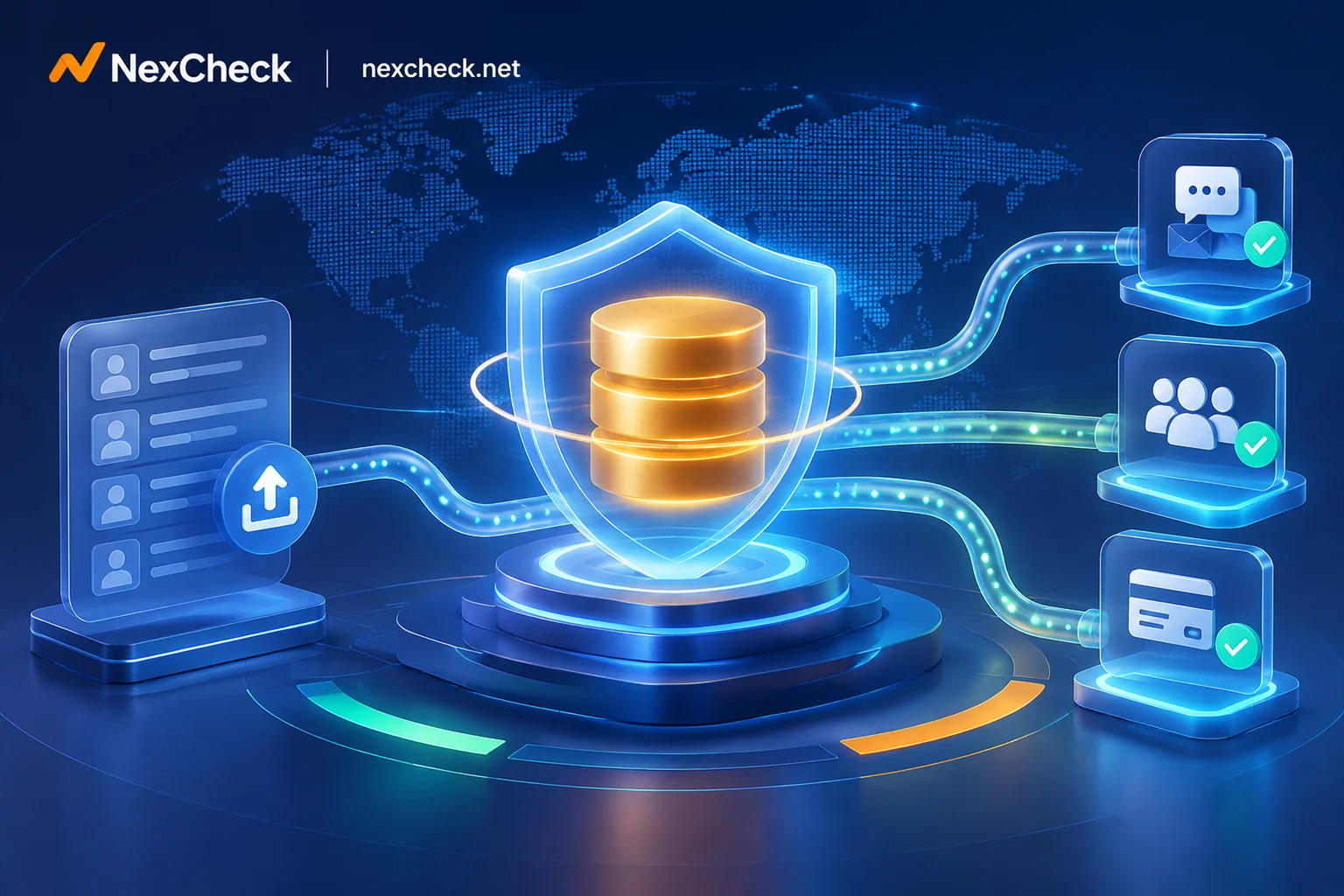
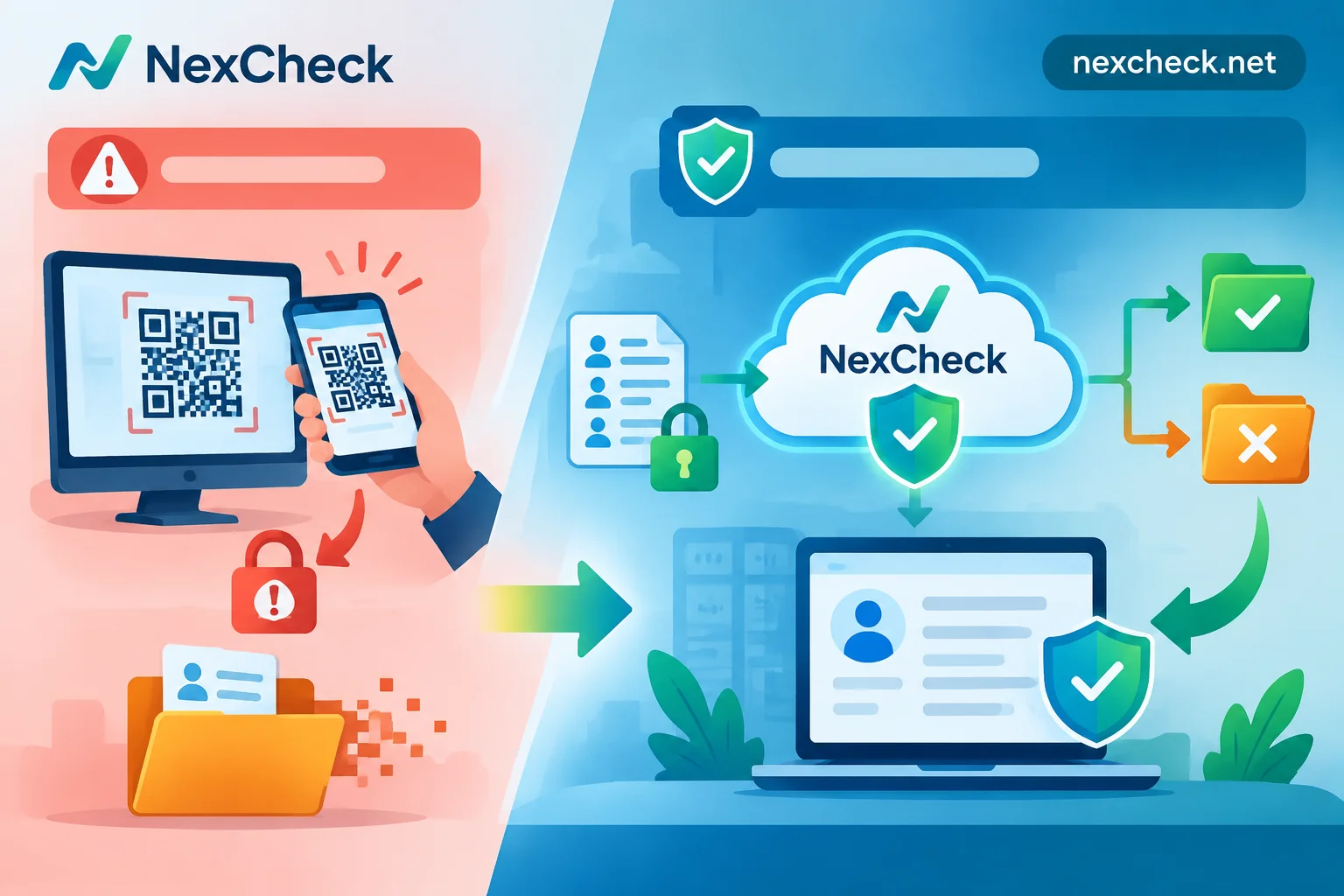
A professional screening platform must completely separate the detection load from the customer's own business accounts. Take NexCheck as an example: the entire screening process is executed independently per project in the cloud. Users do not need to download any local client that may be falsely flagged by antivirus software, nor do they need to scan QR codes to log in to their social or trading platform accounts.
More importantly, it is "non-intrusive" to target customers. For example, when conducting Binance screening (activation detection, email detection, or transfer channel detection), the system strictly follows the principle of not logging into Binance and not sending verification codes to target numbers. Detection only reflects the platform status at the moment of query, which both protects the enterprise's own channel security and absolutely does not disturb or frighten potential customers by triggering login SMS.
Criterion 2: Strict Data Sovereignty and Anti-Leak Mechanisms
In the era where first-party data reigns, screening platforms can only act as data "inspectors," never as data "middlemen."
When evaluating a platform, be sure to check its data governance terms. NexCheck explicitly defines in its Privacy Policy and console mechanism: The customer is the data controller, and the submitted list belongs entirely to the customer. The platform processes data only within the scope of executing detection tasks, never sells customer lists, and never uses customer-submitted data to build number databases for external sale. After task completion, teams can view and export results at any time in the console and independently delete them, fundamentally blocking the risk of core lead leakage.
Compliance Note: Since the customer is the data controller, enterprises themselves must ensure the legality of the source and purpose of the submitted numbers and must not submit lists they have no right to process. In addition, for data minimization retention and security considerations, the platform's task center does not guarantee result retention days. It is recommended to export and write back to the enterprise's own CRM promptly after detection, and not use the screening backend as a long-term archive cloud drive.
Criterion 3: Platform Coverage Breadth and Transparent "Per-Channel" Specifications
Different business stages have vastly different requirements for screening speed, field granularity, and budget. An excellent screening platform does not use a vague "99% accuracy rate" to conceal underlying differences but clearly gives users the right to choose channels and understand result specifications.
In the NexCheck Supported Platforms Overview, detection capabilities are clearly divided into five major matrices, and the same detection item often provides multiple channels to suit different scenarios:
Instant Messaging Ecosystem:
- WhatsApp Screening: Activation detection is divided into fast channel and SVIP channel; gender and age are divided into SVIP, Channel 1, and Channel 2; supports registration time, four-dimensional ecosystem activity and channel-specific activity, real-time online status, zombie and ad accounts, banned accounts, and group link filtering. (Note: Avatar, signature, and last seen are limited by user privacy settings. For specific tiering methods, please refer to "How to Do WhatsApp Screening? From Per-Message Billing New Rules, Zombie and Banned Account Removal to Multi-Dimensional Tiering Solutions").
- Telegram Screening: Supports number activation check, activation format, 3/7/15-day activity tiers, and gender; if you only have handles scraped from social media, you can directly upload
@用户名for username detection and username gender/age detection (since the profile page itself has no gender/age fields, the usability of this result depends on the user's public name and avatar). - Regional Major IMs: LINE Screening filters registrations by region (Taiwan, Japan, Thailand, South Korea, Hong Kong, US), returning UID, nickname, avatar, and comprehensive age/gender (activity detection requires activation screening first); Zalo Screening offers "fast" and "stable" dual channels for activation and gender/age (the stable channel includes nickname, and note that Vietnamese numbers must be in the 10-digit format after the 2018 reform); Viber Screening not only provides activation and activity ranges but also a unique "account age" detection (referring to how long the account has been registered, specifically to eliminate newly registered marketing accounts, not the user's biological age); it also covers Botim, RCS, KakaoTalk, Band, and Signal.
- Social Media Matrix: Facebook Screening supports number activation, email activation, UID, and UID profile gender/avatar (read-only fields that users set as public); Instagram, TikTok, Twitter/X, Snapchat, Moj support number activation screening; LinkedIn activation screening specifically supports US and India numbers.
- Crypto and Financial Platforms: Covers activation screening for Binance, KuCoin, CoinW, HTX, MEXC, Vantage, Paytm, MoniePoint; the first four and Robinhood, Nasdaq also support email dimension detection.
- E-commerce, Logistics, Office, and Local Life: Amazon, Temu, Shopee, Coupang, Flipkart, Bukalapak, Noon, DHL, Microsoft, Microsoft Teams, Airbnb, Magicbricks, The Economic Times, Cian, HeadHunter all provide standardized account activation screening.
- Number Basic Detection Foundation: Includes empty number and on/off status, number type, carrier identification, device model, Apple/Android device分流, iOS blue tick (only answers whether it is on the Apple side, excluding model and Apple account), US carrier and US high-risk and complaint number identification. For ecosystems with only number sources but no platform-specific detection items (such as Cash App, OKX, Coinbase, Discord), this basic detection matrix can also complete on/off validity and device分流 (see "How to Do Overseas Empty Number Detection?").
Criterion 4: Clear Billing Logic and Failed Task Refund Guarantee
Many teams have suffered from "hidden charges" during screening. In NexCheck's prepaid system, billing rules are highly transparent: recharge first, then deduct per item (specific unit prices are subject to the real-time price list in the console), and charges are deducted when creating a task; if a task fails due to channel fluctuations, the system automatically refunds in full, never making customers pay for invalid system errors.
Practical Workflow: How to Run Cost-Effective List Verification with NexCheck?
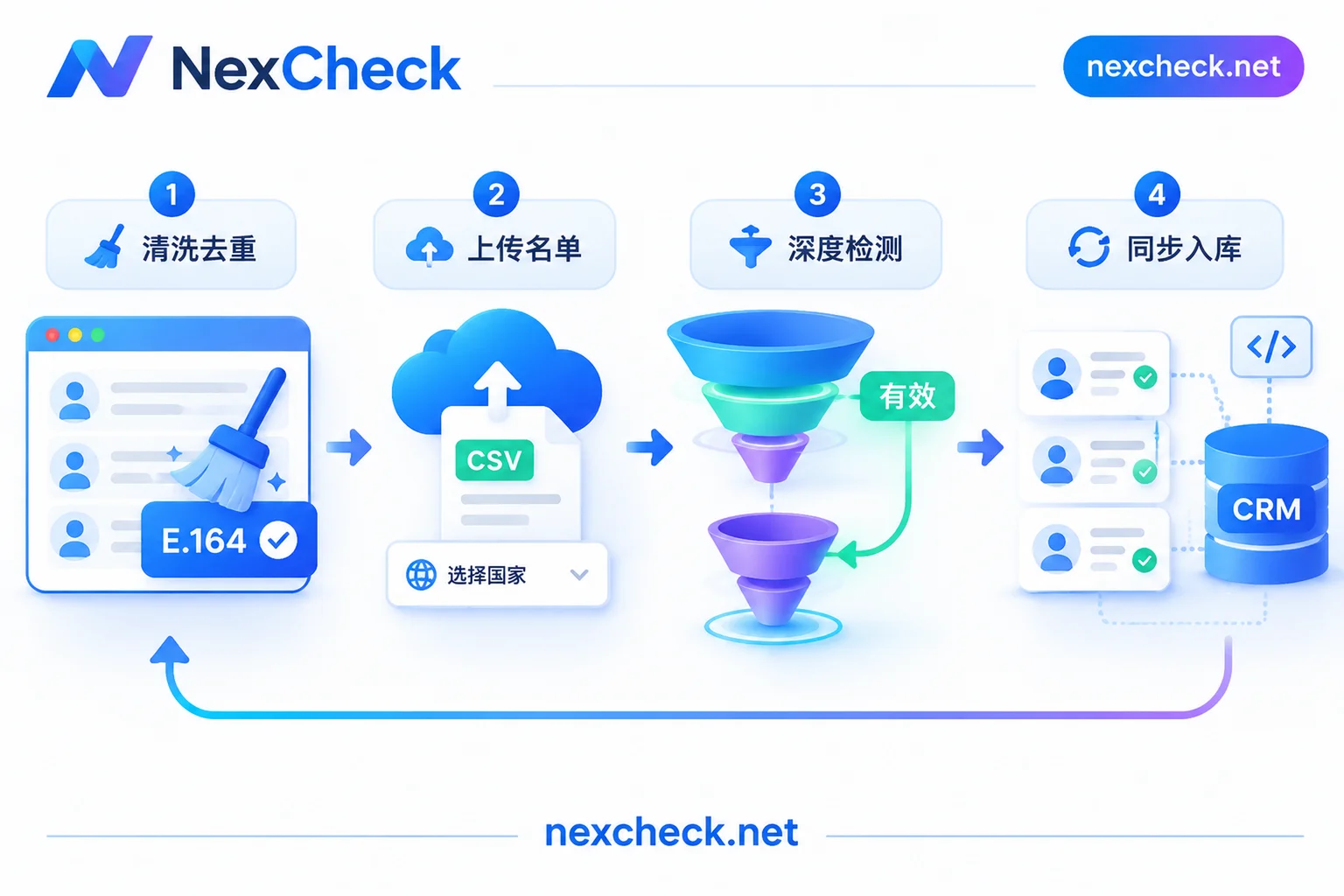
After selecting a reliable screening platform, the correct operation sequence can directly save the team 20%~40% of the detection budget. Here is a four-step standard operating procedure (SOP) verified by many data teams:
Step 1: Combine Regional Solutions and Clarify Target Country Screening Strategy
Communication habits and number segment rules vary greatly across countries. Before uploading lists, it is recommended to first consult NexCheck Regional Solutions (covering major global countries and regions except mainland China). For example, before entering the Vietnamese market, use the regional page to understand local major carriers, the reality of the 10-digit number reform, and the recommended order of "first screen basic real numbers, then screen Zalo and WhatsApp" to avoid blind full screening (Further reading: "How to Do Overseas Number Screening? From Global SIM Real-Name Shutdown Wave to Country-Specific, Ecosystem-Specific Precision Screening Solutions").
Step 2: Pre-Local Cleaning and Deduplication (Avoid Duplicate Billing Pitfall)
This is an easily overlooked money-saving detail: After uploading files, the console batch task does not automatically deduplicate, and duplicate values are billed normally.
Therefore, before formally creating a paid task, be sure to open the free number cleaning tool. This tool runs directly in the local browser and does not create a paid task: it automatically identifies separators, fills in country codes according to the selected default country, uniformly converts to the standard E.164 format with country code, and completes deduplication with one click, directly reporting the number of valid, invalid, and duplicate entries (Note: Do not select the wrong default country, otherwise you will get numbers with correct format but wrong attribution).
Step 3: Console Batch Upload and "Continue Detection" Funnel Chaining
Open the console (see the Quick Start Guide), upload the organized CSV, TXT, or XLSX file (one target value per line in the first column, ensuring the number of lines falls within the minimum and maximum quantity range of the selected project), select the corresponding country or region, and start detection.
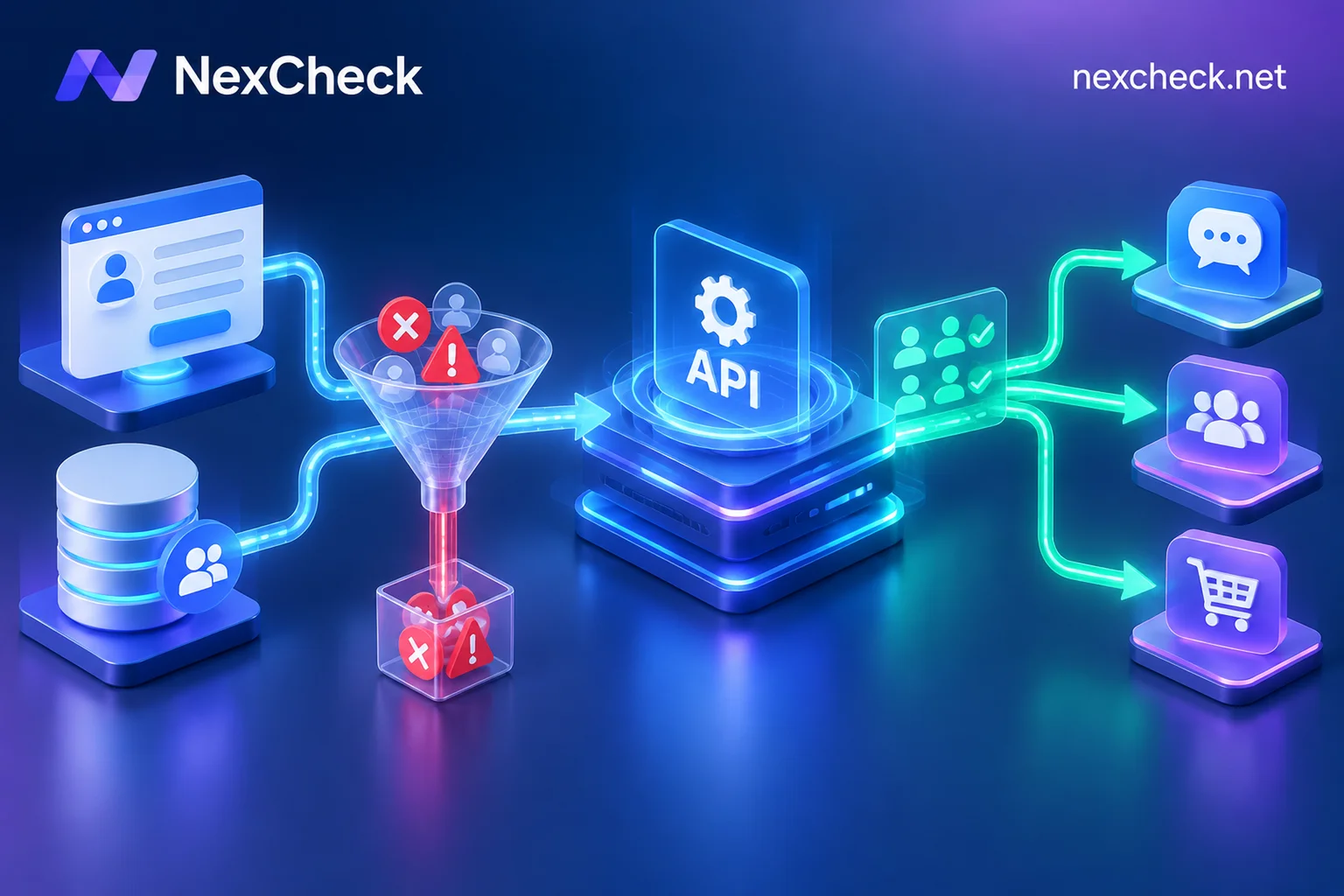
After the first layer of screening (such as "basic empty number detection" or "LINE activation detection") is completed, the results are automatically returned grouped by valid and invalid, supporting online preview and download. At this point, there is no need to download the table locally and re-upload it. Directly use the console's "Continue Detection" function to use the just-filtered valid results as input for the next project (such as "activity detection" or cross-platform "Telegram activation detection"). The system will create a new task and bill separately, using funnel chaining to spend every bit of budget where it matters most.
Step 4: RESTful API Integration into CRM Automation Pipeline
For medium-to-large teams with continuous lead inflow every day, manual table export still lags. NexCheck provides a standard RESTful API that supports batch submission, real-time query, and asynchronous Webhook pushback. Development teams can embed detection capabilities directly into the enterprise's CRM, CDP, or marketing automation system, completing validity interception and multi-dimensional attribute tagging the moment a prospect submits a form (for architecture design, see "How to Integrate Number Screening API? From CRM Real-Time Inbound Interception, Asynchronous Webhook Write-Back to Cross-Platform Automated Cleaning Solutions").
Note: To ensure interface security and channel stability, the public user manual does not display specific API endpoint addresses, parameters, and authentication formats. Teams with development integration needs can contact official customer service directly after registering an account for integration support.
Conclusion: Recognize Data Boundaries and Let Screening Return to Business Essence
When choosing and using a screening platform, maintaining rational data expectations is equally important. On the one hand, any screening result only reflects the platform status at the moment of query, cannot access privacy fields that users have set as non-public, and cannot directly determine the true identity, purchase intention, or business value of the number holder; on the other hand, professional screening platforms focus on "data verification and cleaning" itself, without mixing in mass outreach, code receiving, proxy IP, or number selling businesses—the purity of function is precisely the best guarantee of platform stability and data security.
If you are looking for a cross-ecosystem screening foundation with transparent channels, no business account binding, and strict customer list privacy, welcome to register for a free NexCheck account to enter the console and view real-time price lists and channel details, or read the official user manual for more practical details. For large-batch custom screening or API integration needs, you can contact official customer service via Telegram at @nextipkf for one-on-one solution support.