 NexCheck-筛号平台
Let's give the conclusion directly first: Using a cloud-based tool for pre-Zalo screening will neither ban your own Zalo operating account nor send friend requests, verification SMS, or any pop-up notifications to Vietnamese customers. What truly leads to bans and customer resentment is often teams using their own business accounts or local scripts for high-frequency searches, tentative friend requests, or dragging unscreened lists directly into brute-force mass messaging.
Entering 2026, the data environment in the Vietnamese market has also undergone significant changes: Vietnam's Personal Data Protection Law (Law No. 91/2025/QH15) and its implementing decree (Decree 356/2025/ND-CP) officially took effect on January 1, 2026. Zalo itself also sparked heated discussions from late 2025 to early 2026 due to terms of service and data authorization transparency issues and received an administrative penalty from the Vietnam National Competition Commission. These changes have led more and more Vietnamese users to proactively tighten privacy settings, and have also forced operations teams to clarify "safety boundaries" and "result definitions" before screening numbers.
I. Why do some people get banned as soon as they do "Zalo screening"? The core lies in whether account isolation is implemented
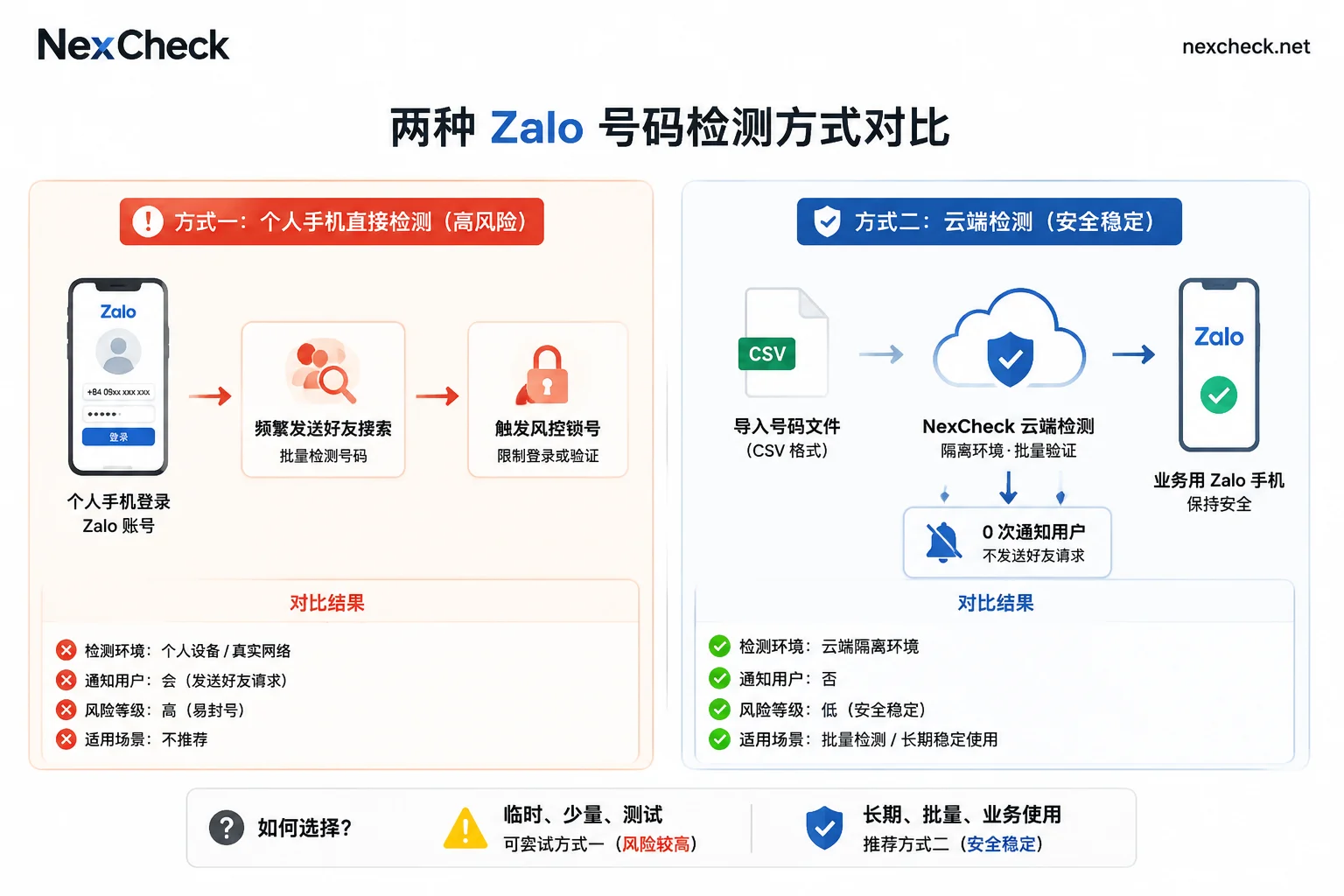
Checking whether a batch of +84 phone numbers have activated Zalo involves completely different levels of risk control pressure depending on the approach:
- High-risk approach: Using your own Zalo account or local scripts to probe
Many teams new to the Vietnamese market buy a few SIM cards or use the main sales account, import phone contacts, continuously enter numbers to search in the client, or even use local simulated click scripts to tentatively send friend requests. Zalo's risk control mechanism is very sensitive to device fingerprints, login IP geolocation consistency, and high-frequency adding behavior—frequently switching accounts on the same device in a short time, using non-Vietnamese local data center IPs to jump around, or continuously initiating searches and add actions to a large number of陌生 numbers can result in search function restrictions at best, or direct temporary suspension or even permanent ban at worst. - Safe approach: Complete pre-screening in the cloud without logging into business accounts
A more reliable way is to run a status verification through an independent cloud platform (e.g., NexCheck) before the list enters the sales or customer service team. The entire detection process does not require logging into your own personal or enterprise Zalo account, nor does it occupy your work phone and network environment, physically isolating "data pre-screening" from "business outreach."
If you need a more systematic understanding of specific field selection, you can also refer to the site's Vietnam 10-digit number cleaning and Zalo layered detection order for matching use.
II. Will customers be alarmed? Clarifying privacy switches and the real reasons for "undetectable"
Compliant pre-screening will not send SMS, trigger voice verification codes, or send friend invitations on your behalf to the target phone numbers; Vietnamese customers will have no perception on their mobile devices. However, many operations staff find a confusion after getting results: clearly holding a batch of recently collected Vietnamese inquiry numbers, why are some "undetectable" or gender and age shown as blank? This usually has three practical reasons:
- Unconverted old 11-digit Vietnamese numbers
Vietnam uniformly converted its original 11-digit mobile numbers to 10-digit format as early as 2018. If you still have historical 11-digit numbers, they cannot be matched to valid accounts in the Zalo system, and NexCheck will likewise fail to find results. Before submission, ensure the numbers are in the converted 10-digit standard format. - The other party has disabled "Allow strangers to find me by phone number"
In Zalo's client privacy settings, there is a switch called "Allow strangers to find and make friends by phone number." In 2026, as local users become more privacy-conscious, many have turned off this entry. If you search manually in the app, the other party directly shows "user not found," which can easily be misjudged as unregistered; when using cloud screening channels, it is also necessary to distinguish between "not activated" and "profile invisible due to privacy settings." - Users set profile fields as non-public
Supplementary attributes such as avatar, gender, or age are essentially limited by the user's privacy visibility settings. As long as the account owner has not made the relevant fields public, no compliant detection tool can forcibly read them. Therefore, seeing some fields missing or unknown in the results is a normal privacy boundary, suitable only as an auxiliary reference for customer pool grouping, not as an absolute judgment standard.
III. Under Vietnam's 2026 privacy regulations, where are the compliance red lines for screening and outreach?
In the past, when discussing the Vietnamese market, most people were still looking at the old Decree 13/2023/ND-CP, but from January 1, 2026, it is replaced by the Personal Data Protection Law (91/2025/QH15), which has been officially elevated to a law, and subsequent penalty provisions have also taken effect—for illegal buying and selling of personal data, fines up to 10 times the illegal gains; for illegal cross-border transfer of personal data, fines up to 5% of the enterprise's previous year's revenue. For the general legal boundaries of social platform screening, you can read the site's Analysis of Compliance Boundaries for Social Platform Screening.
In daily operations, be sure to observe three boundaries:
- Clarify your responsibility as a "data controller": According to NexCheck's platform rules, the list submitted by the customer belongs to the customer's own data, and the customer must ensure the numbers are legally sourced and used for legitimate purposes, and must not submit lists they have no right to process.
- "Activated and active" does not equal "consent to receive marketing messages": Screening solves the technical problem of "whether this number can find someone on Zalo and whether it is a recently active account"; it cannot replace user consent mechanisms, opt-out paths, and frequency control. Dropping tens of thousands of screened numbers directly into mass messaging software for blind bombing not only carries high legal risk but is also the biggest trigger for customer complaints and business account bans.
- Control data retention period: NexCheck only processes the list you submit within the scope of executing the current detection task, will not sell customer data, and will not use it to build a number database for external sale. At the same time, the console task center does not promise a retention period for results and cannot be used as a long-term archiving tool; after exporting results and writing them into internal CRM, it is recommended to promptly delete the corresponding task records in the console (see Privacy Policy for details).
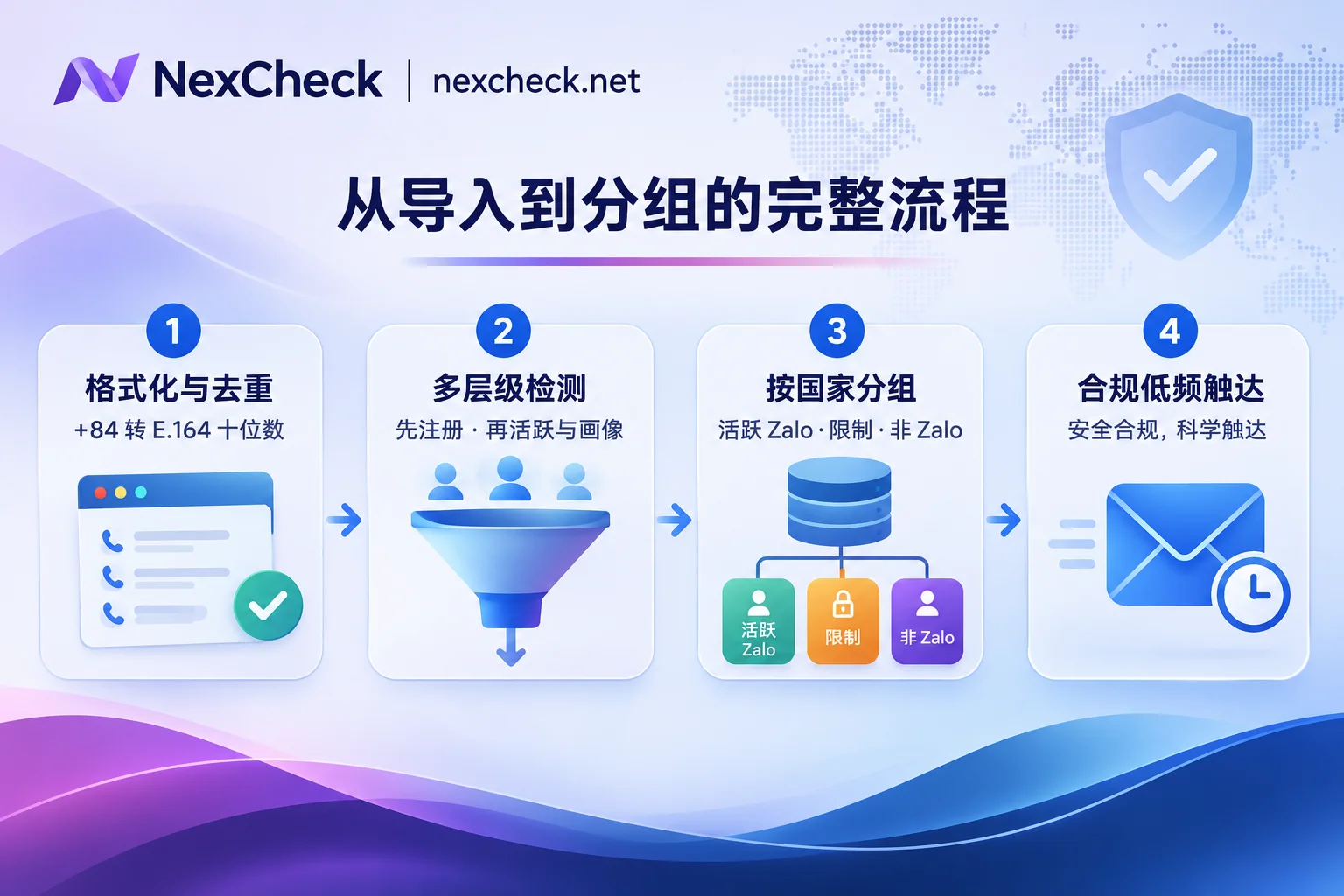
IV. No bans and no budget burn: Recommended 4-step Zalo screening and handover order
To balance account security, Vietnamese local number segment hit rate, and cost control, it is recommended to follow this order:
Step 1: First, use the browser for free number cleaning, convert to 10-digit format, and deduplicate
Before creating any paid task, open NexCheck's browser-based number cleaning tool. It runs entirely in the local browser, does not generate paid tasks, and can help you automatically identify separators, complete the +84 country code according to the default country, uniformly convert to E.164 format and complete deduplication, while counting valid, invalid, and duplicate entries.
This step is very cost-saving: Because when batch uploading CSV, TXT, or XLSX files in the console, the system does not automatically deduplicate, and duplicate numbers will be charged as usual; also remember to check whether the default country is correctly set to Vietnam, as selecting the wrong country will cause the format to look compliant but the actual attribution to error. To understand Vietnam's main local operators and channel characteristics in advance, you can also first check the Vietnam regional solution.
Step 2: First screen "activation," then use "continue detection" to layer-check activity and profile
Do not run the most expensive attribute detection on the entire dirty data package right away. Refer to the Quick Start Guide to place the cleaned numbers in the first column of the file for upload, and submit in batches according to the row limit of the selected project:
- First layer runs "Zalo account activation" (optional fast or stable channel) to first strip out unregistered or old 11-digit numbers that cannot be matched;
- Second layer uses the console's "continue detection" function, directly using only the activated results as input for the next step to run Zalo active interval or Zalo gender and age (gender and age also have fast and stable channels; the stable channel also returns nicknames). Note that "continue detection" will create a new task and be billed separately, but compared to running high-level items on the full volume, this can save the team a lot of无效 overhead.
NexCheck adopts a prepaid model: recharge first, then deduct per item according to the console's real-time price list; charges are deducted when the task is created, and if the task fails, the system will automatically refund in full.
Step 3: Group by results and write back to CRM; different layers go through different channels
After the task is completed, results are returned grouped by valid and invalid. Do not stuff all numbers into Zalo sales accounts; it is recommended to split them directly into three layers in CRM:
- Activated and in active interval: High priority to enter the Zalo customer service or official OA outreach queue;
- Activated but low activity or missing profile: First do manual review or low-frequency probing; heavy resource investment is not recommended;
- Zalo not activated: Decisively route to other channels such as Vietnamese local phone, SMS, or email.
If your team has a large daily processing volume and hopes to automatically complete pre-screening when leads enter the database, NexCheck also supports integration via RESTful API (including batch submission, real-time query, and Webhook callback). Since the public manual does not list interface details, developers can register an account and then directly contact technical support (Telegram: https://t.me/nextipkf) for integration instructions.
Step 4: Maintain anti-ban discipline on the outreach end; don't let prior screening go to waste
It should be clear that NexCheck is only responsible for pre-verification of number and account status, and does not provide message sending, mass messaging, or customer follow-up functions. After screening and entering the formal communication stage, the anti-ban focus falls on your outreach actions:
- Newly registered or newly logged-in business accounts should maintain low-frequency normal interaction in the first 48 hours; do not change profile information or continuously add people right away;
- A single device should be fixed with an independent and stable Vietnamese local network environment to avoid association triggers from mixed login of multiple accounts;
- In messaging, combine Vietnamese purchasing or consumption habits for personalized ice-breaking, control the daily number of proactive outreach, and avoid triggering mass rejections and complaints. For more detailed outreach rhythm and operational strategies, please continue to refer to Deep Cultivation of the Vietnamese Market: Zalo Screening Precision Outreach Guide.
V. Quick Reference for Common Questions
- If I upload an old customer list for screening, will the data be retained by the platform or sold?
No. Customer data is only used within the scope of executing detection tasks; the platform does not sell customer lists, nor does it use them to build a number database for external sale, and supports viewing, exporting, and deleting at any time in the console. - Can I directly run batch detection for free after registering with NexCheck?
Registration is free, and the browser-based number cleaning tool is also free to use; however, formally submitting batch detection tasks in the console requires an available balance in the account, with per-item prepaid deduction. - Does "activated and active" screened out guarantee 100% friend request acceptance?
No guarantee. Detection results only reflect the platform status at the moment of query; they cannot determine the account owner's personal business intentions, nor can they bypass the reality that the owner has disabled stranger add permissions or that the platform throttles marketing accounts for frequent adding. Only by combining pre-screening with compliant outreach on the backend can the ban rate be truly reduced.