 NexCheck-筛号平台
Let's start with the conclusion: Social media number screening itself is a neutral data cleaning technology used to verify customer lists that enterprises have legally obtained (such as form submissions, existing customer CRM, order contacts) and is not illegal; legitimate cloud-based detection will not send SMS verification codes, friend requests, or pop-up notifications to the other party. What truly leads to illegality or account bans is "illegal number sources," "use of out-of-bounds tools," and "treating registered numbers as free to harass."
Many operations, marketing, and data teams feel uneasy before cleaning overseas contact lists: Is batch-checking tens of thousands of customer phone numbers to see if they are registered on WhatsApp, Telegram, Facebook, or TikTok going to violate privacy regulations like GDPR? Will it alert customers or even get your own business accounts banned along with it?
To fully clarify this issue, we must separate legal compliance, technical implementation, and subsequent outreach into three layers.
1. Why do some screen numbers safely and efficiently, while others get banned or even cross legal red lines?
The industry often conflates "number screening" with "account bans" and "black market," because both compliant data cleaning and违规 gray operations exist in the market. Risks mainly come from the following three completely different aspects:
1. Data Source: Do you have the right to process these numbers?
Under data regulatory frameworks such as the EU GDPR, Singapore PDPA, or China's Personal Information Protection Law, the starting point of compliance review is not "what detection tool is used," but "what is the legal basis for processing these numbers."
- Compliant scenarios: Contact information actively provided by customers during independent website registration, exhibition lead collection, customer service inquiries, or historical transaction orders, and your privacy policy clearly informs them that it is used for customer service and operational analysis. Checking the activation status and invalid numbers of such first-party data is normal CRM data governance.
- High-risk and illegal scenarios: Purchasing unauthorized personal mobile number databases from the black market, maliciously scraping non-public data with crawlers, or, as disclosed in recent gray market chains, "batch buying numbers → screening to identify real-name accounts → using SMS verification to rebind → reselling accounts." Such behavior directly involves the crime of infringing on citizens' personal information and is fundamentally different from normal enterprise list cleaning.
2. Detection Method: Will it alert customers or implicate your own business accounts?
Many people worry that "screening will send verification codes to the other party." This concern is not unfounded; it depends on which underlying mechanism you choose:
- Local contact sync / QR code login scripts: Some cheap desktop software requires you to log in by scanning a QR code with your own WhatsApp or LINE account, then batch imports tens of thousands of numbers into contacts to trigger friend refreshes, or even uses reverse-engineered client protocols for forced high-frequency probing. This directly marks your business account as abnormal activity, resulting in rate limits or permanent bans.
- Crude scanning scripts with "verification code fallback": Some irregular scanning scripts on the market, when conventional probing fails, enable so-called "old device verification code fallback (e.g., attempting to send a verification code to the target's logged-in client)" to double-confirm whether the account exists. This not only directly disturbs users and triggers security alerts but also easily leads to complaints.
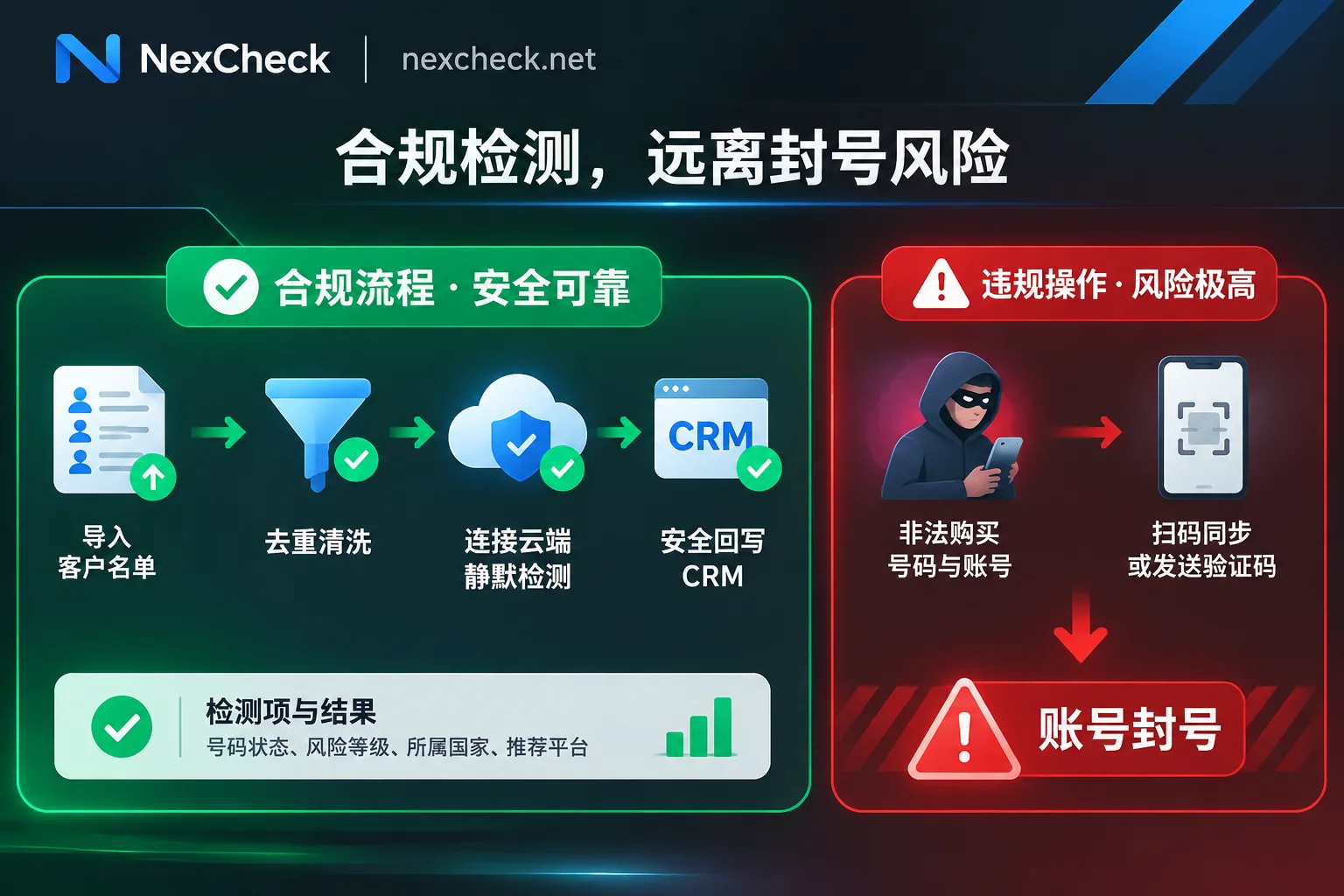
- Cloud-based silent detection: Professional server-side screening does not rely on the user's own social media account login, nor does it send any SMS verification codes, messages, or friend requests to target numbers. It only verifies within the platform's public interfaces and visible status, physically avoiding alerting customers and implicating business accounts.
3. Misinterpretation of Results: "Registered" does not mean "can mass message"
A common misconception among many teams is: once the list is cleaned, they directly use it for aggressive mass messaging, and the account still gets banned. The reason is simple—"the number is registered on a social platform" only indicates technical reachability, not that the user has authorized marketing outreach (Opt-in). If you ignore sending rhythm control and unsubscribe mechanisms, high complaint rates will also trigger platform restrictions.
2. The 4 Red Lines That Must Be Observed in Social Media Number Screening
Whether developing in-house processes or purchasing external tools, enterprise teams are advised to directly check against the following 4 boundaries before conducting cross-platform number verification:
| Verification Dimension | Compliant Practice (Green Light Zone) | Pitfall/Violation Red Line (Red Light Zone) |
|---|---|---|
| List Source | Own forms, order deposits, authorized CRM existing contacts | Purchasing privacy materials of unknown origin, unauthorized scraping of others' mobile numbers |
| Detection Method | Cloud silent verification, no login to own business accounts, no verification codes sent to targets | Scanning QR codes with own alt accounts to sync contacts, using scripts that trigger verification code fallback |
| Privacy Boundary | Only read user status and basic fields set as public, respect hidden settings | Attempting to crack or bypass platform privacy restrictions to read non-public personal profiles |
| Data Retention and Use | Results only written back to own system for segmentation, timely cleanup of intermediate task files | Long-term hoarding of others' numbers for database resale, or aggressive mass messaging beyond authorized scope |
3. How to Implement Compliantly? A Safe Cleaning Process Using NexCheck as an Example
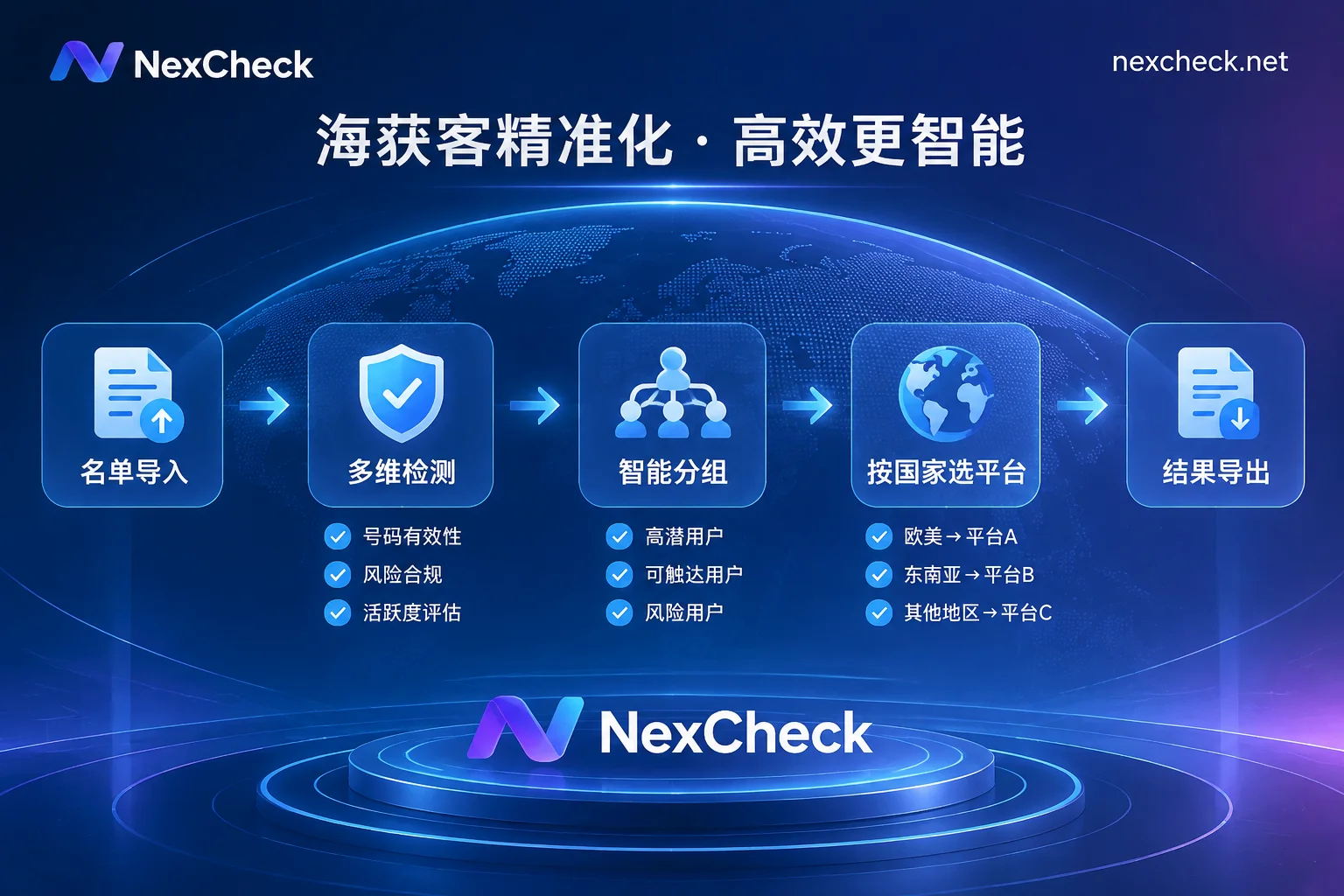
With the red lines clarified, actual selection and execution can follow a three-step process: local preprocessing → cloud silent detection → post-writeback cleanup. Take NexCheck, a prepaid batch detection platform used by our team, as an example; its compliance and risk control design exactly corresponds to the above requirements:
Step 1: First complete format cleaning and deduplication locally in the browser
Before uploading any list to the cloud, do not directly throw raw Excel files with messy notes, duplicate rows, and missing area codes into the system. You can first use NexCheck's number cleaning tool (for detailed format specifications, see "How to Clean Numbers? A Complete Process from Local E.164 Formatting and Deduplication, Basic Invalid Number Risk Control to Cross-Platform Batch Screening"):
- Pure browser-side processing: The cleaning process is completed in the local browser, does not create paid detection tasks, and does not upload invalid or duplicate data in advance for charges.
- Standardization and deduplication: The tool automatically recognizes separators, completes country codes based on the selected default country, converts to standard E.164 format, and completes deduplication. Note that after submitting batch tasks in the NexCheck console, deduplication is not automatic (duplicates are charged per item as usual), so local deduplication at this step saves budget and follows the "minimal necessary" principle of data processing.
Step 2: Perform silent verification according to platform and visible field boundaries
After confirming the list source is legal, select the corresponding detection items from NexCheck's social media number screening capability matrix based on your target market. The core of this step is not overstepping, not alerting, and not borrowing customer accounts:
- No need to scan QR code to log in personal accounts: Completely avoid the "QR code dead account" risk caused by using employee WeChat, WhatsApp accounts to scan and sync contacts (for selection pitfalls, see "How to Choose a Number Screening Platform? From Avoiding QR Code Dead Accounts, Customer List Leak Prevention to Cross-Ecosystem Batch Verification Solutions").
- Explicit silent detection: The detection process only queries the target's registration and public status on the corresponding platform at that moment, without sending messages or friend requests. For example, on the Binance number screening page for crypto and finance, it is clearly stated: The query does not log into Binance accounts and never sends verification codes to numbers.
- Strictly observe platform privacy settings boundaries: NexCheck only returns fields that the platform allows to be read publicly; fields that users set as non-public cannot be read at all. For example, WhatsApp's avatar, signature, and last seen time are limited by the user's own privacy settings; Facebook's gender and avatar are only read from fields set as public on the homepage; Telegram profiles themselves have no gender or age fields, so the usability of related results depends entirely on the user's public name and avatar; and LinkedIn activation screening currently only supports US and India numbers, with no regional solution for mainland China. For fields not returned due to privacy restrictions, simply keep them as "unknown" in the CRM; do not force guesses or attempt to crack.
Step 3: Write back to your own CRM and promptly delete task data
After batch tasks are returned grouped by valid and invalid, download and write the results back into your own CRM or ad audience pool as soon as possible (for cross-platform routing strategies, see "How to Do Social Media Number Screening? From Mass Purge of Fake Accounts Across the Web, Custom Audience Match Rate Optimization to Precise Cross-Social Media Routing Solutions").
Regarding data ownership and retention, NexCheck's privacy policy clearly states:
- Customers are data controllers: The list submitted by customers belongs to the customers themselves, and customers must ensure the source and purpose of the numbers are legal; numbers that you have no right to process must not be submitted.
- No external sales database: The platform only processes the list within the scope of executing the current detection task; it does not sell customer data, nor does it use it to build a number database for external sales.
- No long-term archiving, deletable at any time: NexCheck does not promise a retention period for results, and the task center cannot be used as a long-term archive; after exporting data from the console, you can directly perform a delete operation to ensure sensitive contact data remains only in your enterprise's controlled systems.
In addition, NexCheck is only responsible for screening and status verification; it does not involve mass messaging, customer complaint follow-up, SMS verification code receiving, or account trading—physically isolating "data cleaning" from "outreach marketing" in the toolchain is itself a good habit for reducing business compliance risks.
4. 5-Item Compliance Self-Check List Before Launching a Screening Task
Before opening the NexCheck console or referring to the quick start documentation to upload files, spend 1 minute going through the following 5 questions:
- Is the source traceable? Do these numbers/emails come from customer-submitted forms, completed orders, or explicitly authorized partners? If they are external purchased lists of unknown origin, stop using them immediately.
- Is the policy written? Does the privacy statement for overseas users (especially in Europe and America) include clauses for necessary verification to verify account reachability and optimize notification channels?
- Have you deduplicated locally? Before uploading CSV/TXT/XLSX, have you removed obvious wrong numbers, domestic test numbers, and duplicate records?
- Are expectations reasonable? Does the team understand that "detection results only reflect the platform's public status at the moment of query," neither guaranteeing 100% absolute correctness for each entry nor replacing the user's own identity verification or Opt-in marketing authorization?
- Have you deleted after use? After exporting results and writing back to CRM, have you promptly cleaned up platform task records, and only conducted compliant outreach to registered users with a legal basis for communication?
As long as you guard the data source, use a cloud silent channel that does not alert the other party for cleaning, and after getting the results, follow the "minimal necessary" principle for retention and unsubscribe management, social media number screening is a fully compliant infrastructure that can genuinely help enterprises save budget on ineffective outreach.