 NexCheck-筛号平台
If you've just typed "number detection platform" into a search box, you're likely to encounter a rather confusing phenomenon: on the same results page, there are tools for checking domestic "invalid/real numbers," SMS receiving sites that sell temporary phone numbers to receive verification codes, SMS OTP verification services like Twilio or Alibaba Cloud, and overseas number screening systems specifically for checking whether WhatsApp or Telegram accounts are registered.
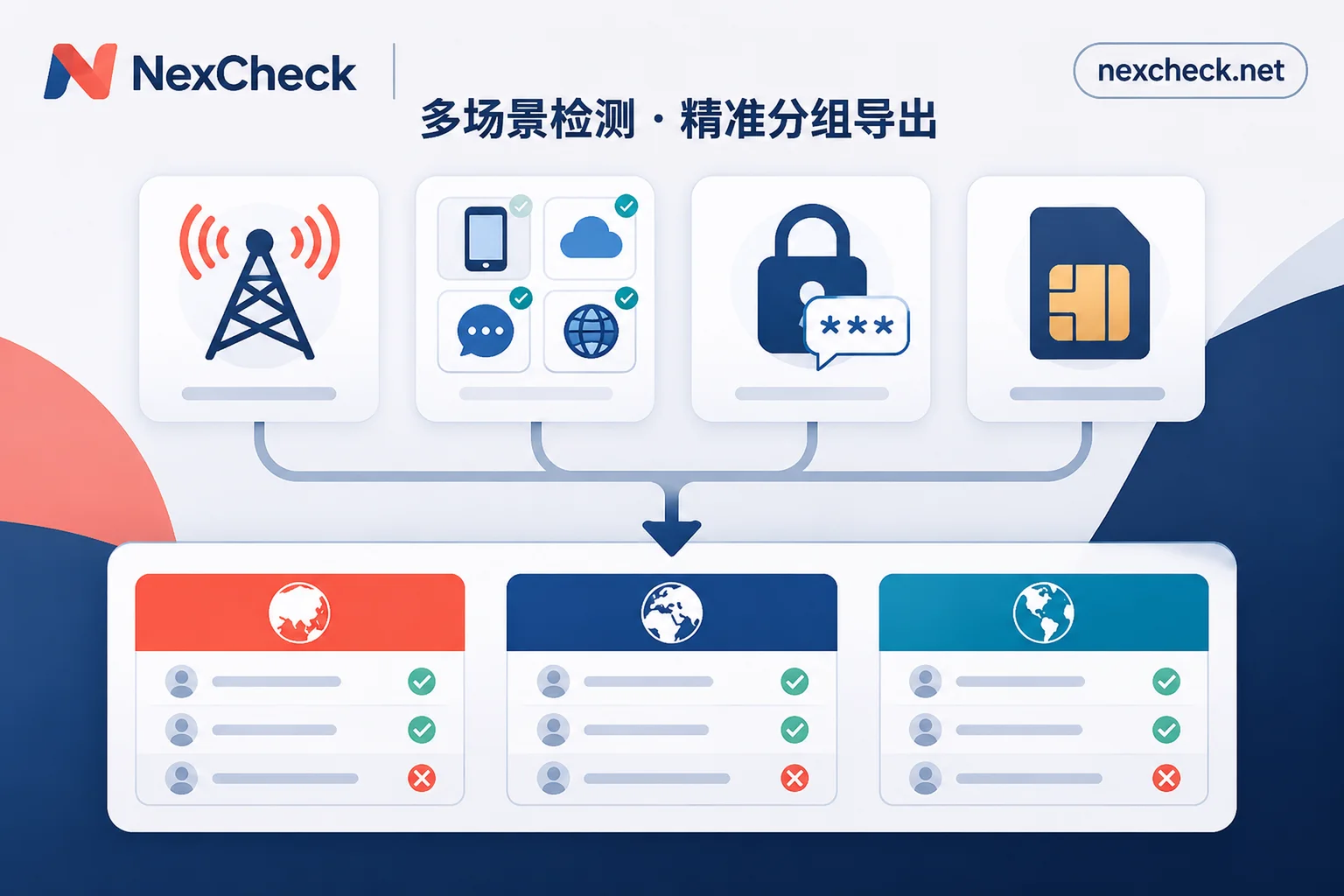
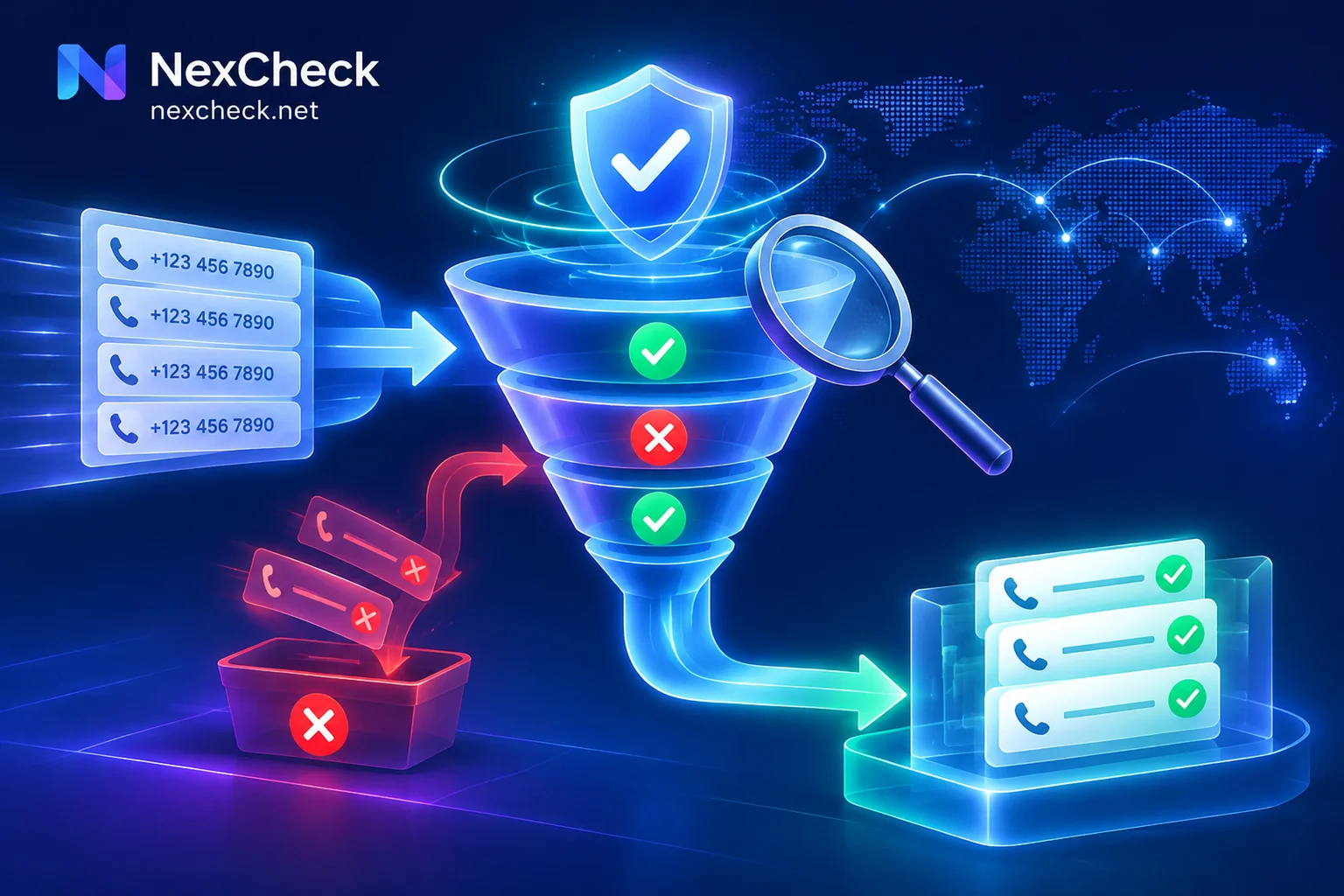
Let's start with the conclusion: these four types of tools solve fundamentally different problems. If you already have a customer or contact list and want to find out, without sending messages or disturbing the recipients, whether the numbers are reachable and which social or financial apps they are registered on, you need a invalid-number/cross-ecosystem bulk screening platform (for domestic pure SMS/call outreach, use domestic three-network invalid-number detection; for cross-border/overseas multi-app reach, use a cross-ecosystem detection platform like NexCheck). If you need to verify the identity of the person operating when registering or logging into an app, you need an OTP or one-click login authentication platform. If you're looking for a temporary number to register an account and receive verification codes, that's an SMS receiving platform, which is the opposite of "verifying an existing customer list."
Below, we'll thoroughly explain the tool categories, underlying principles, and practical implementation steps, covering the most common pitfalls before purchasing and using these services.
I. 4 Common Types of Tools When Searching for "Number Detection Platform" – Identify Yours First
Many teams buy the wrong tools or recharge the wrong service because they confuse these four similarly named services.
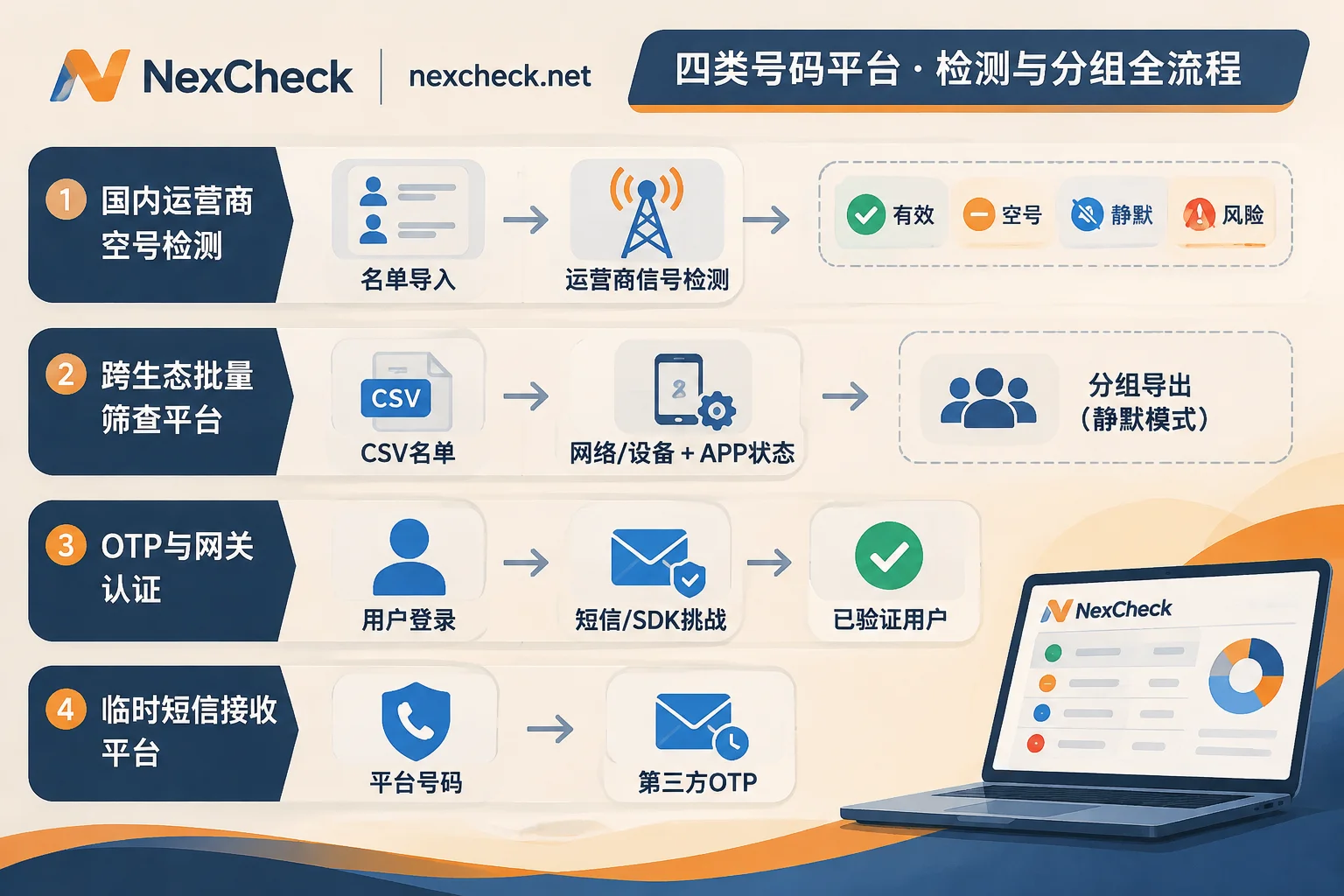
| Platform Type | Core Purpose | Typical Input and Output | Whether It Contacts/Disturbs the Number Holder | Target Users |
|---|---|---|---|---|
| Domestic Three-Network Invalid Number Detection Platform | Clean 11-digit mainland China mobile numbers | Outputs real numbers, invalid numbers, silent numbers, risk numbers, mobile number portability, etc. | No (silent detection) | Domestic SMS bulk senders, telemarketing teams |
| Cross-Ecosystem Bulk Number Screening Platform (e.g., NexCheck) | Bulk verify international numbers' network status and app registration/activity status | Outputs valid/invalid groups, device/carrier, and publicly available attributes such as app registration and activity | No (no verification codes, no messages sent) | Overseas marketing, cross-border e-commerce, CRM data cleaning, and developers |
| OTP SMS/One-Click Login Authentication Platform | Identity verification during user registration, login, and transactions | Sends SMS/voice/WhatsApp OTP or calls gateway to obtain and verify number | Yes (requires user to receive code or authorize on device) | App and website development and security risk control teams |
| SMS Receiving/Virtual Number Platform | Obtain one-time or rented numbers to receive verification codes | Platform gives you a number; you receive verification codes on third-party websites | Not applicable (you are not verifying existing customers) | Software testing, account registration, etc. |
In specific scenarios, if you've confused these concepts before, remember two boundaries:
- OTP authentication cannot be used to clean existing CRM lists: Sending verification codes to dormant old customers is both disruptive and generates high international SMS bills, and may even trigger complaints.
- Domestic three-network invalid number platforms cannot handle overseas and application layers: Domestic invalid number platforms mainly connect to China Mobile, China Unicom, and China Telecom data. They neither cover overseas carriers nor can they tell you whether a Vietnamese or Brazilian number is registered on WhatsApp, Zalo, or Shopee.
II. Why Do Prices and Accuracy Vary So Much for Services Also Called "Detection"?
Even if you've chosen the right direction—"bulk screening existing customer lists"—different platforms offer vastly different prices (from a fraction of a cent to several cents per number) and result definitions. The key lies in which layer the detection is at and whether it uses a cache database or real-time detection.
1. The Three Layers of Number Detection: Don't Use Conclusions from One Layer for Another
A list goes through three stages from acquisition to being usable for precise outreach:
- Format Standardization Layer: Only checks whether the country code, digit count, and numbering rules comply with the E.164 international standard (e.g., removing spaces, parentheses, and extra leading zeros). Correct format only means the notation is compliant, not that the number actually exists.
- Basic Communication and Device Layer: Determines whether a number is invalid, on/off, belongs to a mobile or VoIP virtual number, current carrier (including mobile number portability), and whether it's an iOS or Android device, whether it supports RCS, etc. In international scenarios, common HLR (Home Location Register) real-time queries check a number's network and roaming status by signaling the mobile operator's network.
- Application Ecosystem Layer: Checks whether this number (or email,
@用户名) is registered on specific platforms like WhatsApp, Telegram, LINE, Zalo, Facebook, Binance, Amazon, etc., whether it has been recently active, and whether it has been banned.
A common pitfall for those new to overseas business: they only perform basic invalid-number detection and, seeing "real number," directly launch WhatsApp or LINE marketing, only to face massive bounce rates or account restrictions—because a number being active with the carrier doesn't mean the owner has registered on your target social app.
2. The Difference Between "Cache Database Pre-Screening" and "Real-Time Status Query"
In domestic invalid-number detection and some basic channels, you often see two tiers with prices differing by several times:
- Cache/Big Data Pre-Screening: Compares against historical traffic and carrier periodic data. Advantages are extremely fast throughput and very low unit price, suitable for low-cost rough screening of hundreds of thousands or millions of records; disadvantages include time delay—recently deactivated numbers may still be marked as "real," and recently reactivated numbers may be falsely flagged.
- Real-Time Query Channel: Requests real-time status from the network or target ecosystem interface one by one, reflecting the on/off, network, or account registration status at the moment of query. Unit price is higher than cache pre-screening, and concurrency is limited by interface rate limits, but it's more suitable for precise checks before high-value outreach or CRM entry.
It must be clear: no platform can "guarantee a single result is absolutely correct" or permanently valid—the number holder may have suspended service yesterday or changed number/deactivated account today; detection results only reflect the status at the moment of query. For how to identify "99% accuracy" claims and free tricks in the market, refer to this article Are Number Screening Platforms Reliable? Verification Methods.
3. Platform and Privacy Boundaries: Which Fields Simply Cannot Be Queried?
If a platform claims "regardless of privacy settings, we can extract avatars, age, and precise coordinates," it's basically exaggerating. Legitimate bulk screening can only read dimensions allowed by system mechanisms and publicly available by users:
- Basic Network Layer can determine invalid/on-off status, number type, carrier, iOS blue check (only confirming Apple-side association, not specific model, OS version, or Apple account), and US high-risk complaint numbers, etc.
- Application Ecosystem Layer is highly constrained by target platform rules: for example, in NexCheck's actual detection specifications, WhatsApp's avatar, signature, and last seen time are limited by user privacy settings; Telegram profiles have no gender or age fields; related judgments depend on the user's public name and avatar; Facebook's gender and avatar can only read fields set to public by the user; and services like Cash App, OKX, Coinbase, Discord that have no platform-specific detection items can only stay at the basic number detection layer.
III. How to Choose Between Single-Number Web Tools, Browser Plugins, Bulk Platforms, and APIs?
Once you've determined "which layer to check," you still need to decide the tool format. Different team sizes and business frequencies correspond to completely different choices:
- Free single-number online check: Suitable for temporarily verifying the carrier of a few numbers or one-off checks. For thousands of CRM records, manually pasting each one is impractical.
- Browser-mounted plugins (e.g., detection plugins based on personal WhatsApp Web sessions): Low barrier, seemingly "free," but each request actually consumes your own local account session. Bulk requests easily trigger risk control rate limits or even account bans, and cannot detect cross-platform.
- Independent cloud-based bulk screening platforms: Upload CSV, TXT, or XLSX files; the platform processes them asynchronously with concurrent queues; results are exported in valid and invalid groups. Suitable for daily cleaning by marketing, operations, and data teams.
- API real-time/asynchronous integration: Suitable for development teams to embed detection into registration forms, lead intake flows, or CRM automated workflows. For choosing between polling and callbacks, see Number Screening API Selection and Interface Boundaries.
For Overseas and Cross-Border Business, How to Use NexCheck for Multi-Layer Screening?
If your list targets overseas markets and you need to balance basic number status and multi-platform account ecosystem in the same workflow, take a look at the design of Number Detection Platform NexCheck (nexcheck.net):
- Covers five ecosystem groups plus the basic layer: Supports instant messaging (WhatsApp, Telegram, LINE, Zalo, Viber, Botim, RCS, KakaoTalk, Band, Signal), social media (Facebook, Instagram, TikTok, Twitter/X, Snapchat, LinkedIn US/India only, Moj), crypto and finance (Binance, KuCoin, CoinW, HTX, MEXC, Robinhood, Nasdaq, etc., some support email detection), e-commerce and logistics (Amazon, Temu, Shopee, Coupang, Flipkart, DHL, etc.), office and local life, as well as basic detection of invalid/on-off status, carrier, device model, iOS/Android split, and US high-risk numbers.
- Silent verification and prepaid mechanism: The query process does not log into customer accounts or send verification codes to target numbers (e.g., the Binance page explicitly states that queries do not log into Binance and do not send verification codes). It uses a prepaid model—recharge first, then deduct per query. Fees are deducted when a task is created, and failed tasks are automatically fully refunded. For specific supported regions, unit prices, and quantity ranges, refer to the real-time price list in the console.
- Free local browser preprocessing: Before paid upload, you can use NexCheck's built-in free number cleaning tool. It runs locally in the browser, does not create paid tasks, and can automatically identify separators, complete country codes based on the default country, convert to E.164, and deduplicate.
- Layered "Continue Detection" to save budget: After submitting a task in the console, you can use the "Continue Detection" feature to directly use the valid results from the previous round as input for a new project, avoiding repeated charges for already invalid numbers.
- Developer integration support: The website provides a RESTful API (supporting bulk submission, real-time queries, and Webhook callbacks). Since the public manual does not directly list interface addresses and authentication details, teams needing integration can contact customer service after registration (Telegram:
https://t.me/nextipkf) for integration support.
Two factual boundaries need special attention: First, NexCheck's regional solution pages cover local realities and recommended screening sequences for multiple overseas countries and regions, but there is no mainland China page—if your business is 100% domestic three-network 11-digit SMS/telemarketing number cleaning, a domestic carrier invalid-number platform is more suitable. Second, NexCheck does not provide SMS bulk sending, SMS receiving, or fingerprint browsers; its positioning is to do the "detection and cleaning" step thoroughly.
IV. After Getting the List, Follow These 4 Steps to Avoid Pitfalls
Regardless of which platform you ultimately choose, before uploading thousands of records and incurring charges, it's recommended to go through these 4 steps:
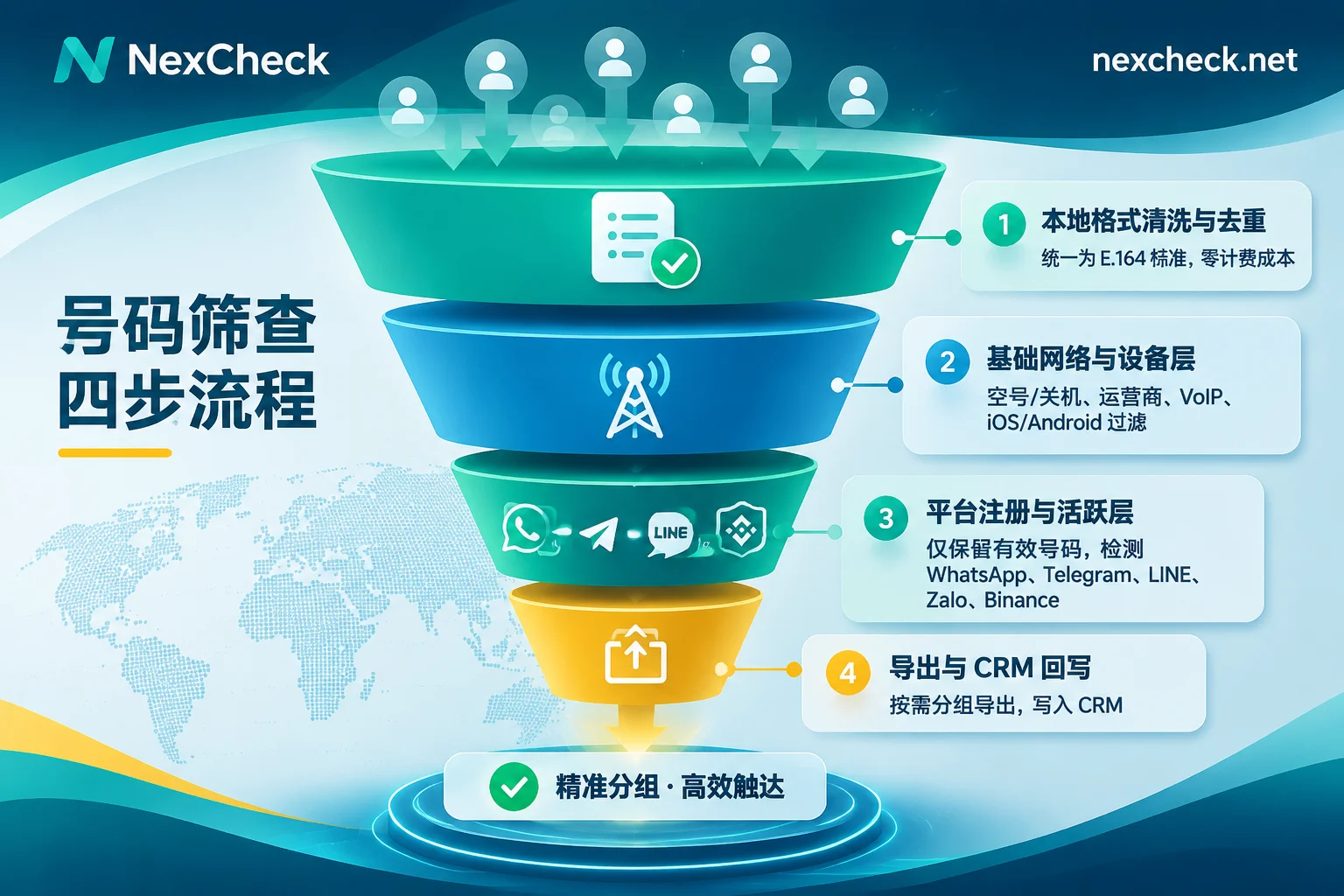
1. Clean Format First, Then Deduplicate—Don't Pay for Duplicate Numbers
Many bulk platforms do not automatically deduplicate when creating tasks (including NexCheck console bulk upload, where duplicate values are still charged). Before uploading CSV/TXT/XLSX, be sure to unify locally into E.164 format with country codes and deduplicate. Also note special country rules—for example, when screening Vietnamese Zalo, it must be the 10-digit new format after the 2018 reform; uploading old 11-digit numbers directly will yield no results. If you select the wrong "default country" in the cleaning tool, the entire batch will become dirty data with "correct format but all wrong country codes."
2. Detect in a "Funnel Order" Layer by Layer, Not All at Once
Suppose you want to import a batch of US e-commerce leads into WhatsApp and SMS marketing pools: the most budget-saving approach is not to buy the most expensive "active + gender/age" full package right away, but to first run basic invalid/high-risk filtering (or first run primary communication platform registration screening by country), then use "Continue Detection" on the "valid" group to check activity ranges or supplement profile fields. Different platforms have subdivisions for detection channels (e.g., speed, coverage, and result definitions). First run a small sample to compare field availability before scaling up.
3. Clarify Data Archiving Boundaries—Write Results Back to Your Own CRM After Export
Never treat any online detection platform's task center as long-term cloud storage or a primary database. For example, NexCheck does not promise a long retention period for result files; after detection, download the grouped results immediately, write tags such as "valid/invalid/platform registration/activity status" back to independent fields in your own CRM, and clean up task records when needed.
4. Maintain Data Compliance and Source Bottom Lines
Whether domestic or overseas lists, the customer is the data controller and must ensure that the source and subsequent use of submitted numbers comply with local privacy and communication regulations, and do not submit personal data you have no right to process. Also check the platform's privacy policy—confirm that the platform processes the list only within the scope of executing the current detection task, does not resell data, and does not use your customer list to build a number database for external sale (for more details on legality and privacy boundaries, see Legality and Privacy Boundaries of Social Platform Number Screening).
Summary: 10-Second Quick Decision
- Domestic 11-digit SMS/outbound invalid-number cleaning → Choose domestic three-network invalid-number detection (use cache for large-scale rough screening, real-time status detection for high precision).
- App/website registration and login anti-fraud verification → Choose OTP SMS/voice or carrier one-click login platform.
- Need virtual numbers to receive verification codes sent by others → Find compliant SMS receiving/number rental services, not invalid-number detection.
- Have cross-border/overseas customer lists and need silent screening of invalid numbers, devices, and WhatsApp/TG/LINE/social media/finance registration and activity → First use local tools for E.164 formatting and deduplication, then go to the NexCheck console to perform bulk detection by channel and layer as needed, and export results back to your CRM.