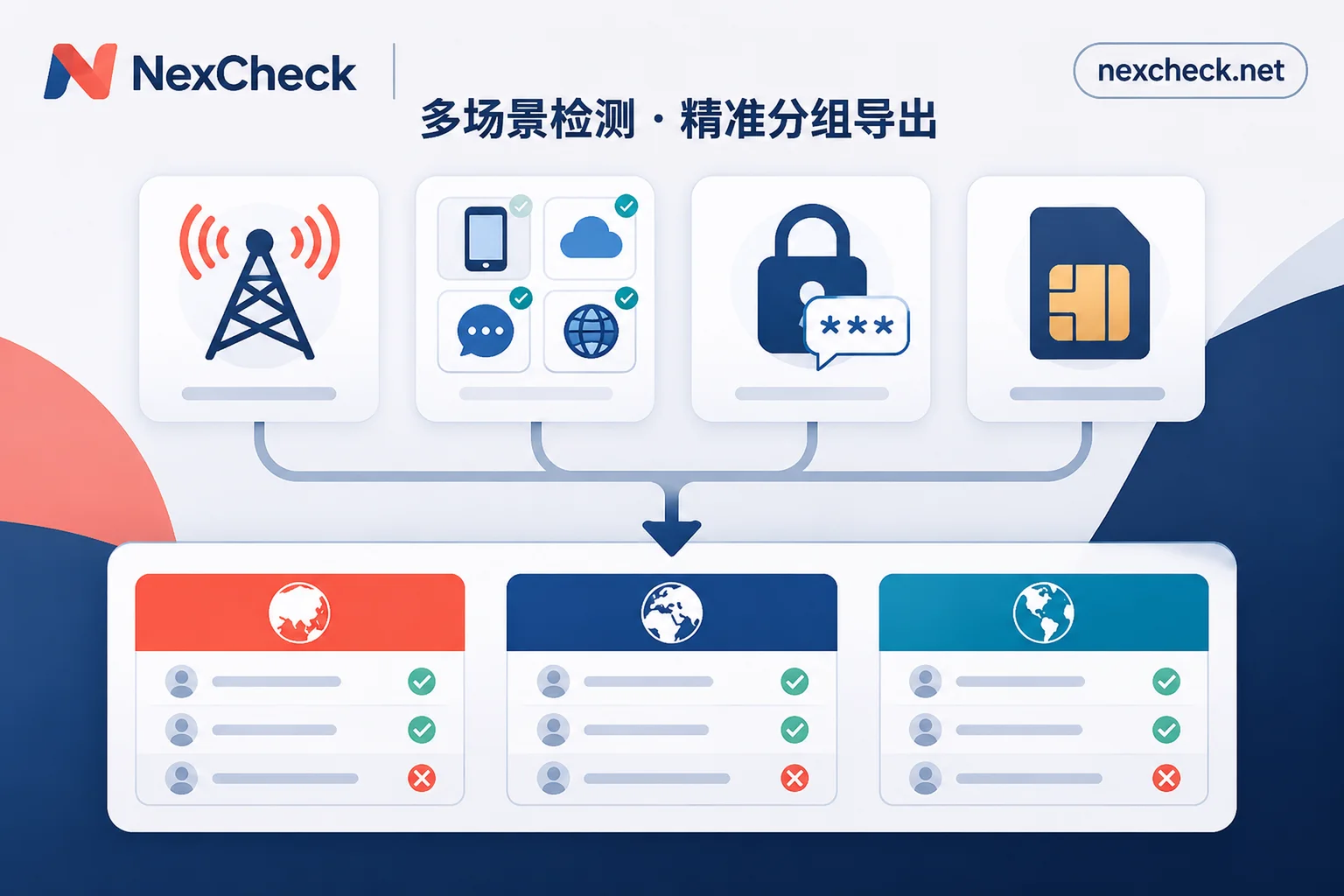
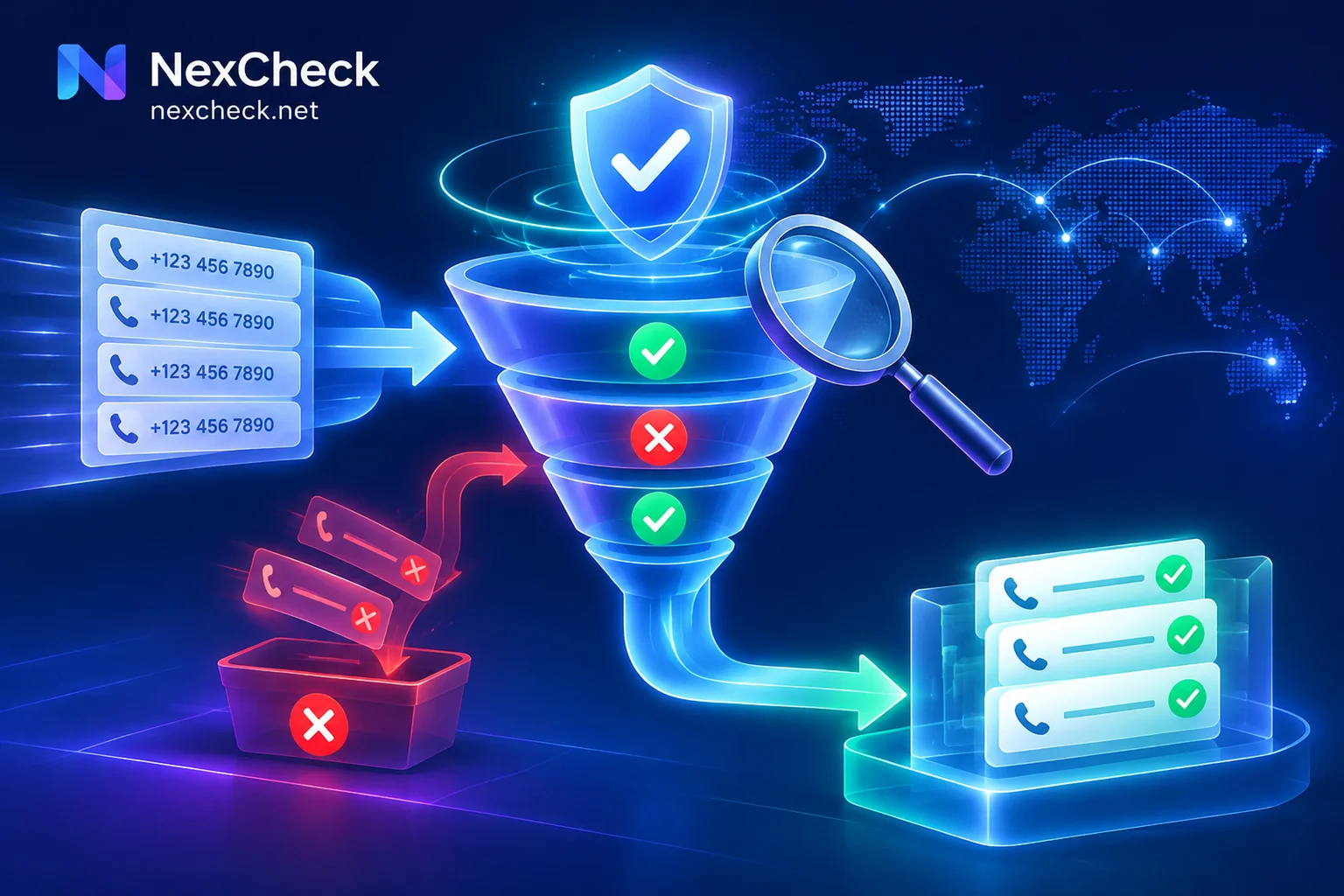
 NexCheck-筛号平台
Let's start with the conclusion: A legitimate number screening platform is reliable and useful. It can help you identify invalid, unregistered, banned, and long-term inactive numbers in your list in advance, reducing the cost of ineffective outreach. However, many services on the market that advertise "free and all-powerful," "99.9% accuracy," or "can even read users' hidden private data" are basically unreliable.
People who just type "number screening platform" into the search box often already know what it does; they are simply confused by the contradictory information flooding their screens: on one hand, various ads promise "screening hundreds of millions per day, accurately identifying gender, age, and online status"; on the other hand, some complain, "I still got banned after screening," "I couldn't find customer service right after recharging," or even "my list was leaked and I was harassed by competitors the next day."
To judge whether a number screening platform is reliable, you don't need to listen to sales pitches. Below, we break down the four most common traps and provide a 4-step blind test verification method that you can complete in 15 minutes before recharging.
I. Why Do Many People Think "Number Screening Platforms Are Unreliable"? 4 Real Sources of Pitfalls
1. Inflated claims of "99% accuracy," even boasting the ability to bypass privacy settings
Any social, instant messaging, or financial platform has strict data privacy and API boundaries. No matter how advanced the technology, it is impossible to bypass the platform's underlying restrictions. If you see a platform claiming "100% accuracy across all platforms" or "can screen age, gender, and precise active time from all apps," you should immediately raise doubts:
- Privacy settings are unreadable: For example, on WhatsApp, if a user sets their avatar, signature, or last seen to "contacts only" or "nobody," external bulk queries cannot read these fields; Facebook's gender and avatar are likewise only read if the user has set them to public.
- The platform itself doesn't have that field: For instance, Telegram's profile page has no "gender" or "age" fields at all. The so-called "TG gender and age identification" on the market is essentially inferred from users' public nicknames and avatars, and its usability depends entirely on how much information the person has made public. For apps with strong privacy architectures like Signal, external parties can almost only make a binary judgment of whether the number is registered; claims of "Signal deep activity detection" are often just pieced together from indirect data.
- Results only represent the moment of query: Numbers can be deactivated or changed, and users can modify privacy switches at any time. No tool can guarantee that a single result is always and absolutely correct.
2. Falling for "free tools" or "low-cost manual screening" and handing over your customer list
When searching for number screening, two high-risk channels are common: various "free online screening webpages/bots" and individuals in chat groups offering "manual screening" services.
Free tools often have problems beyond low quotas or delayed results. More critically, they lack clear privacy policies. Some even require you to scan a QR code to log in to your own operational account or authorize access to your local contacts to trigger queries—this is tantamount to using your own account to hit the platform's bulk risk control red lines (for more on QR code login and ban avoidance, see 《How to Choose a Number Screening Platform? From QR Code Dead Account Avoidance and Customer List Leak Prevention to Cross-Ecosystem Bulk Verification Solutions》).
Sending your raw customer CSV directly to a third-party individual for "manual screening" carries even higher data leakage risks: you have no control over whether the other party keeps a copy or packages and resells it to other buyers. In addition, there have been scams where fake customer service representatives of well-known platforms promote "low-cost recharge" in private chats and guide users to transfer money to personal wallets. Once you pay outside the official website entrance, you are likely to lose everything.
3. Black-box billing and hidden consumption from "repeated numbers charged as usual"
Many users only discover opaque rules after recharging on small platforms:
- A single file contains many numbers with inconsistent formats or duplicates. After uploading, there is no warning or deduplication, and you are charged double based on the number of rows;
- If a batch task fails due to channel fluctuations, the balance is not automatically refunded;
- Low-cost "basic registration check" is used to attract you to recharge, but you later find that you must bind a high-threshold regional package to use it, or the stacked billing rules for multi-step checks are ambiguously written.
4. Mistaking "valid number" for "can mass send without being banned"
Another gap comes from misplaced expectations. A number screening platform essentially only performs data-level status verification—telling you whether a number is registered on a certain platform, whether it is banned, and whether it has been active recently. It does not judge the number holder's purchase intention, nor can it replace legal and compliant contact permission (Opt-in). If your messaging script looks like spam, you haven't obtained user authorization, or the sending account itself is newly registered and not warmed up, even if the list is 100% real, sending messages will still get you reported by recipients or restricted by the platform's risk control.
II. What Should a Reliable Number Screening Platform Look Like? Self-Check Against This Table
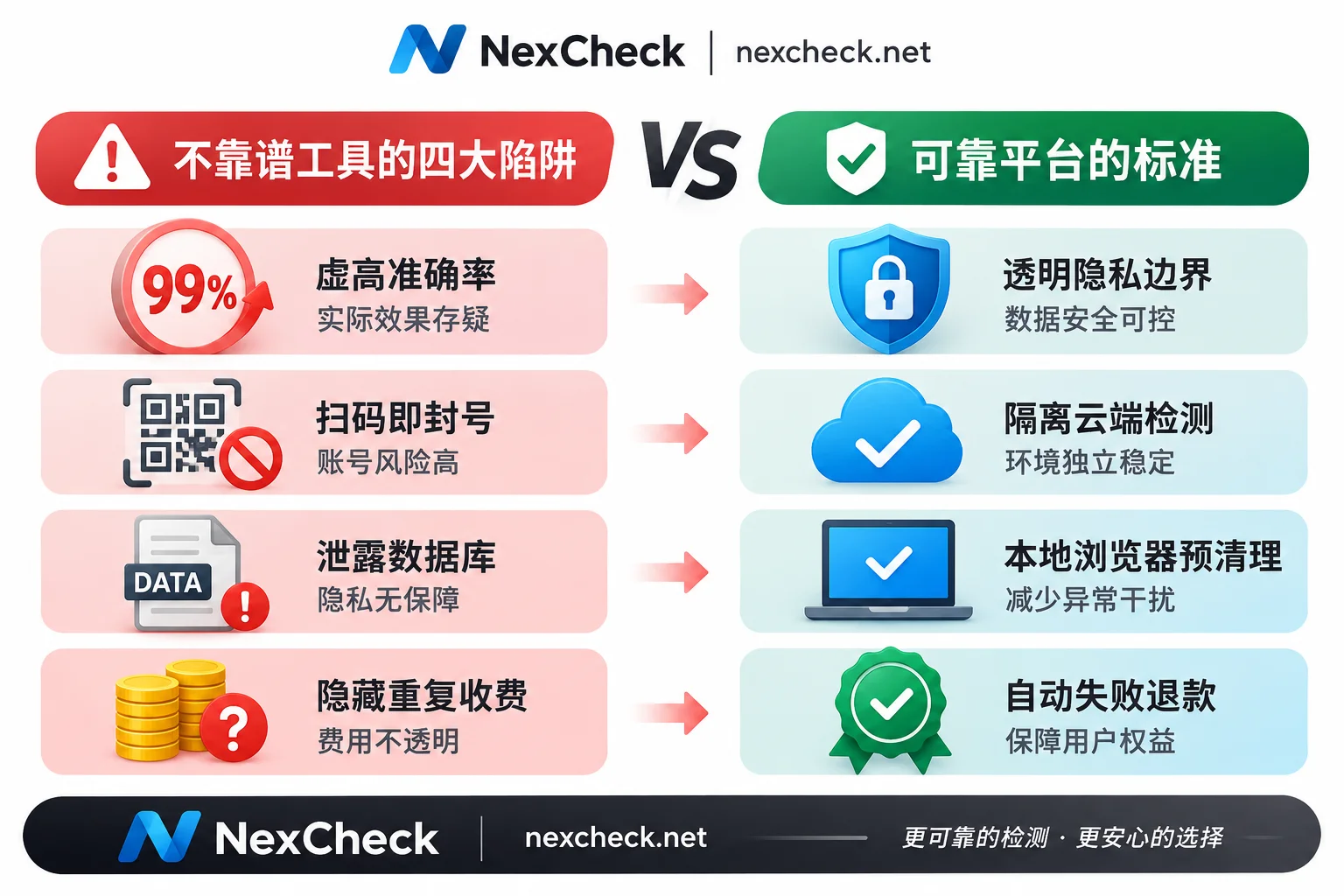
Comparing wildcat tools on the market with standardized professional platforms, the differences mainly appear in the following five dimensions:
| Verification Dimension | High-risk/Unreliable Screening Channels | Standard Reliable Professional Screening Platforms |
|---|---|---|
| Capability and boundary declaration | Often promise "99.9% accuracy," even claim hidden private data will always be returned | Clearly distinguish platforms and channels, honestly inform which fields cannot be read due to privacy settings or architecture limitations |
| Operation and security isolation | Require scanning QR code to log in to your business account, or send lists to private manual screeners | Independent task queue execution, no binding to user business accounts, customers can view, export, and delete in their own console |
| Preprocessing and deduplication mechanism | Dirty data uploaded is charged in full without warning about format errors | Remind standard format (e.g., E.164), even provide free local cleaning tools to deduplicate and correct before submission |
| Billing and failure refund | Opaque pricing, forced high-priced packages, disputes and no refunds on failed tasks | Clear pricing in console, pay-per-item, charged upon task creation and automatically fully refunded if task fails |
| Compliance and responsibility boundaries | Package and sell "ready-made customer databases," even bundle with gray-market mass sending | Clearly process customer's own data only within the scope of executing tasks, do not sell lists, do not build external number databases |
Take our own product NexCheck as an example. As a prepaid bulk number and email screening platform, we put "transparent boundaries" first in our design. You can directly use our practices as an industry reference standard:
- Capabilities are clearly separated by ecosystem and channel, no vague bundling: The platform overview page lists detection items and coverage regions grouped into five categories: Instant Messaging, Social Media, Encryption & Finance, E-commerce & Logistics, and Office/Local Life/Devices. For example, WhatsApp clearly distinguishes registration (Fast/SVIP channels), registration time, four-dimensional activity, zombie/advertising numbers, banned numbers, etc., and directly states that avatar, signature, and last seen are subject to user privacy restrictions; Zalo explicitly warns that Vietnamese numbers must first be converted to the 10-digit format after the 2018 reform, and old 11-digit numbers cannot be checked; LinkedIn registration screening explicitly states it only supports the US and India; Binance detection clearly states that the query does not log in to Binance and does not send verification codes to the number; iOS blue check explicitly answers only "whether it is on the Apple side," excluding specific model, system version, and Apple account; and for apps like Cash App, OKX, Coinbase, Discord that have no platform-specific detection items, the platform directly informs that only basic number-level checks such as invalid number, carrier, and device type can be performed, and will not fabricate fake fields.
- Put local cleaning before charging: The NexCheck console explicitly states that after uploading a file, it will not automatically deduplicate, and duplicate values will be charged as usual. Therefore, in the user manual and number cleaning tool, we directly provide a free cleaning tool that runs entirely in the browser—no paid task is created. It first helps you locally identify delimiters, complete area codes based on the default country, convert to E.164 standard format, and deduplicate (note: choose the default country correctly, otherwise the format will be correct but the attribution will be wrong). Calculate the valid count before uploading.
- Billing and data ownership rules are in black and white: Registration is free, and the model is recharge first and then pay-per-item. The unit price is subject to the console price list. Charges are deducted when a task is created, and if the task fails, a full refund is automatically issued. If you use "Continue Detection" to send screened results to the next project, the system will also prompt that this is a new task and will be charged separately. At the data level, the list submitted by the customer always belongs to the customer. The platform processes it only within the scope of executing detection tasks, never sells it, and does not use it to build number databases for external sale. Customers can view, export, and delete at any time in the console (the console does not archive long-term; it is recommended to export and back up in time; see Privacy Policy for details).
III. Don't Listen to Marketing, Test It Yourself: 4-Step Verification Method for Choosing Any Number Screening Platform
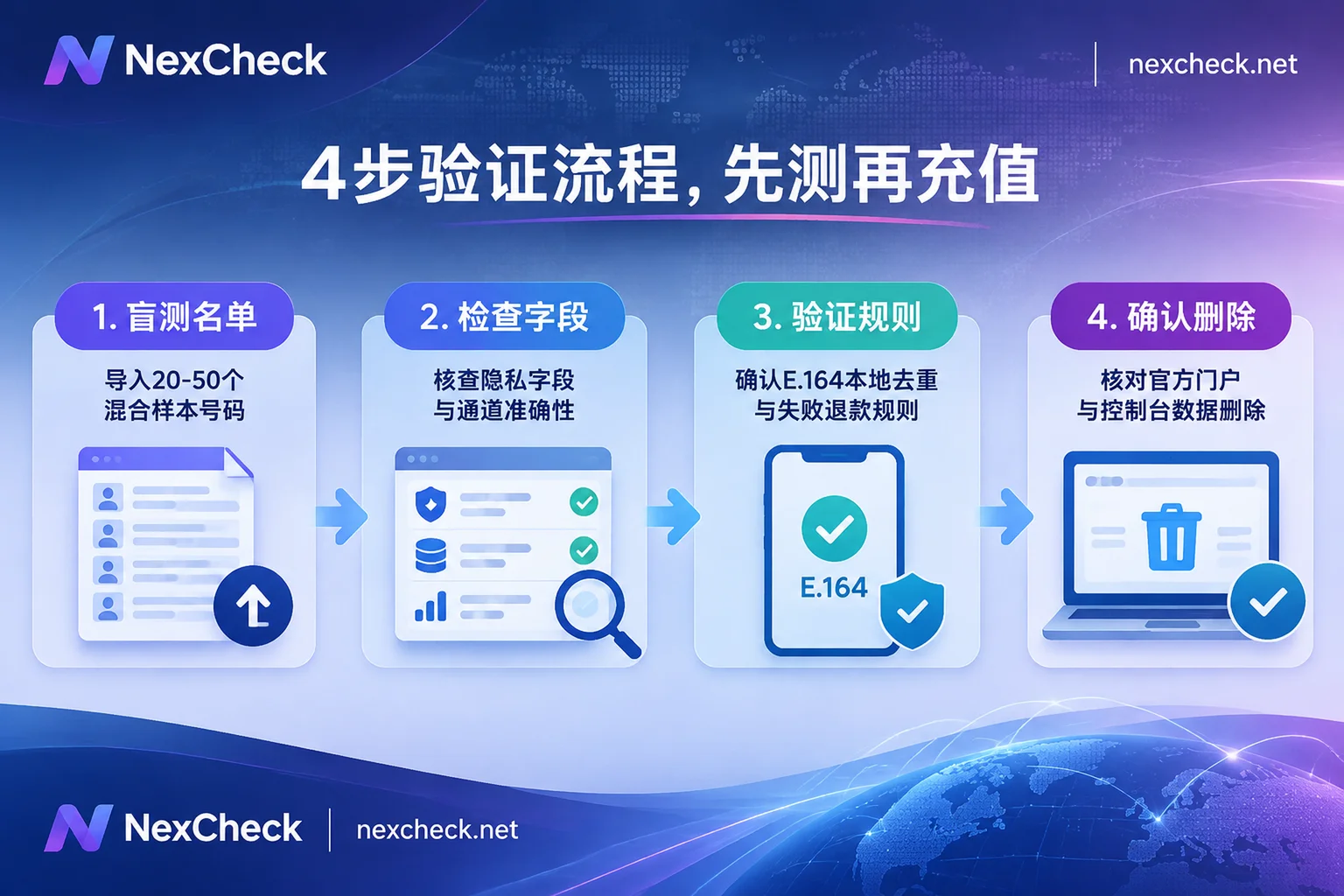
Regardless of which number screening platform you ultimately plan to use, before officially recharging a large budget, it is recommended to spend 15 minutes doing a low-cost verification following these four steps:
Step 1: Prepare 20–50 "known-status" numbers as a blind test control group
Don't upload 100,000 real customer records right away. First, use a small sample mixed with test numbers whose status is known to you and your team (note: check the minimum submission quantity required by the target detection item in the console in advance to ensure the sample size falls within the range). It is best to deliberately mix in four types of numbers:
- Numbers confirmed to be registered with public profiles: to check the basic detection rate;
- Numbers confirmed to be registered but with avatar and last seen set to private: to test whether the platform "makes up data";
- Numbers confirmed not registered on the target platform or deactivated invalid numbers: to test the false positive rate;
- Numbers with spaces/leading zeros or deliberately duplicated: to test cleaning and fool-proofing mechanisms.
Step 2: Compare returned results, focus on how "gray areas" are handled
After running the sample, don't just look at "whether the valid rate is high." Focus on two things:
- Are privacy numbers forcibly "filled with fields"? If a test number whose last seen time or age you clearly hid returns specific values from the platform, this is often the result of a static cache database or even random inference;
- Are missed detections and channel differences reasonable? If individual registered numbers are not detected, first check whether the number format is standard, or whether it is due to recent registration or privacy restrictions (for specific troubleshooting ideas, see 《Why Does Social Account Registration Detection Miss? Three-Tier Results and Sampling Review》). If necessary, cross-compare between the same platform's fast channel and stable/SVIP channel.
Step 3: Run through the "cleaning → billing → export" ledger
Before making a small recharge for the first batch of tasks, format and deduplicate your data locally. When uploading, note that the first column of CSV/TXT/XLSX should contain the target values, and select the correct country or region for the numbers. After submission, verify three accounts:
- Whether the actual charged amount exactly matches the console's public price list × number of items submitted;
- Whether there are hidden package bundles or minimum spending thresholds;
- Whether the refund mechanism is automatically triggered when task status is abnormal or fails.
For the complete standardized operation sequence, you can directly refer to 《How to Use a Number Screening Platform? Complete Process from List Preparation to Result Write-Back》.
Step 4: Verify official entrances, data deletion rights, and compliance boundaries
Before paying and uploading sensitive lists, be sure to confirm the three bottom lines:
- Only use official entrances: For example, log in to the console through the official registration page (app.nexcheck.net/register), and only contact customer service channels publicly listed on the official website (e.g., Telegram @nextipkf). Do not transfer money to any personal address promoted in private chats. If you need to integrate detection into your CRM, you can first consult official customer service about RESTful API, real-time query, and Webhook callback integration details.
- Confirm data deletion capability: After testing, confirm whether the console supports timely deletion of the original list after exporting task results.
- Maintain compliance of data sources: As a data controller, only submit customer and contact lists that you have legal permission to process, and avoid violating regional privacy regulations (for compliance key points, see 《Is Social Platform Number Screening Legal? Will It Alert Customers or Violate Privacy Laws?》).
IV. Quick Answers to Common Questions (FAQ)
Q1: Why does the same list show very different valid rates on two screening platforms?
There are usually three reasons: First, different detection criteria. Some platforms only check "whether registered," while other channels further filter out zombie accounts, banned accounts, or long-term inactive accounts, resulting in a lower but higher-quality valid rate. Second, different preprocessing standards. For example, not adding country codes, retaining leading zeros, or not converting old 11-digit Vietnamese numbers to 10 digits will lower the hit rate. Third, number status changes dynamically. Carrier number recycling, user deactivation, or privacy switch changes can cause differences in results at different times.
Q2: If I clean my list with a number screening platform, will mass sending no longer get me banned?
No. A number screening platform solves the problem of "not wasting messages on invalid, unregistered, and dead numbers," which can significantly remove invalid delivery signals that most easily trigger platform anti-spam alarms. However, whether you get banned later still depends on whether you have active user authorization (Opt-in), whether the sending frequency is restrained, whether the copy is homogenized, and whether the sending account itself is healthy. Screening is the first step to reduce waste and risk control risks, not a free pass for mass sending.
Q3: I only have a few hundred to a thousand numbers. Is it necessary to use a paid screening platform?
If it's just a few dozen numbers for internal verification, manually adding contacts or checking one by one is enough. Once the list reaches hundreds or thousands, manual verification is extremely labor-intensive and highly likely to be restricted by the platform due to high-frequency operations. In this case, choosing a pay-per-item prepaid platform with no subscription bundle (combined with free local deduplication and cleaning), the detection cost of a few cents to a few thousandths per item is usually far lower than the cost of an international SMS, a WhatsApp Business per-message fee, or the loss of a mature operational account.