 NexCheck-筛号平台
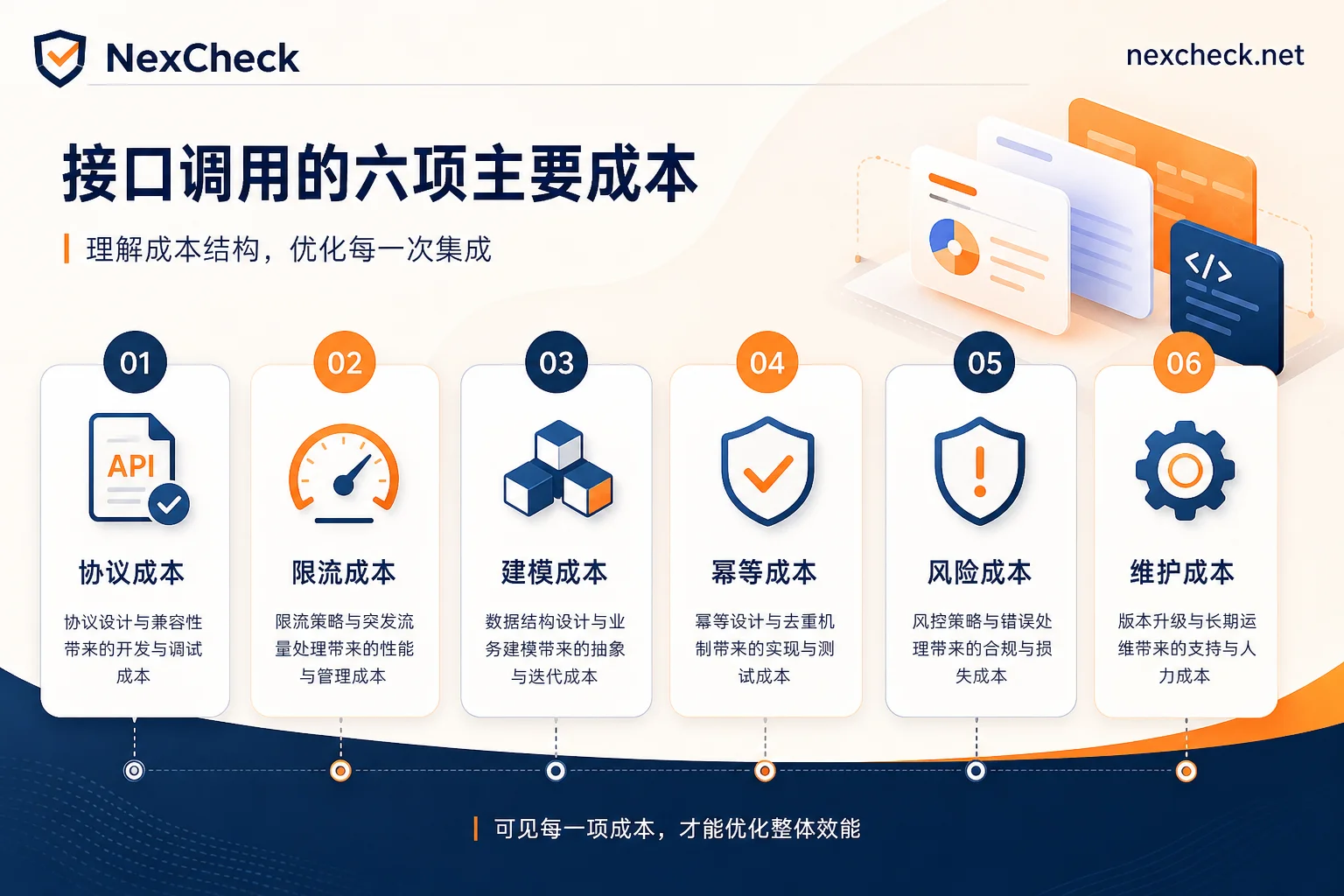
Deciding whether to build or buy a global number screening system comes down to three conditions: how many platforms you need to cover, how often your list refreshes, and who bears compliance and data retention responsibility. Unit price is not the deciding variable—because the real cost drivers hide in engineering details like API protocol constraints, rate limiting strategies, and result modeling. Below, we break down the six costs that self-builders most often overlook, based on the hard constraints in official documentation.
First, the Decision Criteria: Three Conditions Determine Direction, Not Unit Price
Before diving into development, answer three questions: How many platforms does your list need to cover? How often do you refresh a round during normal operations? If something goes wrong with the number data, who bears the compliance responsibility?
Take Telegram as an example. Its MTProto official protocol clearly states that when calling contacts.resolvePhone (official documentation) to resolve a phone number, the client must implement rate limiting (debounce), with a maximum of 1 call every 3 seconds. That means for each platform you connect, you must write a separate rate limiting and backoff logic, which cannot be reused across platforms. The more platforms, the higher the marginal cost of this engineering. So platform count is the first decision variable.
The refresh frequency determines how many times the same detection logic must run. If it's just a one-time cleanup before an event, building in-house might be acceptable; but if you're a SCRM or customer data platform that needs weekly or even daily refreshes, the ongoing computational resources and maintenance costs will quickly accumulate.
Compliance responsibility is the most underestimated. Whether the data source is legal and whether users have authorized it—these issues do not automatically disappear just because the system is self-built. Regardless of the approach, the responsibility lies with the business, but self-building means you must handle all the explanation and evidence burden yourself.
Cost 1: Inconsistent Protocol Semantics—Phone Number, User ID, msisdn Are Not the Same Across Platforms
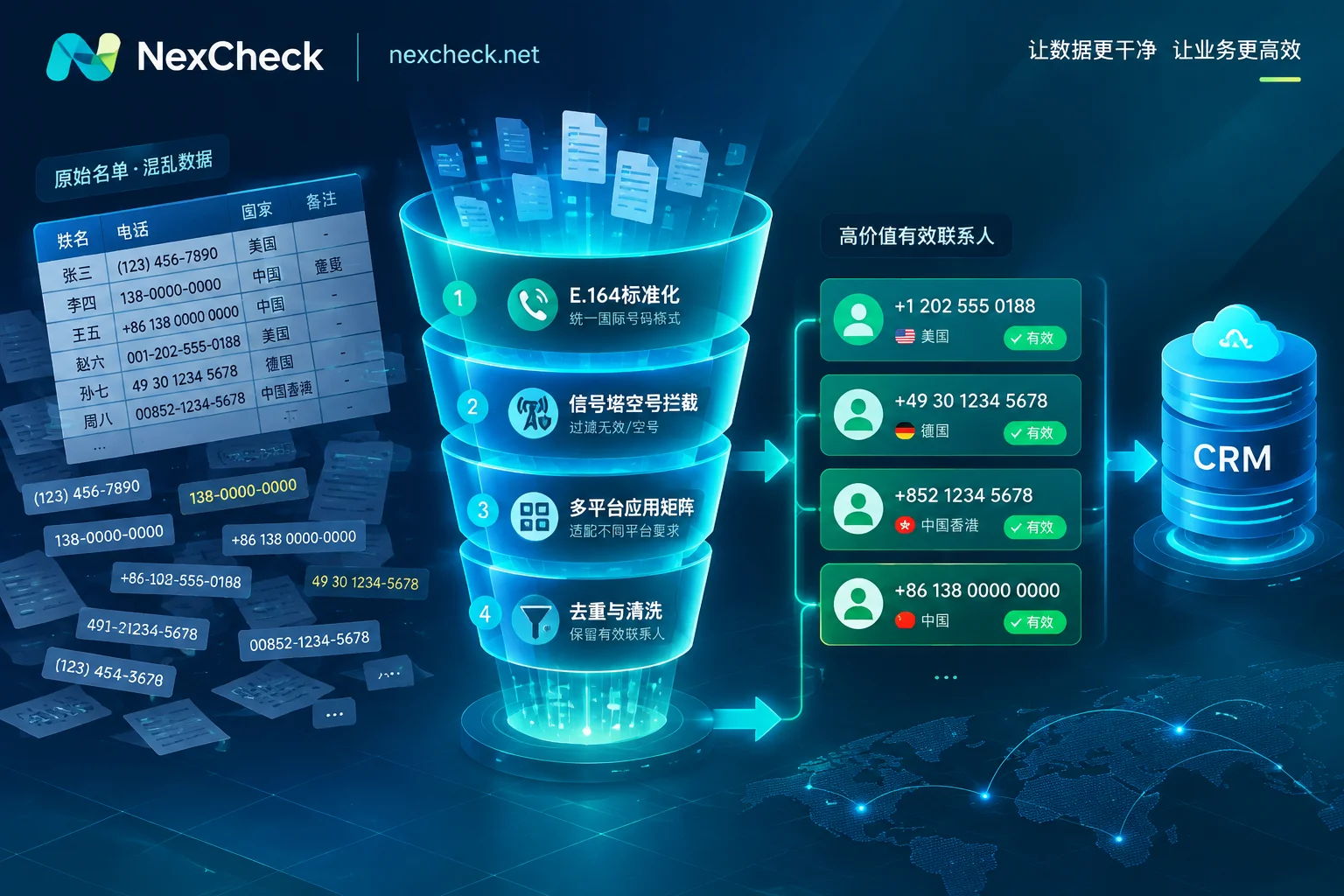
Different platforms have different number identification systems; some use phone numbers, others use User IDs, and some require msisdn format. A self-built system must first do E.164 normalization and then maintain the respective input semantics for each platform.
What's more, these identification systems are evolving. WhatsApp is moving toward privacy identifiers (@lid) direction, and although specific fields and launch dates are not public, the trend is clear—real phone numbers are being gradually isolated. This means the identification layer is a long-term maintenance item, not something you develop once and forget.
Cost 2: Separate Rate Limiting and Backoff for Each Platform—What Telegram's Official 3-Second Debounce Means
Telegram's contacts.resolvePhone requires at most 1 call every 3 seconds, which directly sets the single-thread throughput ceiling. If you have 100,000 numbers, a rough calculation with a single thread gives a theoretical minimum of 300,000 seconds, or about 3.5 days to complete one round. To improve efficiency, you'd need to design multi-threaded concurrency, task sharding, priority scheduling, and handle queueing and backoff.
This is a rough lower bound based on a single account and single thread, excluding failure retries, and is only used to estimate magnitude. Actual throughput is affected by the number of accounts, failure rates, and backoff strategies.
This logic is entirely Telegram-specific; switching to WhatsApp or LINE requires redesigning from scratch. Multi-platform screening indeed requires separate rate limiting for each platform, and each platform has different parameters and strategies.
Cost 3: Results Are Not Boolean—Privacy Blocking and Unregistered Return the Same Error, So Three-Tier Fields Must Be Designed Yourself
According to Telegram's official documentation, when the target number is not registered, or the user has set privacy protection (inputPrivacyKeyAddedByPhone) to restrict phone number reverse lookup, the API returns PHONE_NOT_OCCUPIED uniformly. That is, you cannot distinguish from the return code whether the number is truly unregistered or the person doesn't want to be found.
So the result model must have at least three tiers: detected (clearly registered), not detected (clearly unregistered), and unknown (privacy blocked or cannot be confirmed). You also need to define your own false-negative handling strategy, sampling review ratio, and confidence fields. Be strict about distinguishing several concepts: number format valid, carrier reachable, registered on platform, account active, user authorized—these five things are not the same and should not be conflated.
For how three-tier fields align with business semantics, refer to number registration status detection.
Cost 4: Retry, Idempotency, and Deduplication—Timeout Resends Can Cause Issues in Both Billing and Outreach
LINE Messaging API official specification requires that retry requests carry X-Line-Retry-Key (official documentation (UUID format) to ensure idempotency. If the same request was already successfully received, subsequent retries with the same key return HTTP 409 to prevent duplicate sends and extra charges.
A self-built system must implement its own request key generation, result deduplication in storage, and reconciliation logic. Without idempotency design, a network timeout and resend could lead to duplicate billing for the same number or duplicate outreach on the sending side.
Cost 5: Consequential Risk on the Sending Side—Uncleaned Lists with High-Frequency Pushing Trigger 131056 and Quality Rating Downgrades
Meta WhatsApp Cloud API (official error code documentation) shows that sending too frequently to the same phone number in a short time triggers HTTP 429 with error code 131056 (Business/Consumer pairing rate limit). Additionally, sending to uncleaned invalid numbers causes a decline in phone number quality rating, leading to tiered downgrade limits.
This means a poorly done screening system can directly transfer costs to the sending side. But be clear: cleaning only reduces rejection rates; it cannot raise sending quota tiers or lift rate limits—official tiers depend on historical quality scores and engagement. So don't expect a screening system to "raise your limits."
Cost 6: Who Bears the Long-Term Tracking and Regression Testing After Platform Rule Changes
API semantics, error code meanings, and rate limit parameters can change with platform updates. A self-built team must continuously track and regularly perform regression testing. We recommend monitoring at least these: error code distribution, unknown-tier ratio, rate limit hit rate, and task latency.
When Telegram or WhatsApp adjusts privacy policies, your three-tier model may need to change; when LINE updates idempotency specs, your retry logic must adapt. This is the most often overlooked cost in a self-built global number screening system budget because it's not a one-time investment but an ongoing operational cost.
Global Number Screening System Build vs. Buy Comparison Table: How to Calculate the Tipping Point
Putting the six costs into a table makes it clear what work each approach (self-built vs. buying) entails.
| Cost Item | Self-Build Workload | Remaining Work After Purchase |
|---|---|---|
| Protocol semantics unification | Write conversion logic for each platform, maintain identifier mapping | Still need to do E.164 normalization yourself, but platform-side encapsulation is done |
| Rate limiting and backoff | Independent rate limiting, backoff, scheduling for each platform | Platform handles it, but you need to evaluate its concurrency capability |
| Three-tier result modeling | Develop three-tier fields, confidence, review process | Platform can return three tiers, but you define business semantics |
| Idempotency and deduplication | Build request keys, storage dedup, reconciliation | Platform ensures idempotency, but you still design reconciliation |
| Sending-side risk | Need to clean and monitor quality scores yourself | Platform reduces rejection rate, but sending quota still requires your operations |
| Rule change tracking | Long-term monitoring, regression testing | Platform updates, but you still need to adapt |
Don't use a made-up threshold. Instead, score five dimensions: number of platforms covered, monthly detection volume, list refresh frequency, team person-months available, and compliance responsibility. Score each dimension from 1 to 5; the higher the total, the more you should lean toward buying. For example, if you have only 1 platform and low monthly volume, self-building might be feasible; but if you have more than 3 platforms and weekly refresh frequency, the engineering effort will escalate sharply.
What to Check When Buying: Small-Scale Trial, Sampling Review, Field Reconciliation, and Observability
If you decide to buy, don't just look at the quotation. Verify with these steps:
- Small-scale trial: Use about 1,000 samples and compare with manual review results.
- Sampling review: Manually spot-check the "unknown" tier at 5%-10% to verify error rates.
- Field reconciliation: Confirm that the returned fields can be directly written into your CRM or SCRM, and that field meanings are clear.
- Observability: Check if rate limits and callbacks are monitorable, and whether failed tasks can be replayed.
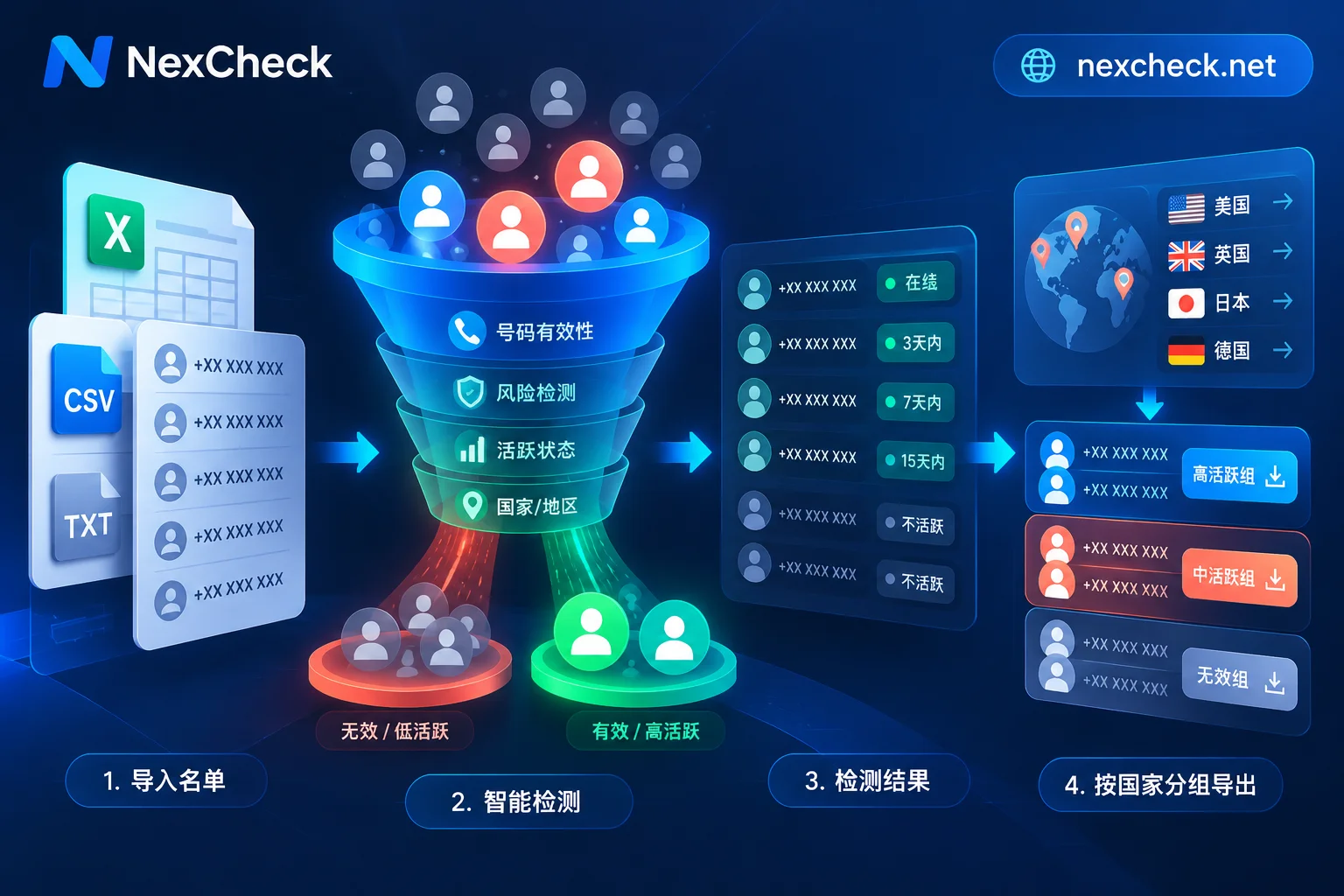
When verifying with the above four steps, you can use a multi-platform unified interface as a reference: NexCheck publicly covers WhatsApp, Telegram, LINE, Viber, Zalo, and 100+ platforms, offering web-based batch filtering and a RESTful API (batch submission, real-time query, webhook callback). If you need to connect more than one platform, each requires separate rate limiting and result fields, so this kind of repetitive engineering multiplies. Using such a unified platform can converge "per-platform rate limiting, per-platform result fields, and per-platform format conversion" into a single interface layer. For related solutions, see multi-platform number detection and batch number detection API.
Whether you choose NexCheck or another platform, after purchase you still need to handle three things: sampling review mechanism, CRM/SCRM write-back field design, and opt-in authorization and data source management. In other words, the platform saves you engineering duplication, but business responsibility remains yours.
Two Things You Can't Skip Whether Self-Building or Buying: Opt-in Authorization and Sampling Review
Finally, two things no system will manage for you.
First, the legality of the data source and user authorization must be the responsibility of the business. Is the number you have left by the user voluntarily, or purchased? Did the user authorize detection and outreach? These are compliance bottom lines; systems don't take the blame.
Second, sampling review must be routine. Set a sampling ratio—for example, 5% for the "unknown" tier and 1% for the "detected" tier—and fix a review cycle. The review criteria should align with the result model, clearly distinguishing concepts like "format valid," "carrier reachable," and "registered." For more ideas, see social account registration detection.
FAQs
What is the Telegram resolvePhone rate limit?
Telegram MTProto officially requires contacts.resolvePhone to be called at most once every 3 seconds, and debounce must be implemented. Exceeding this may trigger rate limiting or bans. When designing a self-built system, calculate throughput based on a single thread, then use multi-threading with sharding to improve overall speed, but do not exceed the single-request limit.
Do I need separate rate limiting for multi-platform screening?
Yes. Each platform (Telegram, WhatsApp, LINE) has independent rate limit rules and error codes that cannot be reused. For example, LINE requires an idempotency header, Telegram has a 3-second debounce, and WhatsApp has pairing rate limits. A unified platform can help consolidate this, but you still need to understand the differences to set task concurrency appropriately.
At what data volume is it worth building your own screening system?
There is no fixed threshold for a global number screening system. We recommend scoring five dimensions: platform count, monthly detection volume, refresh frequency, team person-months, and compliance responsibility. If you have fewer than 3 platforms, monthly volume below tens of thousands, and low refresh frequency, self-building might be feasible; otherwise, buying or using an API may be more cost-effective.
Is per-query billing or subscription more cost-effective for a screening platform?
It depends on your detection volume and frequency. If monthly volume fluctuates, per-query billing is more flexible; if volume is stable and large, subscription is usually more economical. Start with a small trial, compare actual valid number count and cost, then decide on the billing model.
Should I re-run the unknown tier?
We recommend re-running the "unknown" tier once because privacy blocking may change over time (e.g., the user lifts restrictions). When re-running, control the frequency to avoid rate limits. If it remains "unknown" after multiple reruns, mark it as low confidence and lower its priority for sending.


Comments(0)