 NexCheck-筛号平台
As global growth enters deep waters, overseas companies' customer acquisition focus is accelerating toward diversified emerging markets such as Southeast Asia, Latin America, the Middle East, and Eastern Europe. However, many marketing and operations teams find that when processing cross-border leads, tens of thousands of accumulated overseas customer records not only see delivery rates shrink sharply when they actually enter outreach, but also frequently trigger sending channel restrictions or account bans.
The core reason for this dilemma is that global communications infrastructure regulation and the social media ecosystem are undergoing two profound structural changes: first, the global wave of mandatory SIM real-name registration (KYC) and mass shutdowns of abnormal SIM cards; second, the highly fragmented primary outreach ecosystems across countries and vertical industries.
Against this backdrop, overseas number screening is no longer a basic step where you take a generic list and check "whether registered" on a single platform. It must be upgraded to a refined data governance project that "customizes baselines by country and matches channels by business."
1. Why Is One-Size-Fits-All Overseas Number Screening Failing?
In the past, many overseas teams were accustomed to bundling leads from multiple countries and running identical screening actions. But in the current global communications environment, this broad-brush approach runs directly into two walls:
1. Tightening Global SIM Real-Name Rules Cause the "Silent Decay Rate" of Existing Lists to Soar
According to GSMA and related policy tracking data, more than 155 countries and regions have implemented mandatory SIM card real-name registration regulations, covering over 5.4 billion mobile connections (more than 60% of total connections). During 2025-2026, regulators in multiple countries further tightened verification standards:
- Southeast Asia and South Asia: The Philippines' National Telecommunications Commission (NTC) recently ordered mobile operators to conduct a 15-day mandatory KYC review of accounts with abnormally large numbers of SIM cards registered under the same name; numbers that cannot prove lawful ownership and use will be directly deactivated. India's Department of Telecommunications (DoT) has also fully rolled out Aadhaar biometric-based user identity verification and stricter point-of-sale rules.
- Latin America and Emerging Markets: Countries such as Mexico implemented new mandatory identity verification mechanisms for activation in 2026, including biometric requirements.
This means that among the leads sitting in overseas companies' CRMs for more than six months, lists collected at exhibitions, or leads from external channels, a considerable proportion of prepaid SIMs may have been forcibly shut down and reclaimed by operators after failing the latest round of local real-name re-verification. If these numbers that have already become invalid at the telecom infrastructure level are not removed first, subsequent marketing budgets will be heavily consumed on dead numbers.
2. The Fragmented Overseas Communication Ecosystem Means No Single Platform Can Cover Global Audiences
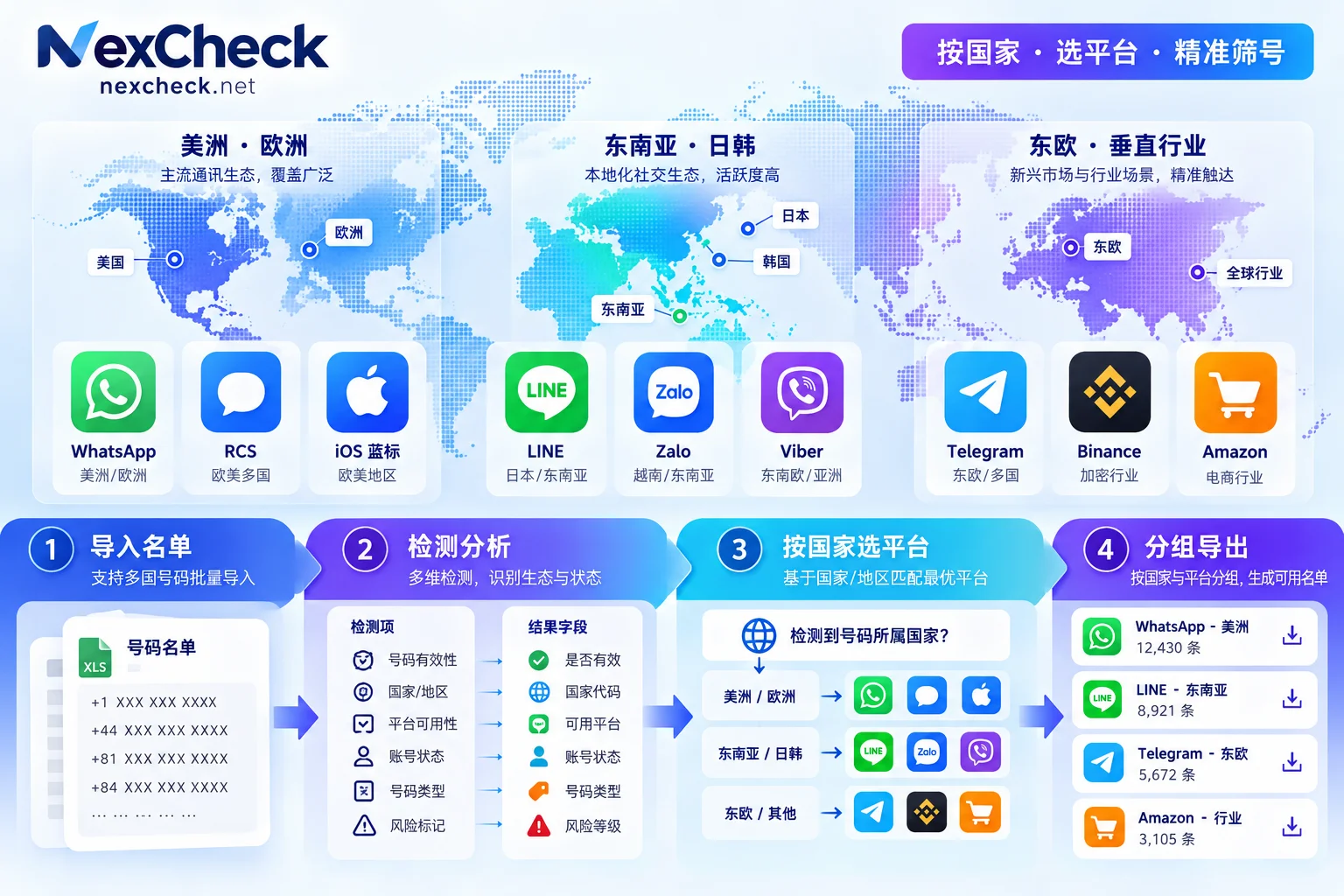
The global mobile communications market shows significant regional fragmentation. According to mainstream overseas digital ecosystem statistics, although WhatsApp dominates in about 70% of countries and regions, in certain high-value markets local super apps are the absolute mainstay:
- Japan, Thailand, and Taiwan, China: LINE remains the top daily communication tool;
- Vietnam: The local platform Zalo ranks first, and local numbers underwent a conversion from 11 digits to 10 digits;
- Eastern Europe, the CIS, and some Asian markets: Telegram and Viber have extremely high penetration and user stickiness;
- North America and markets with a high iOS share: Native SMS, iOS blue bubbles (iMessage), and RCS (Rich Communication Services), which is rapidly spreading across more than 1.2 billion devices worldwide, often offer more certain commercial outreach than third-party social apps.
Therefore, the first step in overseas number screening is not to blindly upload files, but to first understand the communications reality and platform landscape of the number's country of origin.
2. Step One: Zero-Cost Standardization and Country Segmentation Before Ingestion
The most common problem with cross-border lists is messy formatting: parentheses, dashes, spaces, missing international country codes, or mixed-in local leading zeros (for example, written as 0912... instead of the standard international format). Submitting these raw tables directly for detection not only easily causes recognition failures, but also wastes detection credits on duplicate records.
Before creating any paid task, it is recommended to first use NexCheck's online number cleaning tool to complete preprocessing in your local browser:
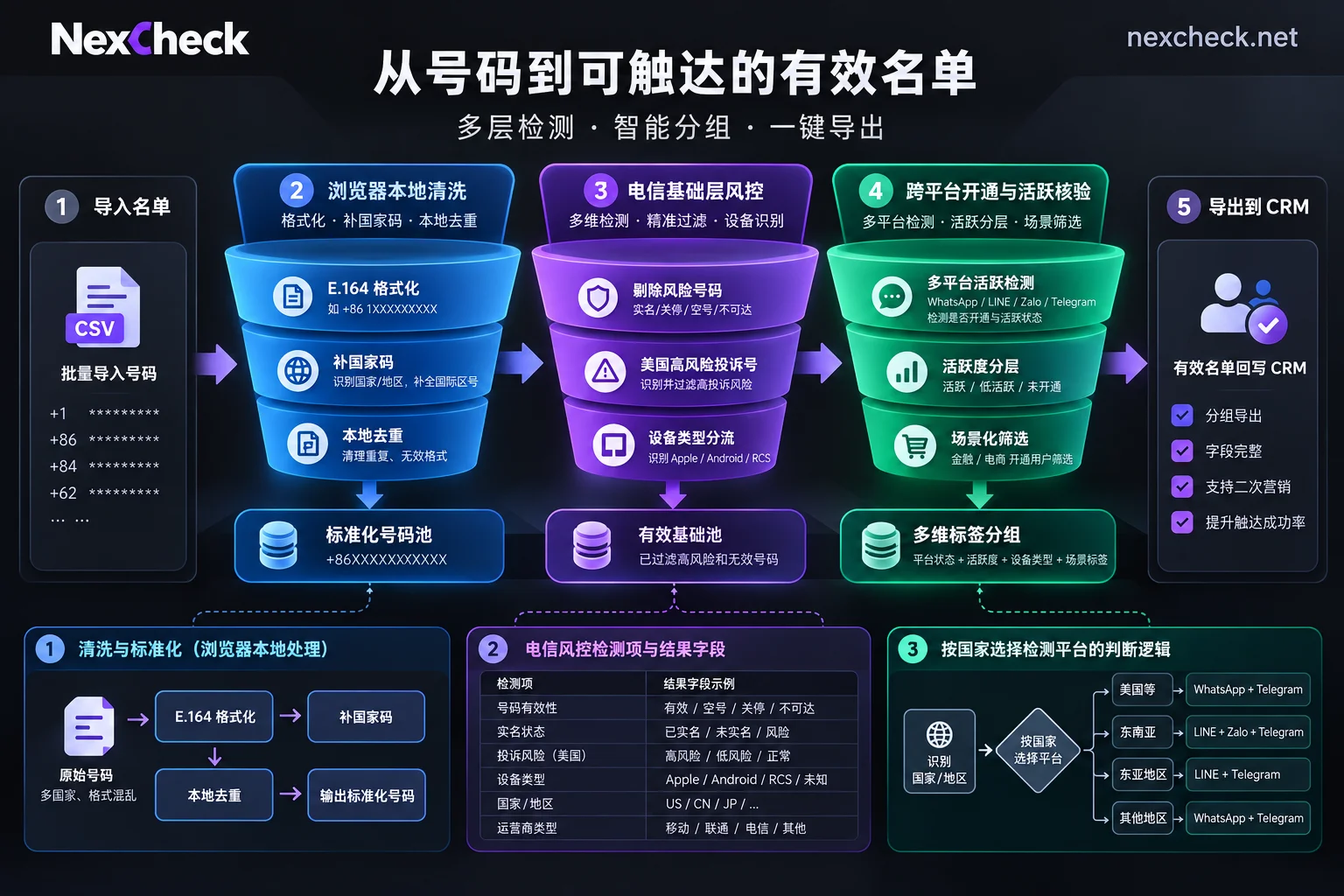
- Automatic conversion to E.164 standard format: The tool automatically recognizes common separators, completes the country code based on your default country setting, and uniformly converts numbers into the standard E.164 format with country code.
- Local pre-deduplication: Because console batch tasks do not automatically deduplicate after upload (duplicate records in the file will still be detected and billed per item), be sure to remove duplicates with the cleaning tool first and review the system-generated report of valid, invalid, and duplicate counts.
- Strictly avoid mismatched country assignment: When processing pure local numbers without country codes, remember to process them in batches by country and select the default country accurately. Once the default country is wrong, the tool will still output format-compliant numbers, but the country attribution will be completely incorrect.
Special note on country formats: If you have an early Vietnamese customer list, you must note that Vietnam implemented a telecom reform in 2018, and all mobile numbers have been unified into a 10-digit format. Old 11-digit Vietnamese numbers will not return results in projects such as Zalo number screening, so they must be converted or removed during the cleaning stage.
If you are unsure about the number length rules, major operators, and recommended screening paths in the target market, you can first check the regional solutions (for example, directly visit the Vietnam regional solution) and formulate cleaning rules based on local realities.
3. Step Two: Telecom-Level Baseline Risk Control Tailored to Local Conditions
Once number formats are standardized and numbers are segmented by country, the next step is to address the "operator real-name shutdowns" and "channel risk control" issues mentioned above. Through basic number detection, companies can first establish a low-cost telecom-level firewall before entering specific social media platforms:
- For high-incidence SIM purge regions (Southeast Asia, South Asia, Latin America, etc.): Prioritize invalid number and on/off detection, number type, and operator identification. This quickly strips out invalid numbers that have been deregistered by local operators, unactivated cards, and landline number ranges that cannot receive messages (for more detailed telecom-layer principles, see "How to Detect Overseas Invalid Numbers? From Operator Shutdown Identification, RCS and Apple/Android Device Segmentation to Cross-Channel Screening Solutions").
- For strict North American compliance markets (United States): Although the United States does not have mandatory prepaid SIM real-name registration, telecom operators and federal regulations impose extremely severe penalties for marketing harassment. For U.S. lists, it is strongly recommended to add U.S. operator identification and U.S. high-risk and complaint number detection to remove number ranges with complaint records or high risk-control risk in advance, protecting outbound calling and SMS channels (see "How to Detect Overseas Mobile Number Validity? From Short-Lived Verification Numbers and U.S. Complaint Risk Control to Dual-Layer Verification for E-Commerce and Social Media").
- For native messaging segmentation needs (Europe, U.S., Japan, South Korea, etc.): If the business relies on system-level outreach, you can use Apple/Android device segmentation, RCS system type detection, or iOS blue bubble detection to precisely split the list into the Apple side and the RCS-capable Android side (note: iOS blue bubble detection only answers whether the number has activated Apple-side services and does not include specific device model, system version, or Apple account information). In addition, for scenarios such as Cash App, OKX, Coinbase, and Discord where only number sources are available and no platform-specific detection item exists yet, this basic layer of detection is also the main way to safeguard baseline quality.
4. Step Three: Layered Verification by Regional Primary Ecosystem and Vertical Scenario
After telecom-layer filtering, the remaining numbers are all "truly alive." At this point, based on the social media penetration rate of the target country and your own business attributes, select the corresponding platform detection item from the supported platforms overview, and use the console's "Continue Detection" function to directly transfer the data that passed the previous round into the next round (the system will create a new task and bill separately).
1. Screening on Mainstream and Regional Core Instant Messaging (IM) Platforms
IM number screening logic varies greatly by country, so never apply the same field expectations across the board:
Global main battlegrounds (WhatsApp & Telegram):
- In Latin America, India, the Middle East, and Europe, WhatsApp number screening cannot stop at activation detection (fast channel/SVIP channel). Given recent platform anti-spam mechanisms that assess interaction frequency, you should combine four-dimensional ecosystem activity and channel-specific activity and real-time online to lock in high-intent audiences, use registration time, zombie and ad account, and banned account detection to remove abnormal numbers, and then use gender and age (SVIP, Channel 1, Channel 2) for layered operations (see "How to Do WhatsApp Number Screening? From New Per-Item Billing Rules and Zombie/Banned Account Removal to Multi-Dimensional Layering Solutions").
- In Eastern Europe, the CIS, and the broader tech circle, Telegram number screening supports checking activation by number, activation format, 3/7/15-day activity tiers, and gender; if the lead database only contains social accounts, you can also directly upload
@用户名to perform username detection and username gender/age detection.
Asia-Pacific and Eastern European local leaders (LINE, Zalo, Viber, etc.):
- Japan/Thailand/Taiwan, China, etc.: When using LINE number screening, registration screening must be submitted separately by region (Taiwan, Japan, Thailand, South Korea, Hong Kong, U.S.); in addition to returning UID, nickname, avatar, and age/gender (comprehensive item), note that activity detection requires activation screening first (for practical details, see "How to Do Batch LINE Number Screening: Number Format Cleaning, Country-Specific Detection, Result Interpretation, and CRM Write-Back").
- Vietnam: Zalo number screening provides account activation, activity range, and gender/age detection, among which activation and gender/age are divided into express and stable channels (the stable channel can also return nicknames).
- Specific markets such as Eastern Europe/Middle East/South Korea: In Eastern Europe and some African markets, Viber number screening can be used to check activation, activity range, and account age (note: "account age" here means how long the account has been registered, specifically used to remove newly registered numbers, not the user's biological age); in the Middle East, Botim number screening can be used (checking activation and gender/age); in South Korea and specific circles in Europe and the U.S., KakaoTalk, Band, and Signal activation detection can be used respectively.
2. Precise Background Checks on Social Media and Vertical Industries (Finance, E-Commerce, B2B)
When overseas teams want to assess leads' purchasing power or industry attributes, cross-platform registration status is the best proxy indicator (see "Beyond 'Activation': How to Build a Precise Cross-Platform Multi-Dimensional Number Insight System?"):
- Public social media matrix: Facebook number screening supports number activation, email activation, UID, and UID profile gender/avatar reading; Instagram, TikTok, Twitter/X, Snapchat, and the Indian short video platform Moj all support number activation screening; for B2B customer acquisition, LinkedIn number screening currently only supports activation screening for U.S. and Indian numbers.
- Crypto and Fintech: For high-net-worth or Web3 audiences, you can screen number activation (registration) through Binance, KuCoin, CoinW, HTX, MEXC, Vantage, India's Paytm, and Africa's MoniePoint; among them, Binance, KuCoin, CoinW, and HTX also support email detection, while Robinhood and Nasdaq only provide email detection. Notably, Binance additionally offers a transfer channel (determined by whether the number can find a recipient in Binance Pay), and the entire detection process does not log in to Binance or send any verification code to the target number, making it completely silent and secure.
- Cross-border e-commerce, logistics, and local life: Supports account activation screening for Amazon, Temu, Shopee, South Korea's Coupang, India's Flipkart, Indonesia's Bukalapak, the Middle East's Noon, DHL, as well as office and lifestyle platforms such as Microsoft, Microsoft Teams, Airbnb, India's real estate and information platforms Magicbricks / The Economic Times, and Russian-language real estate and recruitment platforms Cian / HeadHunter.
5. Four Key Boundaries and Pitfall Avoidance Guidelines for Practical Implementation
When integrating NexCheck into a team's daily overseas number screening SOP or connecting it to CRM via API, operations and development staff need to understand the following four practical boundaries:
- Understand channel differences and objective privacy limitations: The same detection item on the same platform often has multiple channels (such as express, stable, SVIP, etc.), and each channel differs in detection speed, coverage, and returned result scope. Unit prices and supported countries are subject to the real-time price list in the console. At the same time, WhatsApp avatars, signatures, and last-online times, Facebook profile gender/avatars, and Telegram gender/age inferred from public names and avatars are all strictly limited by users' personal privacy settings—any field a user has set as non-public cannot be read by any compliant tool.
- Treat results rationally as "point-in-time snapshots": The valid and invalid grouping results returned by the platform only objectively reflect the target platform's status at the moment of query. They cannot directly determine the number holder's true identity, purchase intent, or commercial value, nor can they guarantee that any single result will remain 100% unchanged at the time of subsequent outreach.
- Export results promptly; never use the task center as cloud storage: The console supports uploading CSV, TXT, or XLSX files (one target value per line in the first column, subject to project minimum/maximum row counts and file limits). After a task is completed, results can be previewed and downloaded online. However, the platform does not promise a retention period for results, and the task center cannot be used as a long-term archive. Be sure to export results promptly after detection and write them back to your own CRM, and clean up historical data in the console as needed.
- Billing mechanism, API integration, and data compliance: NexCheck uses a prepaid model: recharge first, then deduction per item (charged when the task is created; if the task fails, the system automatically refunds in full). For specific operations, see the quick start guide and user manual. For technical teams that need to integrate real-time queries, batch submission, and Webhook callbacks into internal systems, the platform provides RESTful API support (because the public manual does not include specific interface parameters and authentication documentation, you can first complete free registration and then contact official Telegram support for integration support). On data security, the customer remains the data controller and must ensure that the source and use of numbers are lawful; the platform processes data only within the scope of executing detection tasks and never sells it or uses it to build number databases for external sale (see the privacy policy for details).
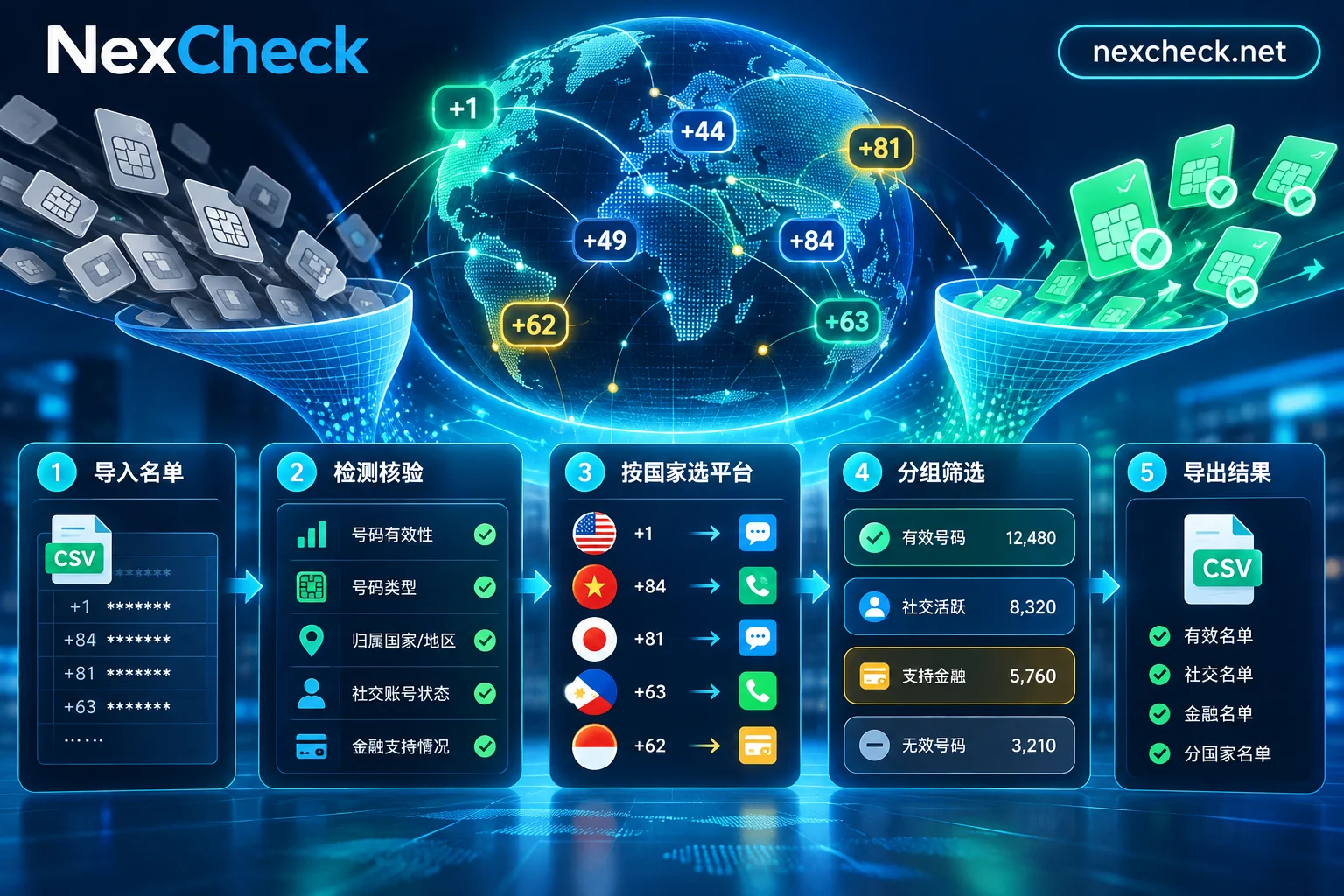
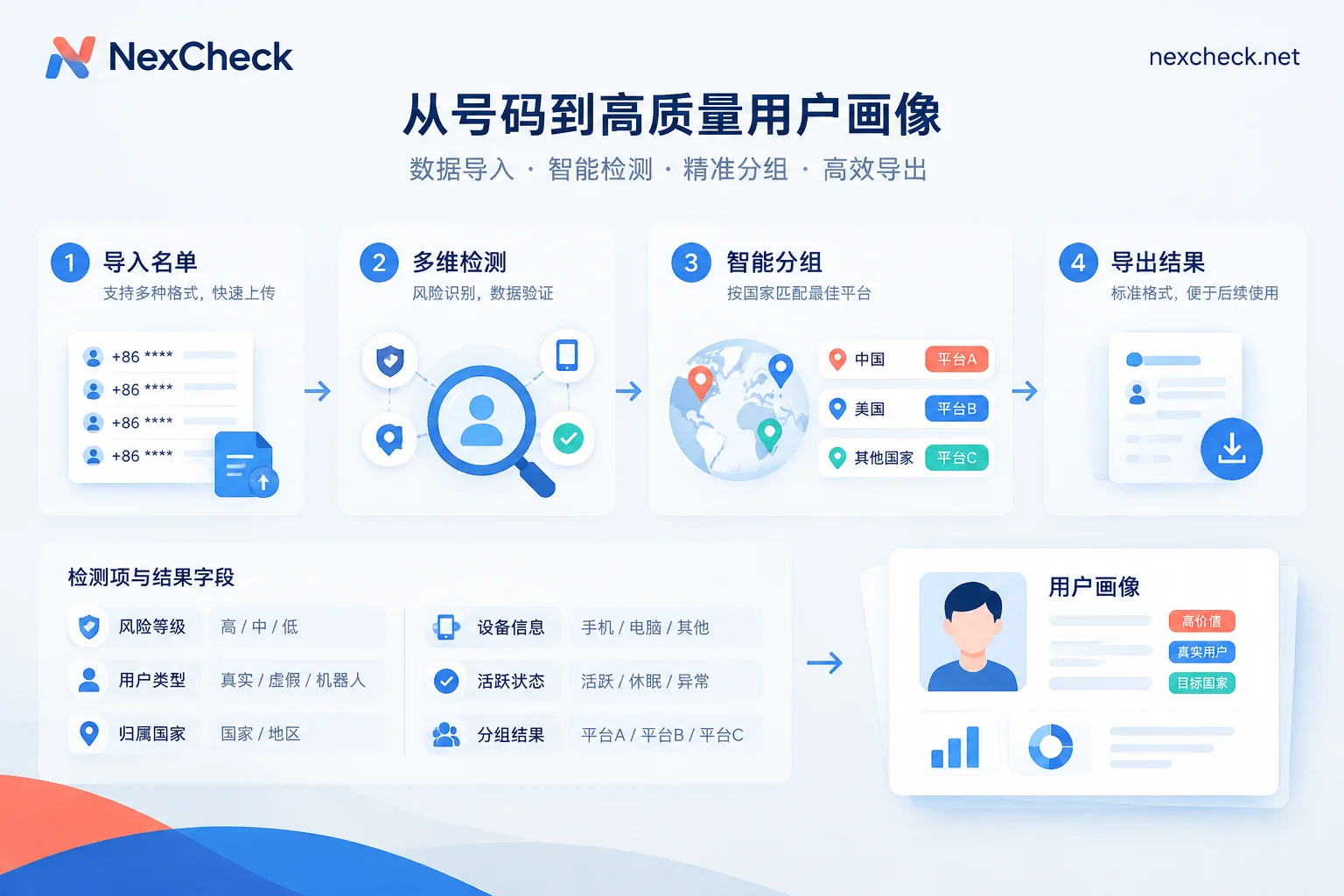
Faced with tightening global telecom real-name regulation and a multipolar social media ecosystem, overseas teams must abandon the habit of "one list for the whole world" and build a funnel system of "local format deduplication → country-specific basic invalid number/risk control filtering → activation and activity layering on regional primary platforms." Only then can every bit of marketing and outreach budget be spent on real, active, and highly matched overseas customers. Go now to the NexCheck console to register an account and start precise and efficient cross-border list governance.


Comments(0)