 NexCheck-筛号平台
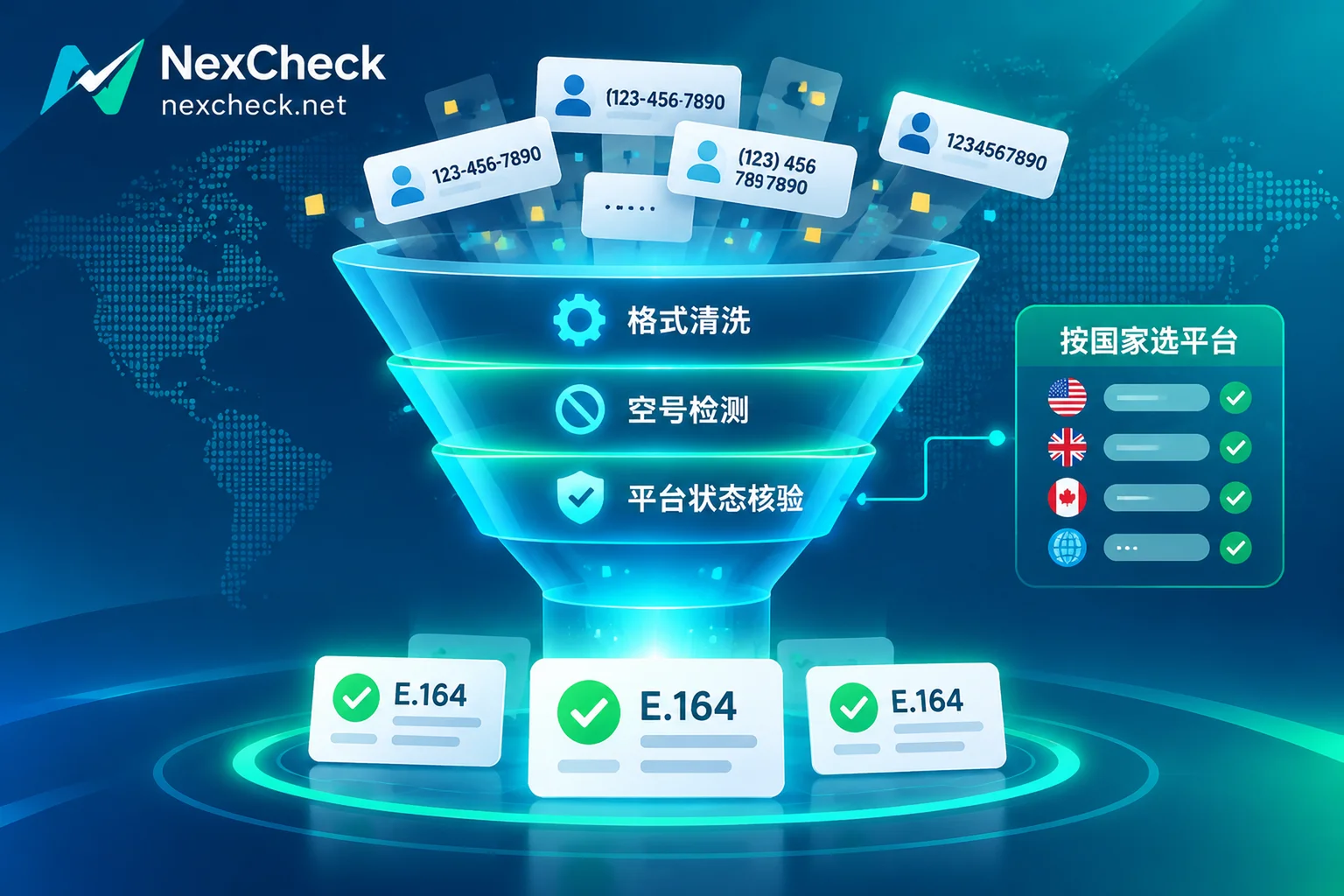
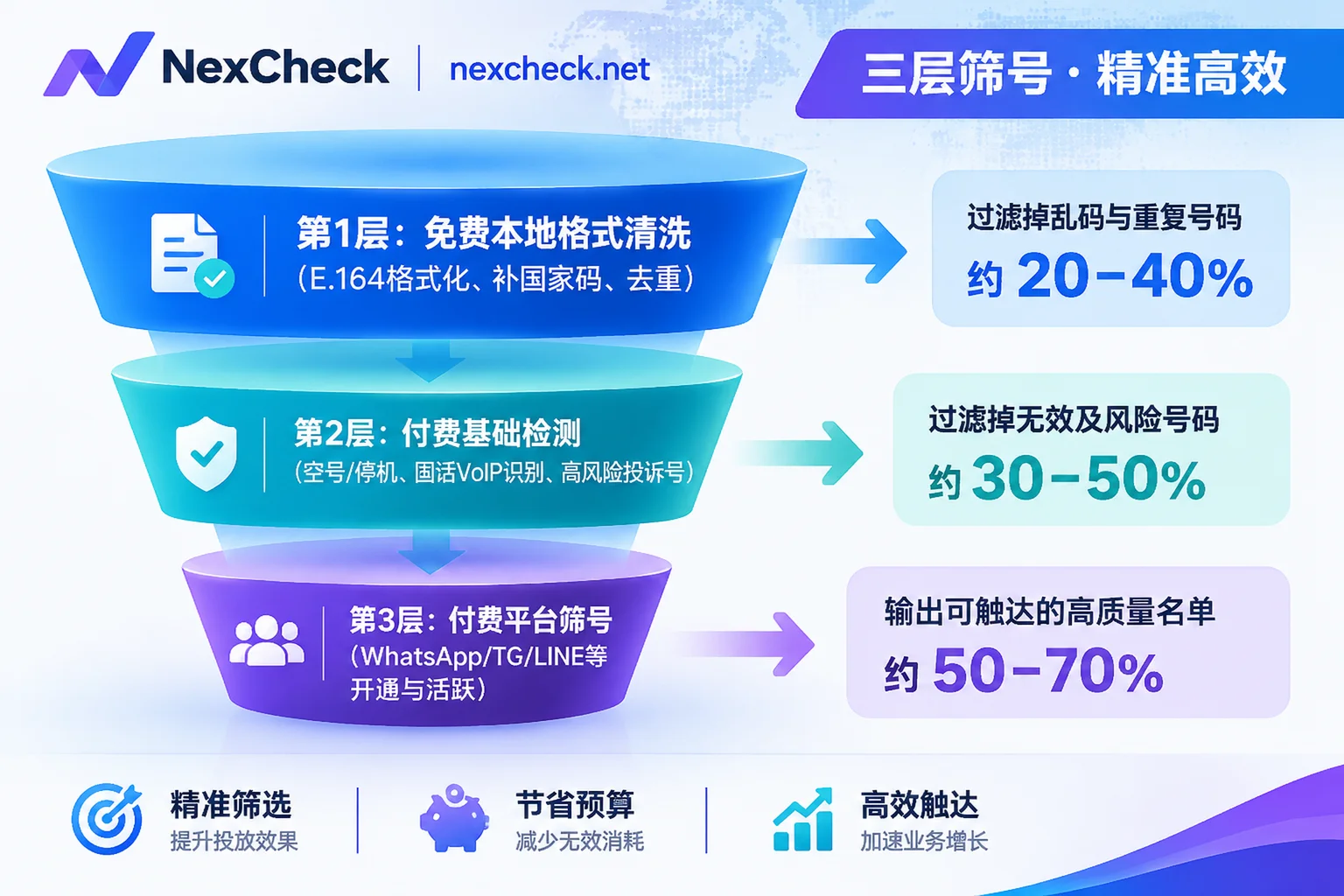
No, they are not the same. What is commonly called "number cleaning" in daily business actually includes three completely different layers of work: the first layer is format normalization and deduplication (which can be done locally with free tools), the second layer is carrier empty-number, number-type, and device-status detection (which requires number-segment databases or real-time channels and is billed per record), and the third layer is registration and activity screening on target platforms such as WhatsApp, Telegram, and Binance (billed by platform and detection dimension).
If these three layers are conflated, the most common outcomes are only two: either you assume that removing spaces and duplicate rows in Excel means the list is "cleaned," yet bulk SMS or outbound calls still hit large numbers of empty numbers, landlines, and complaint risks; or you upload a raw list that has not been deduplicated and has messy formats directly to a paid detection platform, paying unnecessarily for duplicate numbers and misaligned formats.
1. At a Glance: The 3 Layers of Number Cleaning — Which Are Free and Which Cost Money?
Before working on a customer list, use the table below to identify which layer you are stuck at, and then decide whether to use free tools or paid interfaces:
| Cleaning Layer | What Problem It Solves | Typical Actions | Requires Per-Record Payment | Consequence of Skipping This Step |
|---|---|---|---|---|
| Layer 1: Syntax and Format Cleaning | Solves "non-standard format, duplicates, missing country code" | Remove spaces/hyphens/parentheses, complete country codes, convert to E.164 standard format, remove obvious length errors and duplicate rows | No (free local or browser-based tools are sufficient) | Duplicate rows are billed per record; missing area codes cause subsequent detection matching failures |
| Layer 2: Basic Carrier and Device Detection | Solves "can it connect, is it a mobile number, are there risk-control red flags" | Detect empty/disconnected and powered-on/off status, distinguish mobile/landline/VoIP, identify carrier, filter US high-risk and complaint numbers, route Apple/Android devices and RCS | Yes (billed per record, usually cheaper than deep social media detection) | SMS to landlines or empty numbers bounces directly; outbound calls accidentally hitting high-complaint numbers can trigger line suspension or legal risk |
| Layer 3: Platform Registration and Activity Screening | Solves "does this number exist on the target app, and is it an active real person" | Verify whether numbers are registered on WhatsApp, Telegram, LINE, Zalo, Facebook, Amazon, Binance, etc., whether recently active, whether banned, and obtainable attributes | Yes (billed separately by platform, detection item, and channel) | Blind social media outreach has low reach, and creating groups/messaging large numbers of unregistered accounts easily triggers platform risk controls |
If you want to understand the difference between "cache database queries" and "real-time probing" behind different platforms, you can also read another selection guide on this site: Number Detection Platform Principles and Classification Comparison.
2. Why Do Many People Get Worse Results or Waste Money When Cleaning Numbers?
In practice, operations and marketing teams most easily fall into the following 4 hidden pitfalls when cleaning lists:
1. Opening a CSV Directly in Excel Permanently Damages Numbers
Many CSV lists exported from CRMs or forms, once double-clicked open in Excel, have numeric columns automatically treated as values: for UK 07..., Vietnam 09..., or domestic local numbers with leading 0, the leading 0 is simply swallowed; numbers with country codes longer than 11 digits (such as 8613800138000) are converted to scientific notation (such as 1.38001E+10), and after saving, digits after the 12th permanently become 0 — no one can restore them.
2. Uploading to a Paid Platform Without Deduplicating First
Many business teams habitually combine trade show leads, ad form submissions, and old customer tables into one file and upload it directly for number screening. Note especially that most bulk detection systems do not automatically deduplicate before billing (for example, NexCheck console tasks do not automatically deduplicate duplicate values; duplicate entries are billed as usual). If a 50,000-record list contains 15% duplicates, uploading it directly means overpaying for 7,500 records of detection budget.
3. Mixing Multi-Country Lists but Selecting One Default Country
This is the most common error among cross-border teams. If a table mixes US, UK, and Indonesian numbers, none with + signs or country codes, and you uniformly select "United States" as the default country in the cleaning tool, the tool can still output a batch of syntactically fully valid E.164 numbers — but all with the wrong attribution. Running empty-number or social media detection on this batch of "falsely valid numbers" will almost all return unregistered or invalid.
4. Running Expensive Detection Items Without Considering Channel or Number-Segment Age
Underlying rules differ greatly by country and platform. For example, when cleaning a Vietnamese list for Zalo marketing, Vietnam completed its transition from 11-digit to 10-digit number segments in 2018; Zalo screening only recognizes the post-reform 10-digit format, and old 11-digit numbers cannot return results at all. Similarly, LinkedIn's number registration screening currently supports only US and Indian numbers. Blindly submitting everything for detection regardless of scenario only raises the failure rate for nothing.
3. Practical Order You Can Use Right Away: Clean for Free First, Then Pay by Layer
To spend every bit of detection budget on valid leads, strictly follow these 3 steps (for a complete multi-platform workflow, see the Complete Number Cleaning Process Guide):
Step 1: Use a Free Browser Tool for Local Format Cleaning and Deduplication (Zero Cost)
Before spending a cent, clean the "dirty data" and "duplicates" locally. If the list is cross-border or in messy text/spreadsheet formats, you can use the free browser-based number cleaning tool provided by NexCheck:
- No balance consumed: the entire cleaning process runs locally in your browser and does not create a paid detection task.
- Automatic standardization and deduplication: supports recognizing common separators, completing country codes according to your specified default country, uniformly converting to standard E.164 format (without extra symbols or keeping only the standard format), and automatically deduplicating, finally giving counts for "valid, invalid, duplicate."
- Key operational reminder: before processing a mixed multi-country list, first split it into separate files by country, then select the correct default country for each conversion, to avoid "correct format but wrong attribution" (for specific country rewrite logic, see E.164 Normalization: 4 Types of Dirty Number Rewrite Rules).
Step 2: Decide Whether to Run "Basic Number Detection" Based on Your Outreach Channel
After local cleaning, deduplication, and unification to E.164, if the list is large or your core channel is international SMS or voice outbound, it is advisable to run a lower-cost basic screening layer first. In the NexCheck Basic Number Detection Matrix, you can select as needed:
- Required for outbound calls and SMS:
空号与开机/关机,号码类型(remove landlines or virtual numbers that cannot receive SMS),运营商识别; if targeting the North American market, be sure to add美国高风险与投诉号to avoid high complaint risk. - Required for device-targeted outreach:
苹果/安卓设备,iOS 蓝标(only determines whether it is an Apple-side device; does not include specific model, OS version, or Apple account),RCS 系统类型. - Fallback option when there is no dedicated platform interface: if your target business platform currently has no dedicated account detection item (for example, Cash App, OKX, Coinbase, Discord), then this basic filtering layer is the most cost-effective cleaning endpoint.
Step 3: Send Only Qualified Numbers to the Target Platform for Precise Screening
After the first two steps eliminate duplicates, wrong numbers, empty numbers, and landlines, what remains is the "clean list" worth spending budget on for platform verification. When performing cross-ecosystem number cleaning, NexCheck splits capabilities into five groups: Instant Messaging, Social Media, Crypto & Finance, E-commerce & Logistics, and Office · Local Life · Devices:
- Choose the right channel by scenario: the same detection item on the same platform (for example, WhatsApp registration, Zalo registration, or gender/age) often offers different channels, each differing in speed, regional coverage, and result criteria; some regional solutions also provide local mainstream platforms and recommended order (viewable by country on the Regional Solutions page, excluding mainland China).
- Use "Continue Detection" for funnel-style billing: refer to the Quick Start Guide, upload a CSV, TXT, or XLSX file (one target value per line in the first column, and the number of rows must fall within the selected project's minimum and maximum quantity range). After getting results, do not immediately run the most expensive comprehensive dimensions on the entire original list; instead, first run cheaper "registration detection" (for example, first screen out numbers registered on LINE or WhatsApp), then use the console's "Continue Detection" feature to take this filtered valid subset as input and create a new task for "active range" or "gender/age" (new tasks are billed separately), greatly reducing wasted spend.
- Team automation integration: if your business needs to automatically complete the above cleaning when customers enter the CRM, the NexCheck homepage and About page support RESTful API (batch submission, real-time queries, and Webhook callbacks). Because the public user manual does not directly list endpoint addresses, parameters, and authentication formats, development teams can register an account and then contact official Telegram support directly for complete API integration documentation.
4. Three Objective Boundaries to Understand Before and After Cleaning
Regardless of which number cleaning or screening platform you use, you should have clear expectations about technical boundaries and compliance responsibilities before starting:
- Results represent "the state at the moment of query," not permanently valid: carrier suspensions, reactivations, or user account cancellations happen every day, and the platform does not guarantee that any single result is 100% absolutely correct, nor can it determine the owner's true identity, purchase intent, or commercial value for you.
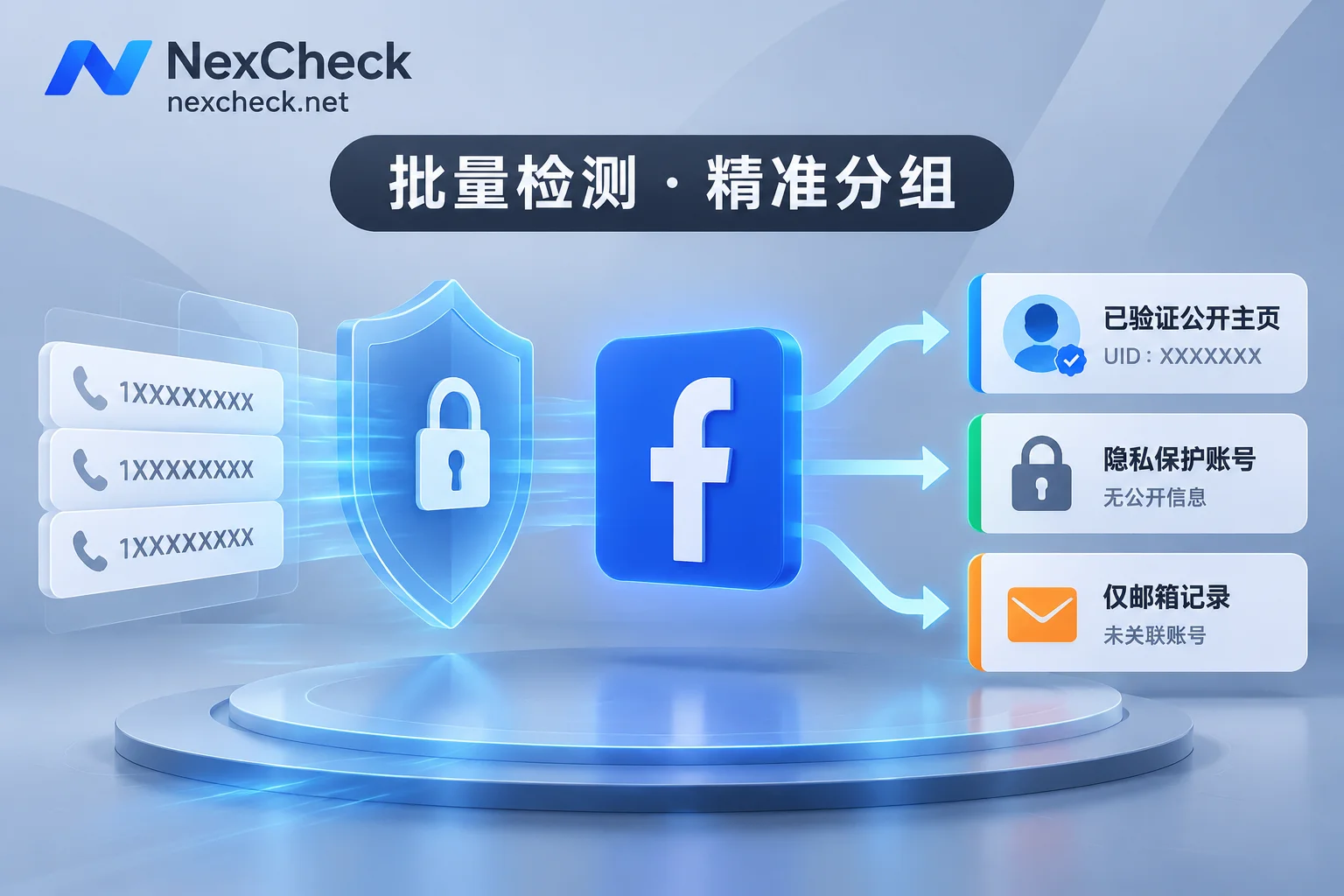
- Fields users set as private cannot be read: during social media cleaning (such as WhatsApp avatar/signature/last seen, Telegram gender/age inferred from public nickname and avatar, gender/avatar on Facebook UID profile pages), if the target user has enabled privacy protection, no compliant detection method can read hidden fields.
- Export and delete results promptly, and maintain a compliant source baseline: NexCheck uses a prepaid model with top-up first and per-record billing (charged when a task is created; failed tasks are automatically fully refunded; specific unit prices and quantity limits are subject to the real-time console page). The backend does not promise long-term retention of task results, so it is recommended to download and archive results immediately after cleaning and proactively delete task data; at the same time, as the data controller, you must ensure that uploaded numbers come from legal sources and that you have the right to process them — the platform processes your data only within the scope of executing detection tasks, does not sell customer lists, and does not use them to build a public number database for external sale (see Privacy Policy).
Start now: take that unprocessed spreadsheet you have on hand, run it through the free browser number cleaning tool for deduplication and E.164 formatting, and see how many duplicate numbers and wrong formats are hidden inside; when you need further empty-number or cross-platform screening, compare your actual outreach channels on the Platform Overview and pick the most cost-effective detection layer.