 NexCheck-筛号平台
When doing Facebook number detection, you often encounter situations where "the customer uses their phone every day, but the search returns blank" or "you only know the number is registered but can't get gender and avatar." This is usually not because the number itself is necessarily invalid, but due to tightened Facebook privacy search permissions, accounts bound only to email without a phone number, or uploaded numbers missing standard international area codes. At the same time, compliant channel-level detection does not send notifications or verification codes to the target, nor does it trigger risk control bans like manually importing contacts repeatedly with a personal Facebook account.
If you have a batch of exhibition business cards, independent site leads, or dormant CRM numbers, understanding "why it can't be found" and "what can actually be found" is more important than blindly switching tools.
1. Why does manual phone number search or direct import often fail to find Facebook accounts?
When many people first encounter Facebook number detection, their first reaction is to paste the phone number directly into the Facebook top search bar, or save it in their phone contacts and sync to the app. But these two methods often have low hit rates nowadays, for four main reasons:
- The platform has long removed public phone number directory-style search: To prevent automated bulk scraping of personal profiles, Meta removed the entry point for directly entering a phone number in the public search bar to look up a profile starting from 2018-2019, and further tightened the contact import interface afterward.
- The other party has disabled "Who can find me by phone number" privacy setting: In Facebook's "Privacy Checkup → How people find and contact you," users can change who can find them by phone number or email from "Everyone" to "Friends of friends" or even "Friends only." Once the other party tightens this permission, even if a stranger saves the number in contacts and syncs, the system will not recommend that profile.
- The account is registered with a personal email and not bound to the current phone number: Especially for European/American and B2B customer groups, many people habitually use personal emails like Gmail or Yahoo to register and log in to Facebook, while their work phone number is only used for calls or WhatsApp registration and is not added to their Facebook account.
- Number format and local encoding are inconsistent: For example, missing country code, retaining domestic dialing prefix
0, or the old 11-digit number segments in Vietnam before the 2018 reform. Non-standard formats directly cause matching failures.
2. What can Facebook number detection actually find, and what can't it find?
To avoid unrealistic expectations of tools, advertising and operations teams need to distinguish between the public boundaries that technology can read and the platform's privacy red lines before ordering detection.
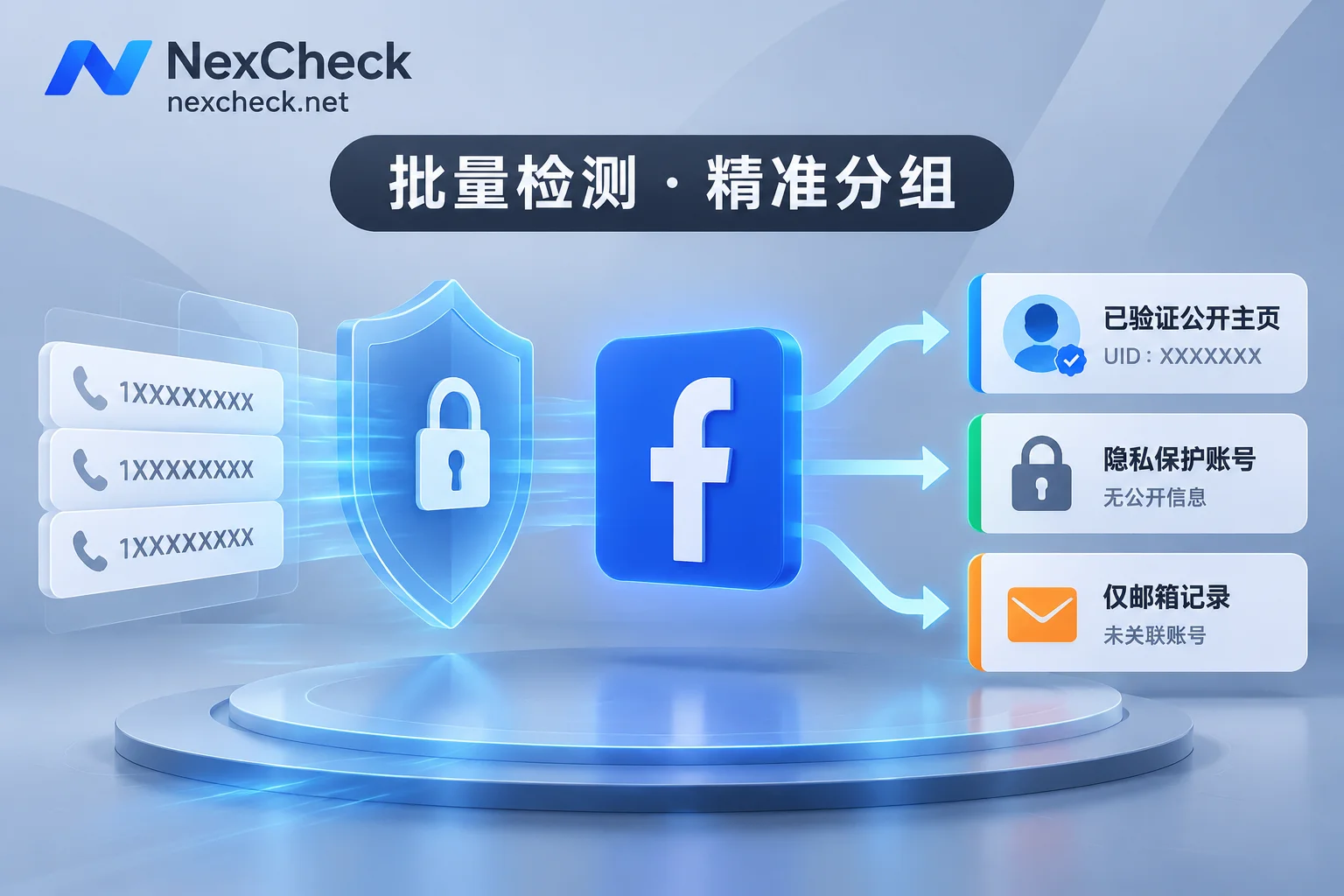
Taking NexCheck (nexcheck.net)'s Facebook detection capabilities as an example, it currently provides four core capabilities around list verification, each with clear return boundaries:
| Detection Dimension | Actual Results Obtainable | Privacy and Field Boundary Explanation |
|---|---|---|
| Number registration filtering | Determine whether a phone number is bound to and has an active Facebook account | Only reflects the current status at query time, not the holder's business value or willingness to cooperate |
| Email registration filtering | Determine whether an email address is registered with a Facebook account | Suitable for cross-verification of B2B lists or customers whose phone numbers didn't hit |
| UID extraction | Obtain the Facebook numeric UID of the associated account | Facilitates subsequent asset archiving or further matching of public profile fields |
| UID profile gender and avatar | Return the gender and avatar fields displayed on the profile | Only reads fields the user has set as public; cannot be read if the user has set them as private or hidden |
Two points require special attention: First, any field a user has set as non-public cannot be read by any compliant screening platform; Second, the Facebook channel itself does not provide private determinations such as "last seen time," "ban reason," or "real age," and a single result should not be treated as 100% absolutely accurate identity verification; it is more suitable as a pre-filtering step for batch list layering and noise reduction.
3. Will detection alert customers? Will testing with my own account cause a ban?
These are the two safety concerns most worrying operations and sales teams, and the answers must be considered separately:
- Will it alert the customer being checked? No. Whether it's a regular search query or compliant backend channel detection, Facebook does not send the target user a notification like "someone has looked you up by phone number," nor does it trigger SMS verification codes.
- Will it ban your own Facebook account? Depends on how you test. If you use your company's personal Facebook account that is being warmed up, running ads, or connecting with customers to repeatedly upload hundreds or thousands of unknown phone numbers to sync contacts in a short time, switch searches at high frequency, or even add friends in bulk, it is highly likely to be flagged by risk control systems as abnormal machine behavior, leading to account restrictions or even bans.
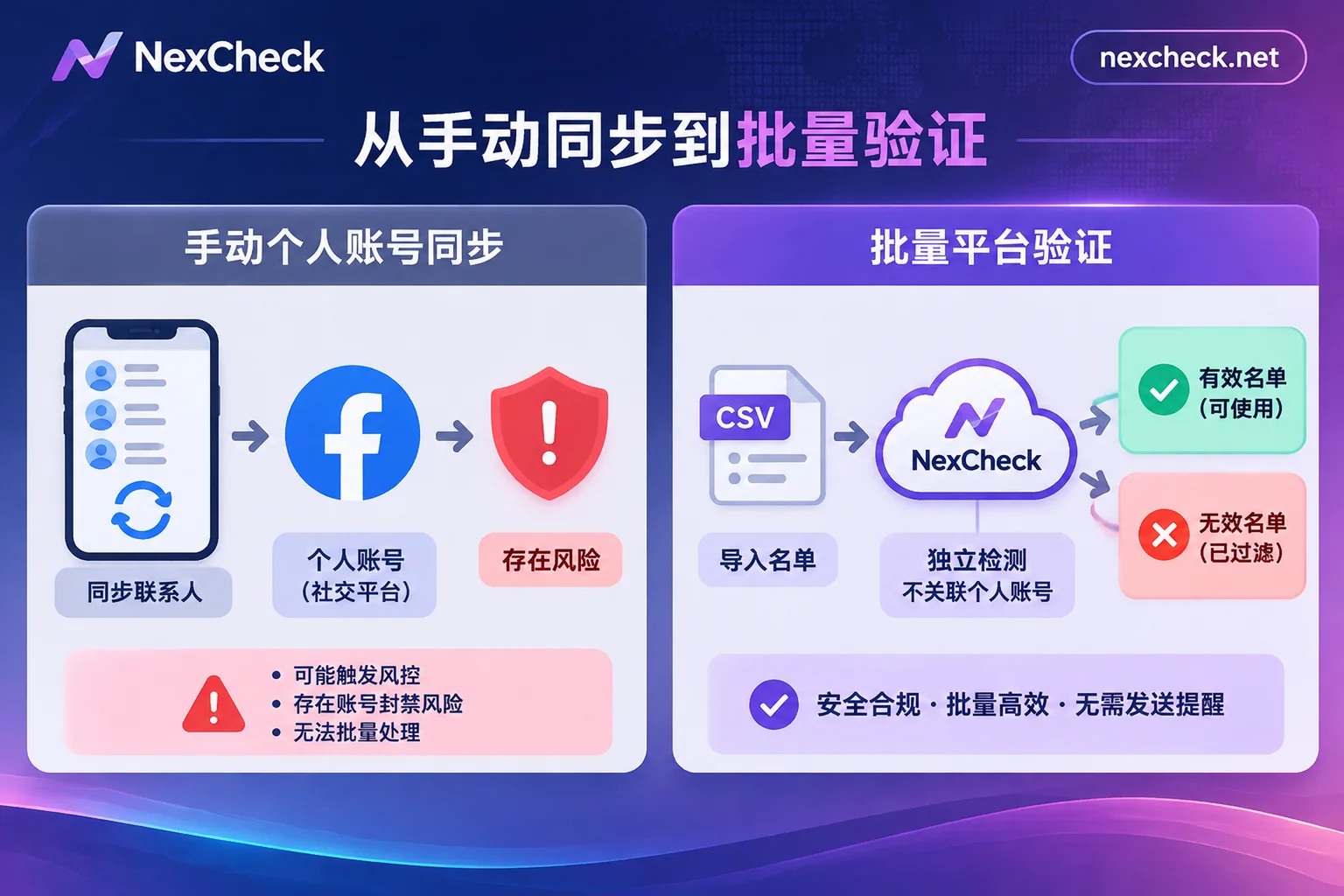
If the list size is hundreds to tens of thousands or more, a safer approach is to completely separate "screening" from "social account warming": submit the list to a prepaid batch number screening platform like NexCheck, which performs channel detection within the scope of the task and returns results grouped by valid and invalid, without exposing your own business accounts or SMS receiving environment to high-frequency probing risks. For compliance and privacy boundaries of cross-platform number filtering, you can also refer to "Is Social Platform Number Filtering Legal? Will It Alert Customers or Violate Privacy Laws?".
4. How to arrange practical operations to save money and improve hit rate?
Now that you know "wrong format causes missed judgments, phone-only checks may miss email users, and duplicate submissions waste credits," follow these four steps before detection to save budget:
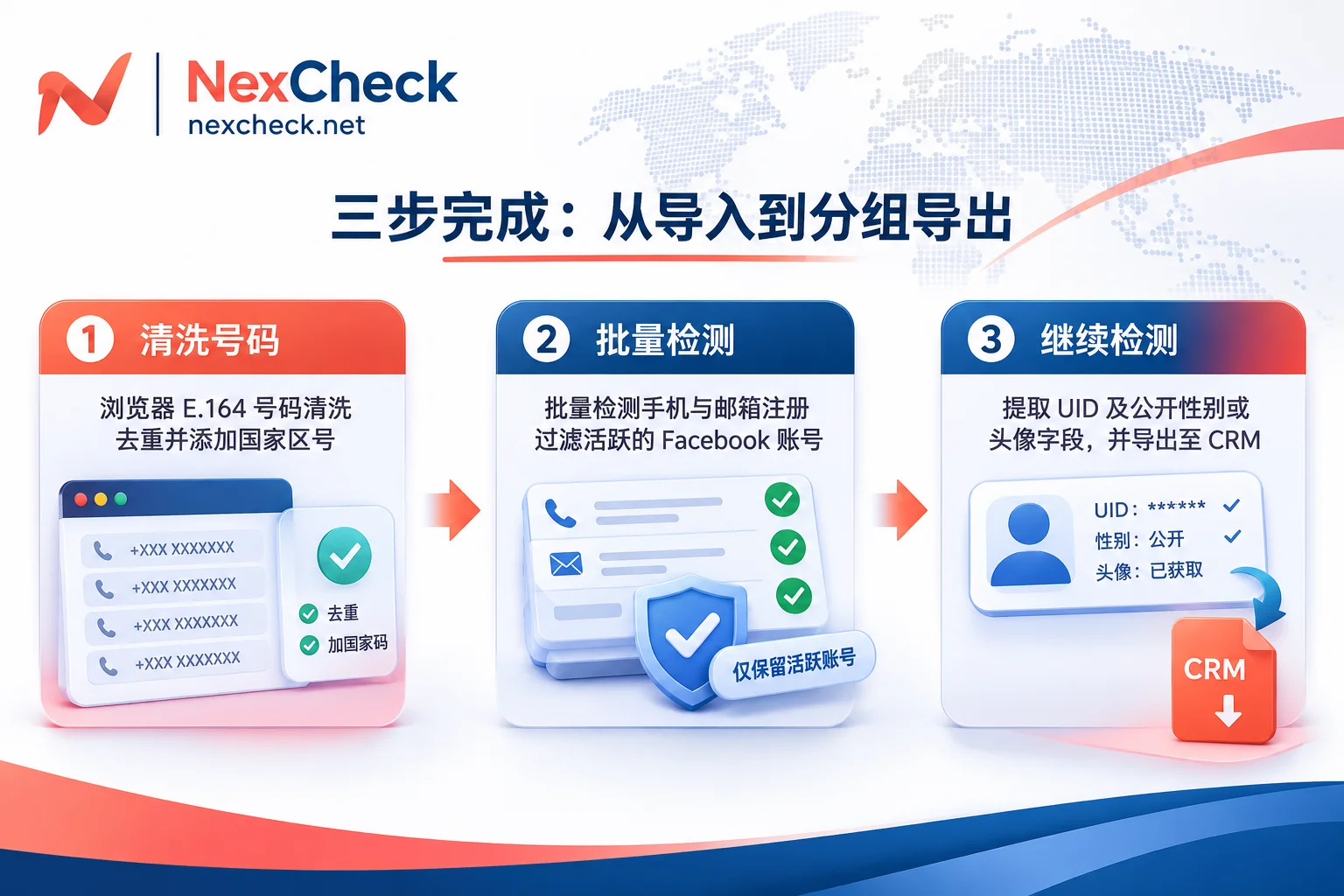
1. Perform local E.164 cleaning and deduplication before uploading
When creating a batch task in the console, duplicate values are not automatically deduplicated; submitting several duplicate records will be charged for each. It is recommended to first run your CSV, TXT, or XLSX list through NexCheck's free browser-based number cleaning tool: it does not create a paid task, can directly identify separators locally, complete country codes based on the selected default country, convert to standard E.164 format, and deduplicate, while counting valid, invalid, and duplicate numbers. The only thing to note is don't select the wrong default country, otherwise it will generate numbers that look compliant but have incorrect country codes.
2. Distinguish primary and secondary channels, use "email registration" to fill blind spots
If your list contains both phone numbers and emails (especially for B2B buyers or high-ticket independent site leads), don't only test the phone number column. Many customers who show as unregistered at the phone number stage often registered on Facebook with a personal email. For the specific order of串联 cleaning of phone, email, and UID, we have a complete breakdown in "How to Do Facebook Number Detection: Number and Email Registration, UID Gender Avatar Reading, and List Cleaning Order".
3. Filter registration first, then use "Continue Detection" to read public avatar and gender
Don't run deep fields on the entire raw uncleaned large table right away. In the NexCheck console quick start process, upload the file (put the target value in the first column and select the corresponding country or region) to first filter registration status; after the task is completed, directly use the "Continue Detection" function to use the filtered results as input for the next task, then extract UID or public gender/avatar from profiles. Although creating a new task is billed separately, it saves budget on invalid numbers. For teams planning to use Facebook ad Custom Audiences, you can also combine with "Budget ROI Plummets? Decrypting the "Data Cleaning Techniques" Behind Facebook Precision Customer Acquisition" to optimize multi-field upload match rates.
4. Export and write back to CRM in time, and manage data ownership
In terms of data flow, NexCheck adopts a prepaid model (recharge first, then deduct per item; charged at task creation, with automatic full refund if the task fails). Specific unit prices, minimum/maximum rows per task, and covered regions are subject to the console price list. Remember: the task center is not a long-term archive repository, and the platform does not promise result retention days; after detection, download and export as soon as possible and write back to your own CRM.
Regarding data security, the list submitted by customers belongs to the customers themselves; NexCheck processes it only within the scope of executing detection tasks, does not sell customer lists, and does not use them to build databases for external sale; customers can view, export, or delete records at any time in the console. At the same time, as data controllers, teams themselves must ensure that the collection sources and commercial purposes of the numbers they hold are legal and compliant.
5. Quick FAQ
Q1: If detection shows "unregistered," can I be sure the person doesn't have Facebook?
Not 100% absolutely certain. Besides truly not being registered, it could also be that the person has changed to a new number, registered only with a personal email without binding a phone, or the original number had format misalignment before import. If used for Meta ad audience targeting, it is recommended to provide multiple fields such as phone number, email, name, and region under the premise of legal collection, and rely on the platform's own hash multi-dimensional matching as a fallback.
Q2: Our R&D team wants to integrate detection into CRM forms for real-time filtering. Is there an API?
Yes. NexCheck provides a RESTful API supporting batch submission, real-time queries, and Webhook asynchronous callbacks. Since the public user manual does not directly disclose interface addresses, authentication, and callback parameter documentation, development teams with integration needs can first complete NexCheck account registration, then contact official technical support for integration guidance.
Q3: If the same list also needs to run on WhatsApp or other platforms, do I need to reorganize the file?
As long as your numbers have been cleaned in standard E.164 format, you can continue cross-platform screening according to the main channels of the target country in the NexCheck supported platforms overview, or directly use the "Continue Detection" in the task center to flow to the next platform project without repeatedly downloading and rearranging tables.
In summary, if Facebook number detection fails to find results or fields are incomplete, 80% of the time it's due to privacy authorization boundaries, email registration differences, and dirty data from early formats. By clearly breaking down the reasons for "can't find," using local cleaning tools to deduplicate and normalize, and then completing registration and public UID field verification through independent batch channels, you can protect your valuable Facebook marketing accounts while ensuring that subsequent cold calls, private domain traffic routing, or ad audience packages are truly built on clean data.