 NexCheck-筛号平台
When daily detection volume exceeds tens of thousands and real-time CRM write-back is required, Webhook is the standard mechanism to avoid wasting polling quotas. For small batches or intranet environments, polling offers more deterministic implementation. Webhook requires the receiving endpoint to return 200 within 5 seconds, otherwise it triggers backoff retries or even message loss. This determines the architecture choice for Bulk Number Detection API.
Workflow and Latency Comparison: Polling vs. Webhook
Polling is driven by client-initiated status query requests, with the server responding passively. Polling has fixed interval latency. High-frequency polling generates sustained network overhead and server load. Webhook, in contrast, is event-driven push: the server sends an HTTP POST to the configured callback URL when the task completes. If the receiving end has not completed subscribed_apps binding or takes longer than 5 seconds to respond, Webhook either silently drops notifications (if not bound to subscribed_apps) or repeatedly retries. Polling failure boundaries are determined by client-side timeout settings. 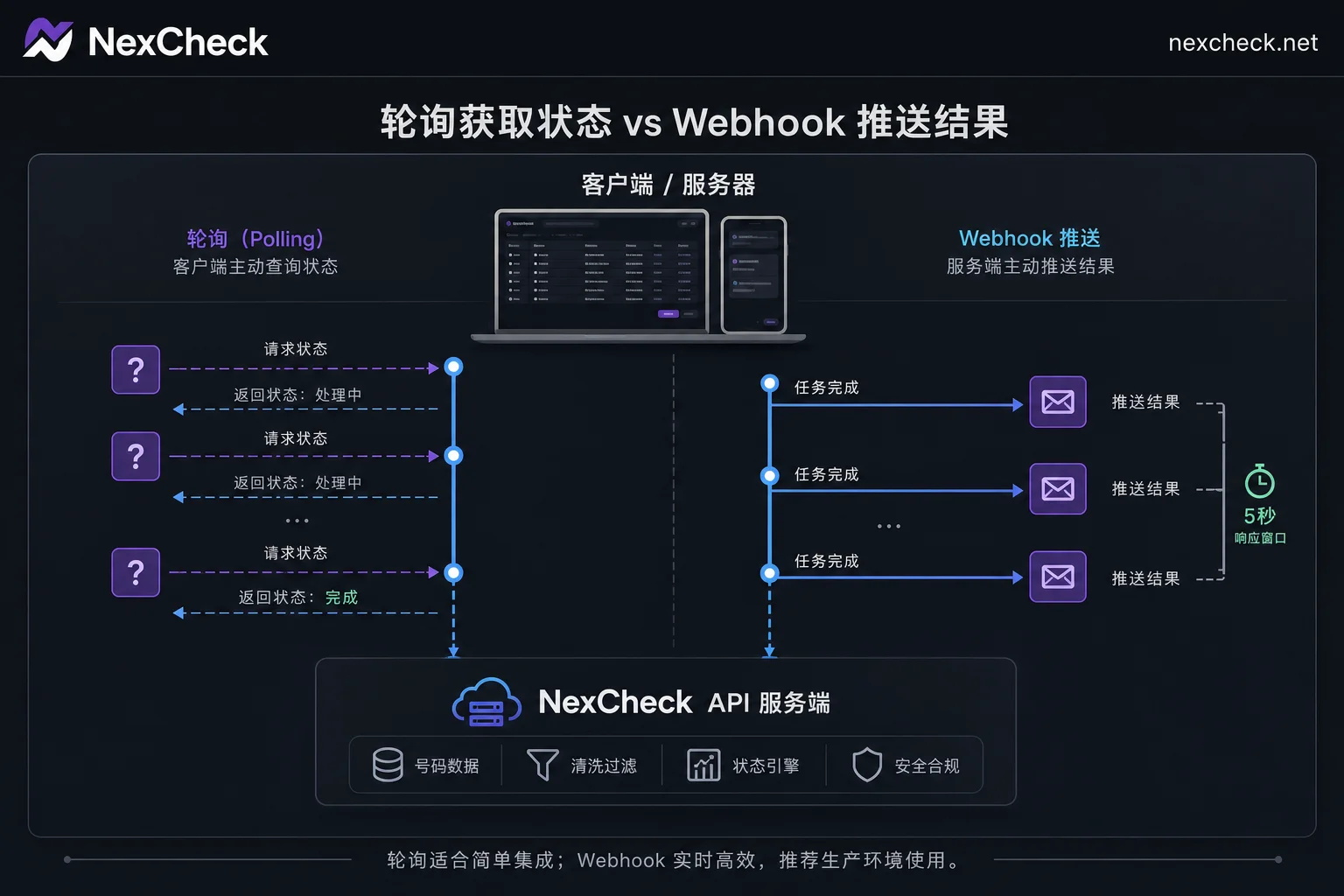
According to Meta's official architecture definition, WhatsApp Cloud API status changes use a dual-track mechanism: synchronous Graph API and asynchronous messages Webhook. For bulk number reachability and registration validation, the final status must be fully tracked through the Webhook status callback. Polling obtains a "current snapshot," while Webhook delivers a "state transition event." Their network interaction directions are completely opposite, leading to fundamental differences in failure characteristics: polling failure manifests as client timeout or Pending status; Webhook failure manifests as silent drop or repeated retries.
Tiered Criteria Table: Task Scale and Latency Tolerance
In real engineering, there is no absolutely superior mechanism—only choices that fit the scenario. The following tiers are based on verifiable technical constraints:
| Decision Dimension | Hundreds / Single-digit / Hourly Offline | Thousands / Double-digit / Minute-level Near-Real-Time | Tens of thousands+ / Hundreds+ / Second-level Real-Time |
|---|---|---|---|
| Recommended Mechanism | Polling (with exponential backoff) | Polling or low-frequency Webhook | Webhook (recommended) |
| Network Overhead Characteristics | Sustained low request count, no spikes | Medium-frequency queries or occasional push | Avoids wasting polling quotas; polling requires accepting hundreds of queries per second |
| Server Load Impact | Predictable constant QPS | Low volatility | Depends on receiver concurrency capability |
| Key Constraints | Firewall-restricted or intranet deployment | Basic public callback endpoint required | If polling, must accept hundreds of queries per second and minute-level latency |
When business needs real-time CRM write-back to trigger downstream marketing actions, polling intervals cannot meet second-level latency requirements. In such cases, continued polling increases invalid API calls and data consistency lag. Conversely, for small intermittent tasks, maintaining a 24/7 Webhook receiver may add unnecessary operational complexity.
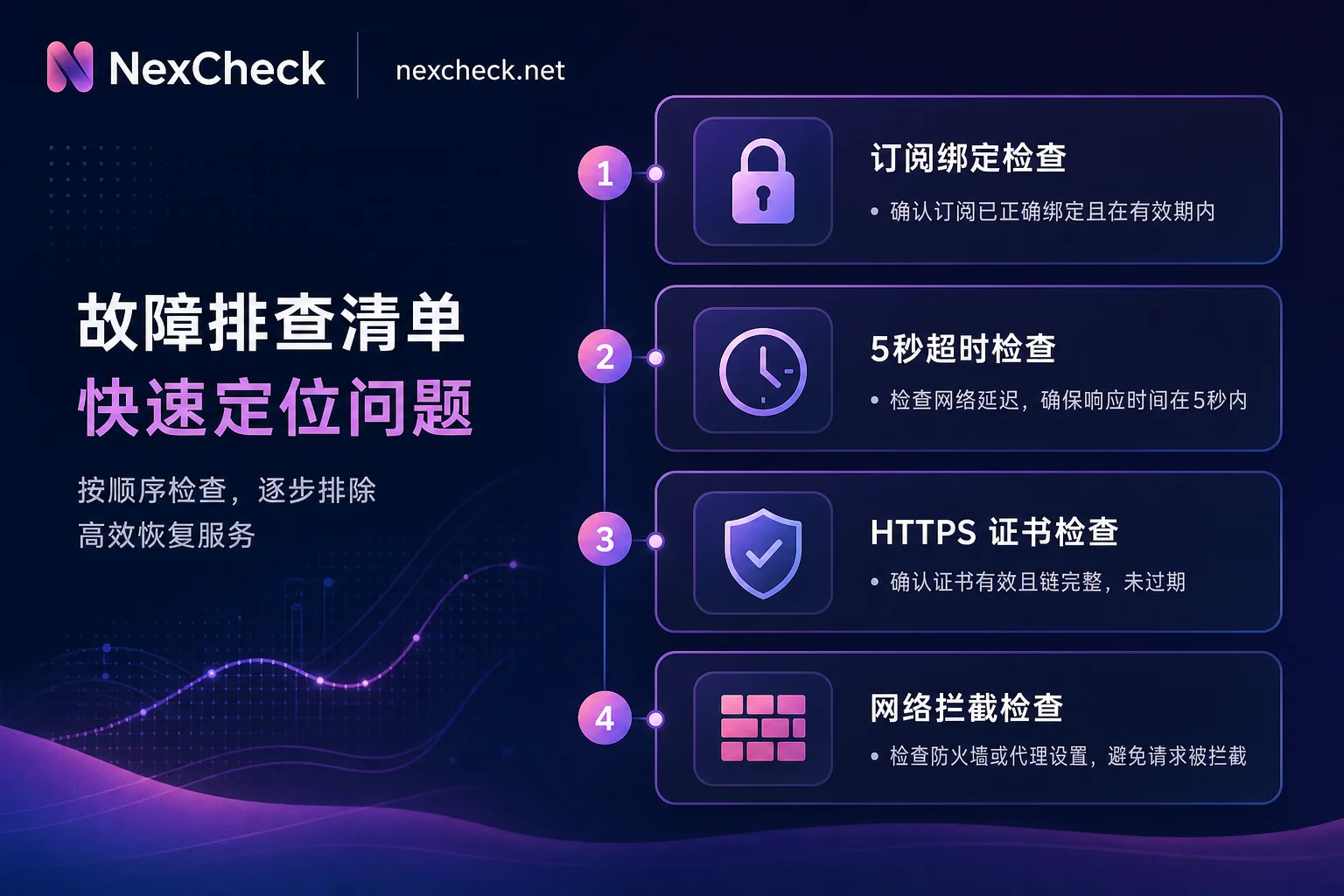
Four-Step Troubleshooting Checklist for Webhook Callback Disconnection
Developers often face issues where social media number filtering results are not returned on time. This is usually not an algorithmic error but a communication disconnect due to configuration gaps.
Step 1: subscribed_apps Binding Status Check
Meta Graph API explicitly requires that before receiving Webhook events for WABA assets, you must explicitly call POST /{WABA_ID}/subscribed_apps to bind the app subscription. Even if the callback URL is configured in the console, if this step is not executed, real production messages and status callbacks are silently dropped. You can query WABA binding status via NexCheck's GET /task/{taskId}/subscription endpoint, or filter Webhook logs for records with response_time>5000 to identify timeout causes. Check whether the messages field is enabled in the developer console and confirm that the API call returns success.
Step 2: Validate Compliance with the 5-Second Response Window
Meta and mainstream BSPs require the receiver to return HTTP 200 OK within 5 seconds. If business logic takes longer than 5 seconds, you must immediately return 200 at the receiver entry and offload processing to an asynchronous queue to avoid blocking the response window. To troubleshoot, record a timestamp at the receiver entry and verify that 200 is returned before business logic runs.
Step 3: HTTPS Certificate and Endpoint Reachability
Webhook endpoints must be valid HTTPS addresses with a complete certificate chain. Self-signed or expired certificates cause TLS handshake failures, manifesting as connection resets rather than HTTP error codes. Use command-line tools to test TLS handshake and certificate chain integrity, and confirm no intermediate proxy returns non-200 status codes.
Step 4: Analyze Firewall and Reverse Proxy Logs
Corporate intranet firewalls or cloud security groups may block inbound traffic from Meta server IP ranges. Check Nginx/Apache access logs for corresponding POST request records. If no records exist, the request never reached the application layer; contact the network administrator to allowlist Meta's egress IP ranges.
Idempotency Protection in Polling and Replay Validation in Webhook
In scenarios of network jitter or timeout resends, avoiding duplicate charges is a critical concern. Industry-standard architecture relies on a unique idempotency key (Client Token / Idempotency Key) attached to requests. The server locks the task state based on this key. On retry or timeout resend, it directly returns the current state of the already-created task, preventing duplicate charges and concurrent Pending tasks.
For Webhook receivers, the risk of forged requests also exists. Meta includes the X-Hub-Signature-256 signature in callback headers. The receiver must compute HMAC-SHA256 using the App Secret and compare it with the header signature. Only requests that pass validation should enter the business processing flow; otherwise, reject them immediately and log security events. This mechanism ensures that even if callbacks are intercepted or replayed, they do not cause false data updates.
Network Reachability and Log Retention: On-Premises vs. Cloud Deployment
Different deployment environments impose hard constraints on mechanism selection:
| Deployment Environment | Polling Feasibility | Webhook Feasibility | Prerequisites | Key Logs to Retain |
|---|---|---|---|---|
| Private Cloud / Intranet | High | Low | Outbound access only; public inbound routing or VPN tunnel | Client request ID and local processing time |
| Hybrid Cloud | Medium | Medium | Depends on gateway forwarding; gateway supports HTTPS | Gateway-level 5xx errors and retry counts |
| Public Cloud | High | High | Elastic IP and container orchestration | Server push logs and ACK response time |
In intranet environments, without public inbound routing, Webhook endpoints are unreachable, making polling the only feasible option. In public cloud environments, with Serverless functions or container orchestration, Webhook better handles sudden traffic spikes. Regardless of the model, retain at least 30 days of raw request and response logs to backtrack historical task states.
Selection Matrix by Scenario, Team Size, and Infrastructure Capability
Based on the technical constraints above, we recommend the following decision matrix:
| Team and Infrastructure Characteristics | Recommended Approach | Key Trade-offs and Considerations |
|---|---|---|
| No dedicated Ops / Small Team | Pure Polling | Sacrifice real-time for implementation certainty (minute to hour latency). Set reasonable polling intervals to avoid rate limiting. |
| Has Kubernetes Cluster / DevOps Support | Webhook Primary | Invest in building a high-availability receiver; implement asynchronous decoupling to meet the 5-second window. |
| Core Business + Disaster Recovery | Hybrid Mode | Primary Webhook for real-time write-back; backup polling for periodic compensation of missed statuses. Resolve state conflicts. |
| Strict Intranet Isolation | Pure Polling | Accept minute-to-hour latency; suitable for offline data cleaning. |
In hybrid usage, define clear state priority rules. For example, a "delivered" status pushed by Webhook should override a "processing" status from polling. But if polling discovers a "failure" while Webhook has not pushed, trust the polling result and trigger manual review.
FAQ
How to troubleshoot when Webhook callbacks are not received?
First, check whether you have called the POST /{WABA_ID}/subscribed_apps endpoint—this is the most common cause of silent drops. Next, check the server access logs to see if there are requests from Meta IPs. If no requests are found, check firewall and security group inbound rules. If requests are present but no business logs, verify HTTPS certificate validity and whether the application returns HTTP 200 within 5 seconds.
How to distinguish whether a task stuck in Pending is due to incomplete detection or status loss?
A task stuck in Pending usually indicates a break in the status sync chain. If using Webhook, verify subscribed_apps binding and callback endpoint health. If using polling, check if API quota is exhausted or network connectivity is stable. The server-side taskId query endpoint allows manual verification of the true server state, helping distinguish between incomplete detection and failed status delivery.
Will API timeout resends cause duplicate charges?
Standard API designs support idempotency. If you pass a unique Idempotency Key (e.g., UUID) in headers or parameters, the server will detect duplicate keys and return the first request's result without charging again. If no key is passed, timeout resends may lead to duplicate charges. Always generate and include an idempotency key in integration, and store the mapping between keys and order numbers in a local database.
Can a team with no dedicated ops use Serverless for Webhook?
Small teams can maintain Webhooks by simplifying architecture. Instead of building a complex high-availability cluster, use cloud Serverless functions (e.g., AWS Lambda or Alibaba Cloud FC) as receivers—they natively provide auto-scaling and high availability. Simply write verification and message queuing code, offload time-consuming logic to backend queues, and meet Meta's 5-second response requirement with minimal operational burden.
If your number detection task volume exceeds tens of thousands per day, or you need real-time CRM write-back to trigger downstream marketing actions, prioritize evaluating Webhook and complete subscribed_apps binding and endpoint health checks. If your team currently lacks ops resources to maintain a high-availability callback endpoint, or you are deployed in an intranet environment, short polling with idempotency keys remains a reliable option. The API documentation provides complete integration examples and troubleshooting log specifications for both modes.


Comments(0)